The Lie in Penal Substitution
The Father Never Poured His Wrath on the Son
Read: Genesis 15:7 to 18 · Isaiah 53:4 to 6 · Galatians 3:13 to 14
·
The verses in this article are rendered by Ten Words Press from the Hebrew and Greek. Where Scripture uses the personal Name of God, written with four letters (YHWH), it is given as Yahweh. Elohim is the Hebrew word for God, and Messiah is the Hebrew title behind the word Christ.
Most of us learned what happened at the cross through a picture. Maybe a Sunday school teacher drew it on a whiteboard, or a pastor told it from the pulpit on Resurrection Day. A courtroom. A holy judge on the bench. A guilty sinner standing before Him with no defense. A sentence of death that must be carried out. Then Jesus steps forward and says, “Put it on Me.”
That picture has carried the gospel to millions of people, and much of it is true. Many of us came to faith through it, taught by people who loved Jesus and loved us. So this is not about tearing that picture down. It is about setting it inside a larger frame, the one Scripture itself uses, so that we can see the cross the way the prophets and apostles saw it.
That frame is the covenant.
Section IWhat the Familiar Picture Gets Right
Start with what the courtroom picture says that Scripture says too.
Jesus stood in our place. Isaiah saw it seven hundred years before it happened:
Peter says He “Himself bore our sins in His own body on the tree” (1st Peter 2:24). This is not a figure of speech. He took what was ours.
There was a real penalty. Sin is not a small thing that God overlooks. Paul writes, “Messiah has redeemed us from the curse of the Book of the Law, being made a curse for us” (Galatians 3:13).2 A curse was owed, and a curse was carried.
And blood was shed: “For this is My blood of the New Covenant, which is shed for many for the remission of sins” (Matthew 26:28).
Hold on to all three. Nothing that follows takes any of them away.
Section IIThe Oath Between the Pieces
Open your Bible to Genesis 15, because this is where God Himself explains what kind of thing the cross is.
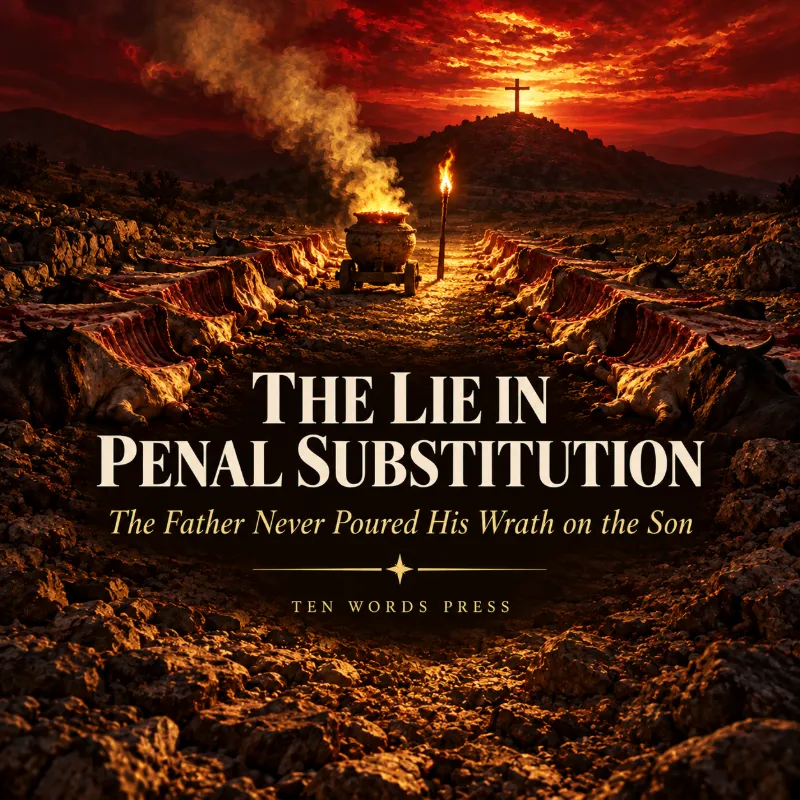
Abram asks how he can know God’s promise will come true. God answers by cutting a covenant. Abram takes a heifer, a goat, and a ram, splits them down the middle, and lays the halves in two rows facing each other, with a path between them.
To us, that is a strange scene. To Abram, it was perfectly clear. Jeremiah tells us what it meant. In his day, when the leaders of Judah swore an oath, they “cut the calf in two and passed between its parts” (Jeremiah 34:18). Walking that path was a way of saying: If I break my word, let what happened to these animals happen to me. The penalty for breaking the covenant was built into the oath itself.
Now watch what happens. Abram does not walk between the pieces. God puts him into a deep sleep. And then:
God walked the path alone. He bound Himself to the penalty of the covenant. If the covenant was ever broken, even by Abram’s children, the curse would fall on the One who had sworn.
Read Genesis 15 with Isaiah 53 open beside it, and the cross comes into focus. We broke the covenant. The curse fell on the One who swore it. This was not a stranger paying off a judge. It was God keeping His own oath, in His own flesh. As Paul puts it, “Elohim was in Messiah, reconciling the world to Himself” (2nd Corinthians 5:19).
Section IIIWhose Curse He Carried
Scripture names the curse precisely. Just before Galatians 3:13, Paul quotes Moses: “Cursed is everyone who does not continue in all things written in the Book of the Law, to do them” (Galatians 3:10, quoting Deuteronomy 27:26).
To understand this, it helps to know that Scripture speaks of two different written instruments at Sinai. The Book of the Covenant is the vows God spoke directly to His people in Exodus 19 to 24, with the Ten Words at its heart. The Ten Words are what most Bibles call the Ten Commandments; in Hebrew they are literally “the ten words,” the spoken vows of the King. The Book of the Law is the additional body of statutes given through Moses after the golden calf, which Paul says “was our tutor to bring us to Messiah” (Galatians 3:24).
The Book of the Covenant: Exodus 19 to 24, the vows God spoke directly to His people, with the Ten Words at its heart, sworn to and sealed in blood (Exodus 24:7 to 8).
The Book of the Law: the statutes added through Moses after the golden calf and placed beside the ark as a witness (Deuteronomy 31:26), the tutor until Messiah (Galatians 3:19, 24).
The Book of the Law pronounced a sentence on everyone who broke the vows. Not one of us escaped it. Then came Jesus, the only man who ever kept the Ten Words from the heart, without a single breach. He did not deserve the sentence; He was the one person it could not touch. And He took it anyway, for us.
That is substitution. The Keeper took the breakers’ curse.
Section IVWhat the Blood Does
In a courtroom, there is no place for blood. In a covenant, blood is the seal.
At Sinai, after the people heard the Ten Words and promised to keep them, Moses took the blood of the offering, sprinkled it on the people, and said:
The blood did not calm an angry God. It ratified the vows and bound the two parties together.
On the night He was betrayed, Jesus took those very words into His own mouth: “This is My blood of the New Covenant.” He was not quoting a courtroom. He was quoting Sinai. His blood seals the marriage between God and His people.
That is why the cross does more than declare us “not guilty.” A courtroom can acquit you, and then you walk out the door alone. A covenant joins you to someone. God promised through Jeremiah, “I will put My instruction in their inward parts, and write it on their hearts; and I will be their Elohim, and they shall be My people” (Jeremiah 31:33).3 The Holy Spirit writes the Ten Words on the heart, and we become what Scripture calls the Bride: the one people God is gathering from Judah, from scattered Israel, and from every nation, joined to Christ as a wife to her husband.
Section VThe One Place We Need to Be Careful
The courtroom picture often adds one thing that Scripture never says: that at the cross, the Father poured out His anger on His Son.4
Read Isaiah 53 carefully, and you will not find a single word for God’s wrath in the whole passage. The only place the Hebrew calls the Servant “smitten of Elohim” is verse 4, and that is what the onlookers thought. The very next verse corrects them: He was wounded because of our covenant-breaking.
The rest of Scripture speaks the same way. At the Jordan the Father said of His Son, “This is My beloved Son, in whom I am well pleased” (Matthew 3:17). The cross rose as “an offering and a sacrifice to Elohim for a sweet-smelling aroma” (Ephesians 5:2), the language of an offering received with joy. Jesus said of His own life, “No one takes it from Me, but I lay it down of Myself” (John 10:18). Paul says “we shall be saved from wrath through Him” (Romans 5:9); he never says the wrath was poured on Him. And John tells us where it all began:
Love came first. Love sent Him.
Isaiah does say, “Yet it was Yahweh’s will that He be crushed” (Isaiah 53:10). The Hebrew word, chafets, means God willed it, God purposed it. The Hebrew of the same verse ends by naming the purpose: “He shall see seed, He shall prolong days, and the pleasure of Yahweh shall prosper in His hand.” The hands that crushed Him were wicked hands (Acts 2:23). The heart that gave Him up was a Father’s heart.
The Father did not turn on the Son. Father and Son together kept the oath sworn between the pieces.
Section VITaking It Home
If you were raised on the courtroom, hear this as a trumpet from the wall. You were told the Father turned His fury on His own Son. The text never says it. Isaiah does not say it. The apostles do not say it. Men added it, and it has been preached from pulpits since the Reformation as though Elohim had spoken it. He did not. That teaching makes the Father the Son’s enemy at the very hour Scripture says They were one in purpose, and it hides the love that sent Him behind an anger the text never names.
Test it. Open Isaiah 53 and find the wrath. You will not find it.
Substitution stands. Jesus took your place. He bore the curse of the Book of the Law. His blood was shed for you. None of that is in question. What is in question is whether you will go on carrying a word men added to the cross once you have seen it is not there. “Do not add to His words, lest He rebuke you, and you be found a liar” (Proverbs 30:6).
The shofar has been blown. What you do with it is yours to answer for.
The covenant frame adds what the courtroom cannot hold. You were not only acquitted; you were claimed. The God who walked between the pieces alone, in the dark, while Abram slept, is the same God who hung on the cross while His disciples scattered. He did not do it because He was angry at His Son. He did it because He had given His word, and He does not break His word.
He kept His oath. And now He has written His vows on your heart.
- What picture of the cross were you taught growing up? What did it get right?
- Read Genesis 15:12 to 18 aloud. Why do you think God put Abram to sleep instead of having him walk between the pieces too?
- How does knowing the cross was an oath kept, rather than a sentence carried out by an angry judge, change the way you think about God the Father?
- What is the difference between being acquitted and being joined to someone in covenant? Which one describes your relationship with God?
- Read 1st John 4:10. What comes first in that verse, and what does that tell you about why Jesus went to the cross?
Father, You swore the oath and walked the path alone. You did not wait for us to keep our side; You kept Yours. Thank You for Jesus, who bore the curse we earned and sealed a new covenant in His blood. Write Your vows on our hearts by the Holy Spirit, and teach us to love You as a faithful Bride. In Jesus’ name, amen.
NotesNotes
- Rendered from the Greek of the Septuagint. Greek anomiai, Hebrew pesha’enu, “our rebellions”: pesha is the word for a vassal’s revolt against the king he swore to (2nd Kings 1:1), so what was broken is a vow, and the rendering names the covenant. The Hebrew reads, “He was pierced for our rebellions, crushed for our iniquities.” Peter quotes the last clause, “by whose bruise you were healed” (1st Peter 2:24). ↩
- Greek nomos. Paul is pointing to the Book of the Law: in verse 10 he quotes Deuteronomy 27:26, the curse that Book pronounced on those who broke the vows. ↩
- Hebrew torati, “My instruction.” The content God writes on the heart is the Ten Words, the covenant spoken at Sinai (Deuteronomy 5:22), in the same passage that announces the New Covenant. ↩
- This emphasis became common in the Reformation era; see John Calvin, Institutes of the Christian Religion, 2.16.10 to 11. ↩
- Greek hilasmos, often rendered “propitiation.” Its cognate hilastērion names the mercy seat (Hebrews 9:5), the place where the covering was made. John puts love before it as its cause. ↩
Scripture is rendered by Ten Words Press from the Hebrew and Greek. Isaiah 53 is rendered from the Septuagint with the Hebrew noted; the first clause of 53:10 follows the Hebrew.
Comments
No comments yet. Be the first.