One Verse That Says Before
A Commentary on a Conversation About the Rapture
What an exchange over a prophecy chart shows us about the last trumpet, the hour of trial, and the hope of the Church
·
Section IHow the Conversation Began
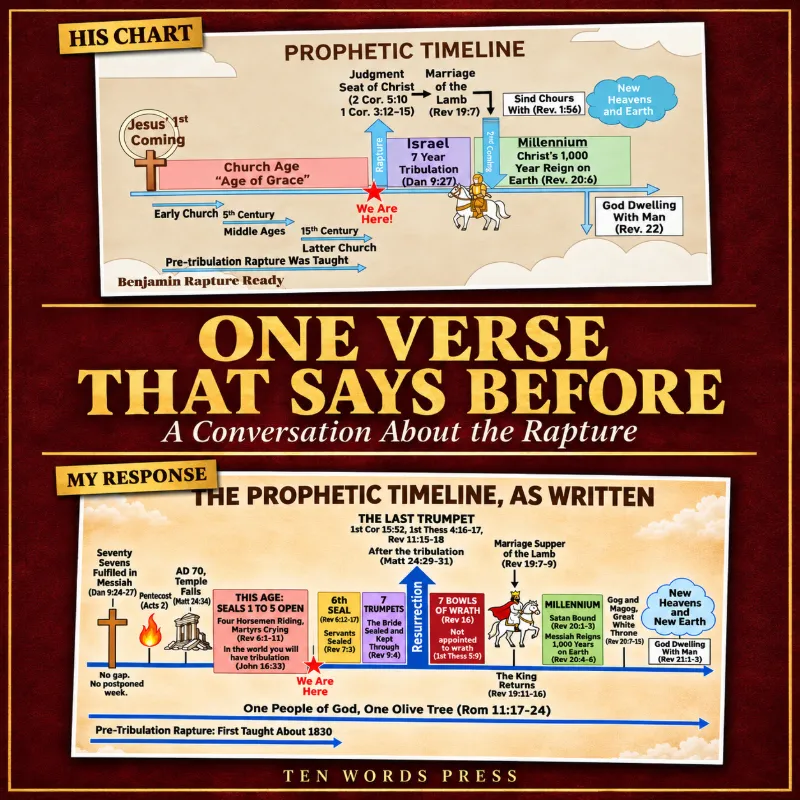
A man who posts under the name Benjamin Rapture Ready shared a prophecy chart. Many of you have seen one like it. The Church Age runs along the left. An arrow lifts the Church out before a seven-year tribulation. That tribulation is labeled for Israel. Then Christ returns and the thousand-year reign begins.

I answered with a chart of my own, drawn from the order Scripture gives: the seals, the trumpets, the resurrection at the last trumpet, the bowls of wrath, the return of the King, and the Millennium. Benjamin replied that my chart was the work of someone with “Biblical dyslexia.” You can read the thread for yourself.

I do not hold that against him. He loves the Lord and he is watching for His appearing, and so am I. He was taught this chart by people who loved Jesus. Many of us were. So I asked him for one thing only, and I kept asking through the whole exchange: one verse that places the gathering of the Church before the tribulation.
He gave three answers and then a longer explanation of Matthew 24. Each deserves a fair hearing, so we will take them one at a time.
Section IIThe Last Trumpet
Paul tells us when the dead are raised and the living are changed.
Benjamin’s answer was that this trumpet is “completely different” from the seven trumpets of Revelation. Those seven, he said, are judgment and woe. Ours is a call home.
It is a sincere answer, and it has two problems. The first is the word Paul chose. He wrote last. If the Church rises at a trumpet and seven more sound after it, then Paul’s trumpet was not the last one.
The second is what the seventh trumpet actually announces. It is more than woe. When the seventh angel sounds, the kingdoms of this world become the kingdom of our Lord and of His Christ, and the elders say that the time has come for the dead to be judged and for reward to be given “unto thy servants the prophets, and to the saints” (Revelation 11:15-18). That is resurrection and reward. One chapter earlier John is told that in the days of the seventh angel “the mystery of God should be finished” (Revelation 10:7). Paul opened his own sentence with the same word: “I shew you a mystery.” Paul and John are describing the same mystery, the same trumpet, and the same day.
Jesus, Paul, and John stand together here. Jesus sends His angels “with a great sound of a trumpet” to gather His elect (Matthew 24:31). Paul says the Lord descends “with the trump of God” (1st Thessalonians 4:16). John hears the seventh angel sound. Three witnesses, one trumpet.
Section IIIThe Trumpets He Brought to the Table
To show that trumpets gather God’s people, Benjamin took us to Numbers 10, to Joshua 6, and to Zechariah 9. I am glad he did. They are the right passages, and they should be read carefully.
In Numbers 10 God gives Moses two silver trumpets. They call the congregation together (verse 3). The very same trumpets sound the alarm for war (verse 9). One instrument does both jobs. So there is no need for two kinds of trumpet at the end, one to gather and another to judge. The seventh trumpet gathers the saints and announces judgment on the enemy in the same breath, just as the silver trumpets always did.
Benjamin suggested that the two trumpets are Israel and the Church, sounding side by side since 1948. He introduced that with the words “I believe,” and that is the honest label for it. Numbers 10 does not say it. What the chapter does say is that when both trumpets sound, the whole congregation gathers as one.
Joshua 6 is the clearest picture of all. Seven priests carry seven trumpets for seven days. On the seventh day they circle the city seven times. Then comes the long blast, the people shout, the wall falls, and every man goes up straight before him (Joshua 6:5, 20). God’s people go up at the end of the sevenfold trumpets, and not before the first one.
And look at Rahab. She believed, and she belonged to the people of God before the first trumpet ever sounded. She was not carried out of Jericho ahead of the trouble. She was marked with a scarlet cord in her window and kept safe inside the city until the last blast. Then she was brought out (Joshua 6:17, 22-23).
Rahab was not taken out before the trumpets. She was marked, and she was kept.
Zechariah 9:14-16 tells the same story. The Lord appears over His people, blows the trumpet, and defends and saves them “in that day.” They are present when it sounds. He guards them where they stand.
Section IVKept From the Hour
Benjamin’s second answer was the promise to the church at Philadelphia.
His point was the little Greek word ek, “out of.” Kept out of the hour, he said, must mean removed before it begins.
This is where the Bible interprets itself. The phrase “keep from” in that verse joins the verb tereo to the word ek. That pairing appears in only one other place in the whole New Testament. The same apostle wrote it down, and the words are the Lord’s own.
Jesus uses the phrase and tells us what He means by it. He does not ask the Father to take His people out. He asks the Father to keep them. In the Lord’s own prayer, being kept and being removed are set against each other. Benjamin posted the Greek of Revelation 3:10 in reply, and I was glad to see it, because the Greek is the argument.
Notice also who the hour of trial is for. It comes to try “them that dwell upon the earth.” In Revelation that phrase always describes the unrepentant world (Revelation 6:10; 8:13; 13:8, 14; 17:8). The trial is aimed at them. God has done this before. When the plagues fell on Egypt, Israel lived in Goshen, inside Egypt, and the plagues did not touch them (Exodus 8:22; 9:26). In Revelation the servants of God are sealed before the trumpets begin (Revelation 7:3), and the judgment is commanded to pass over everyone who bears the seal (Revelation 9:4).
Benjamin’s card raised an honest worry: saints die in great numbers in Revelation, so how can anyone say they were kept? Jesus answered that Himself. “Some of you shall they cause to be put to death,” He said, and then, in the next breath, “there shall not an hair of your head perish” (Luke 21:16-18). To the church at Smyrna, in the same set of letters as Philadelphia, He wrote, “Be thou faithful unto death, and I will give thee a crown of life” (Revelation 2:10). Suffering at the hands of men is not the wrath of God. The saints are kept from His wrath, and they overcome the enemy even in death (Revelation 12:11).
The card closed by saying the verse only makes sense if “Church saints” and “Tribulation saints” are two different groups. Scripture never makes that division. The saints in the middle of Revelation are those who “keep the commandments of God, and the faith of Jesus” (Revelation 14:12). That is a description of the Church.
Section VWho Was Jesus Talking To?
I asked more than once about Matthew 24, where Jesus places the trumpet and the gathering of His elect “immediately after the tribulation of those days” (Matthew 24:29-31). Benjamin’s third answer was that Matthew 24 is about the future of Israel and has nothing to do with the Church.
Consider who was sitting on the Mount of Olives that day. The disciples came to Jesus privately (Matthew 24:3). These are the men to whom He said, “I will build my church” (Matthew 16:18). These are the men He sent to teach all nations “to observe all things whatsoever I have commanded you” (Matthew 28:20). The Church is built on the foundation of these apostles (Ephesians 2:20). If the words Jesus spoke to them are not for the Church, the Church has very little left.
Jesus says the angels gather “his elect.” Paul uses that word for the Church again and again (Romans 8:33; Colossians 3:12; Titus 1:1). And when Paul teaches the Thessalonians about being caught up, he says he is speaking “by the word of the Lord” (1st Thessalonians 4:15). Which word of the Lord? The Lord descending, the angels, the trumpet, the clouds, the gathering. Paul is teaching Matthew 24.
Then Paul gives the Church the order of events in plain language.
Benjamin said that I read with my eyes on the Antichrist and the day of the Lord, while he waits for the day of Christ and the blessed hope. But look at the passage. The subject is “our gathering together unto him.” The day is called “the day of Christ.” And Paul, writing to a church, says that day does not come until the man of sin is revealed first. That order is Paul’s. I did not invent it.
As for the blessed hope, Paul defines it: “that blessed hope, and the glorious appearing of the great God and our Saviour Jesus Christ” (Titus 2:13). The blessed hope is His appearing in glory. It is one event, and every eye will see it.
Section VIIs the Sermon Only for Israel?
Benjamin followed with a fuller explanation of Matthew 24, and I want to give it its full weight. He called it “a sad fact” that many readers assume the sermon speaks to the Church. His case runs like this. Daniel’s seventy weeks were determined for Daniel’s people and Daniel’s city, so the last of those weeks belongs to the Jews alone. Jesus first sent His disciples only to the lost sheep of the house of Israel. The warnings about Judea and the Sabbath are plainly Jewish. The elect in the chapter are the Jewish people, who become the elect again once the Church is in heaven. And the Church is not on earth for any of it, having been taken up seven years earlier.
Begin with the Lord’s own last sentence. Mark records the same sermon, and Jesus ends it this way: “And what I say unto you I say unto all, Watch” (Mark 13:37). He tells us who the sermon is for. It is for all.
Now Daniel. Read what the seventy weeks were appointed to accomplish: “to make an end of sins, and to make reconciliation for iniquity, and to bring in everlasting righteousness” (Daniel 9:24). If the seventieth week has nothing to do with the Church, then neither does the atonement. Those things were finished at the Cross, where Christ “put away sin by the sacrifice of himself” (Hebrews 9:26). Daniel says the covenant is confirmed “with many” (Daniel 9:27). At the table Jesus lifted the cup and said His blood of the covenant is “shed for many” (Matthew 26:28). And Daniel never mentions a pause between the sixty-ninth week and the seventieth. The gap of two thousand years is not in the passage. It has to be brought to it.
Now Matthew 10. It is true that Jesus first sent the twelve only to Israel. It is also true that the same Lord lifted that limit for the same men: “Go ye therefore, and teach all nations” (Matthew 28:19). We do not have to leave the sermon to see it. “This gospel of the kingdom shall be preached in all the world for a witness unto all nations” (Matthew 24:14). “Ye shall be hated of all nations for my name’s sake” (Matthew 24:9). Ask who carries the gospel to every nation, and who is hated for the name of Jesus. That is the Church.
Now Judea and the Sabbath. The people who flee to the mountains are the people who believe Jesus and do what He said. That makes them His disciples. Living in Judea does not place a believer outside the Church. The first church met in Jerusalem, and every member of it was a Jew who believed (Acts 2).
Now the elect. No verse says that the Jewish people become the elect again after the Church is gone. In this very chapter the elect are those whom the false christs cannot deceive (Matthew 24:24). They know the true Christ. Paul says the election is “a remnant according to the election of grace” (Romans 11:5), and that the natural branches will be grafted in again “if they abide not still in unbelief” (Romans 11:23). They are grafted into the same olive tree, the cultivated tree of Israel where believers from the nations already stand by faith. This is not the Church replacing Israel. It is one tree and one people, and every branch in it stands by faith in the Messiah.
Benjamin pointed to Ezekiel 34, where God gathers His scattered sheep in the cloudy and dark day. Read ten verses further. “And I will set up one shepherd over them” (Ezekiel 34:23). Jesus takes up those words: “there shall be one fold, and one shepherd” (John 10:16). Ezekiel is describing a gathering into Christ. He is not describing a second program running beside Him.
That leaves the last claim, that the Church was taken up seven years before these events. This is the very thing I had asked him to show from Scripture. The whole explanation of Matthew 24 rests on it, and no verse was offered for it.
Section VIIThe Mindset of a Martyr
Benjamin said I read my Bible with the mindset of a martyr. I take that as a kindness, though he did not mean it as one. The apostles went back through the churches they had planted, “confirming the souls of the disciples,” and the way they strengthened them was to tell them “that we must through much tribulation enter into the kingdom of God” (Acts 14:22). Jesus said, “In the world ye shall have tribulation: but be of good cheer; I have overcome the world” (John 16:33).
This is not a gloomy teaching. It is a steadying one. Think of the believers in our own day who are in prison for the name of Jesus. A chart that promises the Church will be gone before trouble comes has nothing to say to them. The Scriptures have everything to say to them. You are sealed. You are known. Not a hair of your head will perish. Be faithful, and He will give you a crown of life.
And here is where Benjamin and I stand on the same ground. God “hath not appointed us to wrath” (1st Thessalonians 5:9). That is true, and it is precious. The wrath of God is poured out in the seven last plagues, the bowls, “for in them is filled up the wrath of God” (Revelation 15:1). The Bride, the one people God is gathering in Christ, is sealed through the trumpets, raised at the last trumpet, and with her Lord before the bowls are poured. She never tastes His wrath. She does not need to be removed seven years early for that promise to hold.
So we agree on the heart of it. Jesus is coming. The trumpet will sound. The dead in Christ will rise, and we who remain will be caught up to meet Him, and so we shall ever be with the Lord. We are to comfort one another with these words. The only question between us is when, and on that question I asked for a verse.
Section VIIIWhat the Conversation Teaches
By the end, Benjamin told me that what I had posted was my own interpretation and not what the Bible says. I understand why it feels that way. When a teaching has been in front of us all our lives, on charts and in sermons and in novels, anything else sounds like an opinion.
But look back over the exchange. Paul says the last trumpet. Jesus says after the tribulation. John records the Lord praying that we be kept and not taken out. Paul says the day of our gathering does not come until the man of sin is revealed. Those are quotations. The other side of the conversation offered a belief about two silver trumpets, a division of the saints that no verse makes, and a claim that the Lord’s own sermon was not meant for His Church.
I closed my side of the thread there, and I want to tell you why. Benjamin and I were never going to agree, because we begin in two different places. I begin by letting Scripture interpret Scripture. Paul’s last trumpet is explained by John’s seventh. “Keep from” in Revelation 3:10 is explained by the same words in John 17:15. The gathering in Matthew 24 is explained by the gathering in 2nd Thessalonians 2. Benjamin begins with the dispensational system, which holds that God has two peoples and two programs, Israel and the Church, and then assigns each verse to one or the other. When that system is laid over the text first, Matthew 24 cannot be for the Church, however plainly Jesus says “unto all.” Two readers who start that far apart will not arrive at the same place by trading verses, and it is better to part in peace than to keep circling.
The Bereans were called noble because they “searched the scriptures daily, whether those things were so” (Acts 17:11). That is all I am asking of you, and all I asked of him. Do not take my chart on my word. Do not take his on his. Ask of every chart the same question: where is the verse?
I am still glad to hear one. I told Benjamin what I will tell you: what we share is greater than what divides us. Jesus is coming, the trumpet will sound, and I expect to see my brother there, whichever one of us has the timing right.
1. Read 1st Corinthians 15:51-52 beside Revelation 10:7 and 11:15-18. What do the two passages have in common?
2. Read Joshua 6 from start to finish. When do the people go up? Where is Rahab while the trumpets are sounding?
3. Read John 17:15 and Revelation 3:10 together. What does Jesus ask the Father to do, and what does He ask the Father not to do?
4. Read 2nd Thessalonians 2:1-3. What two things does Paul say must come before the day of our gathering to Christ?
5. Read Mark 13:37 and Matthew 24:9-14. Who does Jesus say the sermon is for, and who carries the gospel to all nations?
6. Read Daniel 9:24 and Hebrews 9:26. When were the purposes of the seventy weeks accomplished?
7. Read Acts 14:22 and John 16:33. How would these verses comfort a believer who is suffering today?

Comments
No comments yet. Be the first.