Grandpa's Bible,
Read Again
A covenant commentary on "Grandpa Was a Preacher: Why Dispensationalism Worked, Until It Didn't"
·
Section IA Story Worth Telling
On October 29, 2026, Orthodox Reflections published "Grandpa Was a Preacher: Why Dispensationalism Worked, Until It Didn't," by a writer named Nicholas, a member of the Western Rite Vicariate of the Antiochian Orthodox Christian Archdiocese. Readers should take the whole of it in its own words before reading this answer.
The first half is a fine piece of family memory. His grandfather was a brawler and a drinker, saved at a Pentecostal tent revival, called to preach, gifted in the pulpit and barely able to read. He planted church after church in farm towns across the South and Midwest, lost each pulpit to a Bible college graduate once the bankers and merchants started filling the pews, went back to fixing heavy equipment, and started over. He did that for forty-five years and died with nothing. The map he preached from was the Scofield Reference Bible.
The grandson's central point is correct, and it deserves to be said plainly. Dispensationalism did not win a debate in rural America. There was no debate. For a congregation that had never heard of John Nelson Darby, the notes in the margin were indistinguishable from the text on the page. In his words, "It literally was the Bible." Darby built the system in the 1830s; Scofield printed it into millions of Bibles in 1909; the country preacher carried it to places the seminaries never went. Most histories of the movement skip that man entirely. This one does not, and the portrait of a sincere and penniless preacher is the best thing in the article.
Section IIWhere the Text Stands With Him
On the doctrines that define Dispensationalism, Scripture agrees with the grandson, and it does so on its own testimony.
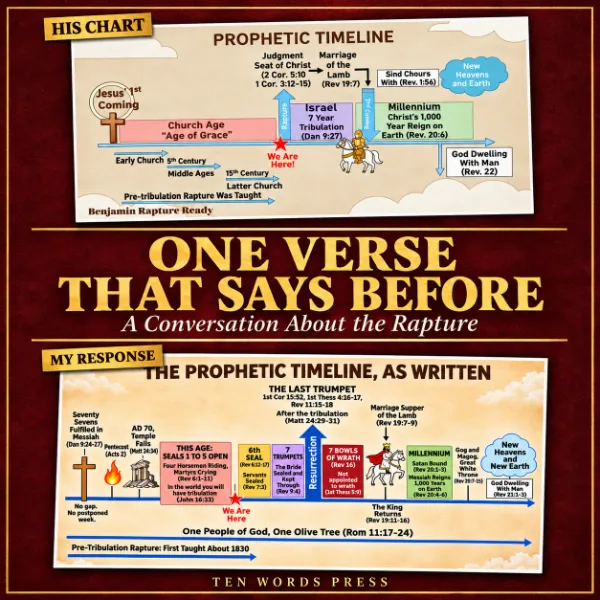
There is no secret rapture. The Apostle places the resurrection and the change of the living saints at one moment, and he names the moment.
The trumpet of God in 1st Thessalonians 4:16 and the seventh trumpet of Revelation 11:15 are the same trumpet. Three witnesses, one event, and it comes at the end of the trumpet sequence, not before it. The saints are sealed and preserved through the trumpets, as Israel was preserved in Goshen while the plagues fell on Egypt, and gathered at the last. A doctrine that lifts the Bride out before the trouble begins has no text under it.
The State founded in 1948 is not the regathering the prophets foretold. It came by a vote of the United Nations and a secular declaration of statehood. The regathering of Ezekiel 37 comes by the breath of Yahweh, and the prophets describe it ending in repentance: the house of David looking on the One they pierced and mourning for Him (Zechariah 12:10). A political event decided by Gentile governments is not that.
Daniel's seventy sevens contain no gap. The prophecy lists six things the seventy sevens will accomplish (Daniel 9:24), and Messiah accomplished them in His ministry, confirming the covenant with many at His Table (Matthew 26:28) and causing sacrifice and offering to cease in the midst of the week. The seven-year tribulation postponed two thousand years into the future is the load-bearing beam of the Dispensational house, and Daniel never laid it. The budding fig tree reading fails on its own terms as well: Luke records "behold the fig tree, and all the trees" (Luke 21:29), which leaves no room for a single tree standing for a single modern state.
Last, the grandson is right that Christian Zionism, as Darby, Scofield, Lindsey, and Hagee taught it, sets unbelieving Israel above the believing Bride. Paul says the opposite. The natural branches "because of unbelief were broken off" (Romans 11:20). They are not a second chosen people with a covenant of their own running alongside Messiah's. Their chosenness is fulfilled in Him, and they stand again only by faith in Him.
Section IIITrading One Set of Notes for Another
Here the commentary has to part ways. The grandson's diagnosis is that his grandfather received an interpretive system he never examined and mistook it for Scripture. His cure is to receive an older interpretive system: the Fathers, the councils, the liturgy, the icons, what he calls the historical teaching. That is the same move with an earlier date on it.
Grandpa's error was not that he lacked a tradition. He had one, and he called it the text. A man who exchanges Scofield's notes for the notes of the fourth century has changed annotators, not authorities. Messiah's charge against the teachers of His day was not that their tradition was too new. It was that tradition had displaced the Word: "making the word of God of none effect through your tradition" (Mark 7:13). Age does not cure that problem. Only the text does.
Scofield is wrong because 1st Corinthians 15 and Daniel 9 refute him, not because Justin Martyr outvotes him. Had every Father taught a secret rapture, it would still be absent from the Apostle's letter. The standard is the one Luke praises in the synagogue at Berea, where the hearers received the word readily "and searched the scriptures daily, whether those things were so" (Acts 17:11). They checked Paul against the text. They did not check him against a council.
The grandmother's story makes the point from the other side. She called a baptismal rite nearly two thousand years old "new fangled," while treating praise bands and grape juice as ancient. She was measuring by her own tradition. Her grandson measures by an older one. Neither measure is the Word.
The structure the grandson now holds carries its own problem, and it is not a small one. The Orthodox Church keeps a separate priestly order, an altar, and a Eucharist offered as sacrifice. Hebrews answers that directly.
One offering, never repeated and never re-presented. The veil tore from top to bottom (Matthew 27:51), from heaven's side. Every believer is now a priest (1st Peter 2:9; Revelation 1:6), and the body of the Bride is the Temple (1st Corinthians 3:16). An altar, a sacrificing priesthood, and a mediating clerical order after the Resurrection preserve in shadow what the Resurrection completed in substance. The icons meet the Second Word, which forbids the likeness made for veneration (Exodus 20:4-5). These are not matters of taste. They are the same question the grandson put to his grandfather: does this come from the text, or was it laid over the text later?
Section IVOne Tree, Not a Replacement
The grandson commends the teaching that "the Church is Israel." That is replacement: one people taking the place of another. Dispensationalism errs by making two peoples with two destinies. Replacement errs by erasing one of them. Scripture gives a third picture, and it is neither.
Paul's image is one cultivated olive tree, rooted in the fathers. Natural branches were broken off for unbelief. Wild branches from the nations were grafted in among them, by faith. And the broken branches, "if they abide not still in unbelief, shall be graffed in: for God is able to graff them in again" (Romans 11:23). There is no second tree. There is no felled tree with a new one planted in its place. There is one tree, pruned and enlarged.
Ezekiel saw the same thing as two sticks, Judah and Joseph, joined into one in the prophet's hand (Ezekiel 37:16-22). Paul saw it as the middle wall broken down to make "of twain one new man" (Ephesians 2:14-15). The Bride is believing Judah, the house of Israel scattered among the nations, and the sojourner grafted in by faith, one body under one Bridegroom. That is not Israel replaced. That is Israel restored and enlarged, exactly as the prophets said it would be.
And Paul attached a warning to that picture, addressed to the wild branches.
Section VThe Tutor and the Vows
To answer Dispensational preachers who use the conquest of Canaan to defend modern warfare, the grandson quotes Fr. Lawrence Farley's essay "The God of Joshua." Farley's argument is that the provisions given to Israel at its founding as a nation, including conquest, sacrifice, circumcision, and the food code, were a stage to be passed through on the way to Christ.
Part of that is sound. Paul says the Book of the Law was added because of transgressions and served as a tutor until Messiah came (Galatians 3:19, 24). The tutor's term ended. But Farley places everything given at Sinai into that one temporary stage, and the text does not.
The Ten Words were spoken by the Voice to all the people without a mediator, and then "he added no more. And he wrote them in two tables of stone" (Deuteronomy 5:22). They were written by the finger of Elohim and placed inside the ark. The Book of the Law was written afterward by Moses and set beside the ark as a witness (Deuteronomy 31:26). The tutor is dismissed when the child is grown. The vows are not dismissed; they move. Jeremiah promised that in the New Covenant Yahweh would write His instruction on the heart (Jeremiah 31:33; Hebrews 8:10). Same Words, new tablets. A reading that folds the vows into the tutor and lets them expire together loses the one thing Sinai gave that was never temporary.
There is a better answer to the preacher who waves Joshua over a modern war. The conquest was a named judgment on named nations, delayed four hundred years because "the iniquity of the Amorites is not yet full" (Genesis 15:16), and executed at Yahweh's word. It was never a standing license handed to a bloodline. No modern government of any people holds that commission, and no preacher can issue it. Yahweh did not "transition" into another God between Joshua and the Cross. "I am Yahweh, I change not" (Malachi 3:6). What changed was the covenant phase, not the character of the One who made the covenant.
Section VIWhere the Covenant Cannot Follow Him
About two-thirds of the way through, the article turns from a theology to a people. It moves from what Dispensationalists believe about Jews to a list of social ills it lays at the feet of Jews as such: Hollywood, feminism, pornography, socialism, mass immigration, and more, offered as what young Americans are now "learning" about Jewish behavior. That is a charge against a whole people for the acts of some of its members, and the Covenant forbids it on two grounds.
A sweeping charge against every member of a people is false witness against most of them. And guilt in Scripture is personal: "The son shall not bear the iniquity of the father, neither shall the father bear the iniquity of the son" (Ezekiel 18:20). Every man answers for his own deeds. That rule does not bend for the people we are angry with.
Rabbinic tradition rejected Messiah, and some of its writings speak of Him with contempt. Scripture does not hide the unbelief of the natural branches, and neither should we. But Paul, writing about the very branches that had been broken off, said that "as touching the election, they are beloved for the fathers' sakes" (Romans 11:28). The man who grieved for his kinsmen enough to wish himself accursed for them (Romans 9:3) is not a model for contempt. The covenant position rejects Christian Zionism's elevation of unbelieving Israel above the Bride. It rejects contempt for unbelieving Israel just as firmly. Both are boasting against the branches.
The article's political claims about Gaza, AIPAC, and American wars are contested, and it states them as settled. The covenant answer to its theology does not depend on settling them. What the Covenant does settle is the standard. The Sixth Word protects every life: the Palestinian Christian, the Muslim child, and the Israeli family alike. No prophecy chart overrides it, and no anger at a government licenses a charge against a people.
The same Word governs insinuation. That Mark Tooley once worked for the Central Intelligence Agency does not answer anything he wrote, and suggesting that pastors who disagree are intelligence operatives is an accusation made without witnesses. "At the mouth of two witnesses, or at the mouth of three witnesses, shall the matter be established" (Deuteronomy 19:15). An argument that needs innuendo is an argument that has run out of evidence.
Section VIIWhat Tooley Actually Said
The grandson presents Tooley's essay in The Dispatch, "We Need a New Defense of Christian Zionism," as a sudden admission of collapse. Tooley does argue that the Christian Zionism of the late twentieth century is aging, that its Dispensational foundation no longer persuades the young, and that a new defense has to be built. But the search for that replacement is not new. In 2015 Tooley's Institute on Religion and Democracy hosted a conference at Georgetown that called for a Christian Zionism grounded in the historic traditions of the church rather than end-times scenarios, and Tooley has argued since then that Christian Zionism reaches back to the early Fathers.
That is the most telling fact in the whole exchange. The grandson offers the Fathers as the cure for Christian Zionism. Tooley offers the Fathers as its new foundation. Both men appeal to the same tradition and reach opposite conclusions. Tradition cannot settle the question, because tradition is being enlisted by both sides. Only the text can, and the text has already spoken: one tree, one Bride, no secret rapture, no gap in Daniel, and no people, natural branch or wild, permitted to boast against the other.
Section VIIIGrandpa's Bible, Read Again
Grandpa was wrong about the rapture and wrong about 1948. But he believed two things his grandson has given up, and on both of them the old preacher was right.
He believed Messiah will reign on the earth for a thousand years, and Revelation says so six times in seven verses (Revelation 20:1-7). The tombs are still full (John 5:28-29). Death still reigns (1st Corinthians 15:26). The nations do not yet go up year by year to worship the King (Zechariah 14:16). The thousand years have not happened, and allegorizing them away does not make them past. And he believed the Bible itself was the authority. He was wrong about which notes were the Bible, but he was right that nothing stands over it.
The grandson found the cure for one error and lost the old man's strength in the bargain. The way out of Scofield is not back to Constantinople. It is back to the page, with the notes torn out of the margin on both sides, read by men and women who check every teacher, ancient or modern, against the Word.
This article is commentary, criticism, and teaching on "Grandpa Was a Preacher: Why Dispensationalism Worked, Until It Didn't," published October 29, 2026 by Orthodox Reflections. It refers to that article, and to the works of Mark Tooley and Fr. Lawrence Farley that it cites, for the purposes of comment, criticism, and religious instruction, as contemplated by Section 107 of the U.S. Copyright Act (17 U.S.C. § 107). Quotation is limited to a single brief phrase; all other references are summarized in our own words.
All rights in the original works remain with their authors and publishers. Ten Words Press is not affiliated with Orthodox Reflections, The Dispatch, the Institute on Religion and Democracy, or the Orthodox Church in America, and none of them has reviewed or endorsed this commentary. Readers are encouraged to read the original article in full. Scripture quotations are from the King James Version, with the divine Name rendered Yahweh.
Comments
No comments yet. Be the first.