The Four Horsemen
The Character of Our Age
The riders are not a future program. They are the fourfold signature of the age the Lamb has already opened.
·
Section IThe Riders Are Not Coming — They Are Here
There is a way of reading the four horsemen of Revelation 6 that has captured the popular imagination for a little over a century and a half, and it is almost entirely backward. In this reading the horsemen are a program — a sequence of catastrophes packed into a seven-year window that opens only after the Bride has been snatched away, a countdown timer that begins ticking on some future morning. The riders become spectators' theater: dreadful, but distant; terrible, but tomorrow's problem. The whole apparatus of charts and countdowns and generation-calculations rests on the assumption that these horsemen belong to a future not yet begun.
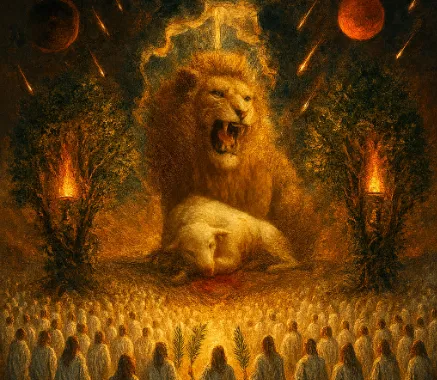
Read the text again, and more carefully. The Lamb opens the first seal (Revelation 6:1). The seals are broken by the One who was slain and is standing — the Lamb who has already conquered, who has already been found worthy to open the scroll (Revelation 5:5–7). The breaking of the seals is not a countdown to His victory; it is the unrolling of His victory across the length of an age He has already inaugurated. When did the Lamb take the scroll? At His enthronement — after the Cross, after the empty tomb, after the Ascension of His offering of the First Fruits Saints, and His final Ascension when He sat down at the right hand of the Majesty on high (Hebrews 1:3). The seals begin opening when the Lamb begins reigning. And the Lamb has been reigning since Golgotha.
So the horsemen are not a future intrusion into an otherwise placid world. They are the character of the age — the fourfold signature of the entire span between the first coming of Messiah and the sixth seal that has not yet been broken. They have been riding since the Holy Spirit fell on the gathered Bride. They are riding now. They will ride until the sky recedes as a scroll (Revelation 6:14). To live in this age is to live among the riders.
This is not a minor adjustment of prophetic timetables. It changes everything about how the Believer reads the moment. If the horsemen are future, the age we inhabit is a lull — a waiting room, a pause before the real story begins. If the horsemen are present, then conquest and war and famine and death are not interruptions of the age but its ongoing texture, and the Bride is called to be faithful inside the thunder of hooves, not to be evacuated before the first hoof strikes.
The riders are not coming. They are here — and so is the Lamb who opened every seal.
Ten Words Press
Section IIThe White Horse — The Age of Contest
The white of this rider is the white of counterfeit — the borrowed color of righteousness worn by a conquest that is not the Kingdom's. He is not the Rider of Revelation 19, whose name is Faithful and True, whose eyes are a flame of fire, who is called the Word of God (Revelation 19:11–13). The first seal's rider only imitates Him: a crown he was given rather than won, a bow with no arrow ever named, a conquest that advances by deception rather than by the Blood of the Lamb. He is the first face the Bridegroom warns of on the Mount of Olives — "Take heed that no one deceives you. For many will come in My name... and will deceive many" (Matthew 24:4–5). The opening rider of the age is the great deceiver, going out to conquer the earth under a stolen white.
This rider is not the Gospel. The Gospel does not conquer by force, fraud, or the seizure of loyalties; it wins by the Word and the witness of the Ruach HaKodosh, and the crown it offers is the Bridegroom's, not a counterfeit's. The white horse is the great deception, and its conquest has worn many uniforms across the age. It rides as communism, which promised a paradise of equality and delivered famine, the informer, and the mass grave. It rides as industrialization, which promised mastery over creation and chained the many to the machine and the clock. It rides as commercialization, which promised abundance and trained the nations to worship what they can buy. It rides as government corruption, which promises order and justice and delivers the rule of the strong over the weak dressed in the language of law. Each is a conquest; each wears the white of a righteousness it does not possess; each goes out "conquering and to conquer," seizing the labor, the loyalty, and the worship of the earth.
So the age is an age of contest — not because two horses of equal standing ride the same road, but because the true King advances His Kingdom by the Word and the Spirit through a world already overrun by a rider who conquers by lie. The Bride is not neutral in this. To follow the true King is to refuse the white rider's stolen crown — to see through the salvation-promises of every system that rides against the Kingdom and to name each one for what it is. The first seal tells us what kind of age we inhabit: an age crowded with counterfeit conquests, each demanding the allegiance that belongs to the Lamb alone.
Section IIIThe Red Horse — The Age That Cannot Keep Peace
Notice the grammar of the age: peace is taken from the earth. Not that peace never existed, but that peace is not the settled condition of this age — it is the exception snatched away, again and again, by a rider whose whole commission is the great sword. The red horse is not one war. It is the impossibility of lasting peace across the entire span of our day.
Yeshua said as much on the Mount of Olives: "You will hear of wars and rumors of wars. See that you are not troubled; for all these things must come to pass, but the end is not yet. For nation will rise against nation, and kingdom against kingdom" (Matthew 24:6–7). And then the phrase that unlocks the whole prophetic timetable: "All these are the beginning of sorrows" (Matthew 24:8). The beginning — not the climax, not the final tribulation, but the labor-pains that characterize the entire pregnancy of the age. Wars and rumors of wars are not the sign that the end has arrived; they are the ordinary climate of the age the Lamb opened.
This is why the honest historian and the faithful reader arrive at the same conclusion by different roads. There has been no century since Pentecost without its sword. The red rider has never dismounted. To expect the age of Messiah's ongoing reign to be an age of geopolitical calm is to misread the seal entirely — the red horse guarantees that people will kill one another from the opening of the second seal until it is folded up in the sixth. The Bride is not promised a peaceful century. She is promised a peace the world cannot give (John 14:27) and cannot take, held in the middle of a world from which peace is perpetually taken.
Section IVThe Black Horse — The Age of the Rigged Scale
Of all four riders this is the one whose relevance to our own moment is hardest to miss. The scale is the instrument of the market, and a denarius was a day's wage (Matthew 20:2). A quart of wheat for a denarius means a full day's labor purchases barely enough grain to feed one worker — the whole day's pay consumed by the day's bread, with nothing left for a family. The black rider is not outright famine that kills at once; it is managed scarcity, the economic upheaval in which the necessities are priced at the edge of survival while, tellingly, "the oil and the wine" — the luxuries, the assets of the comfortable — are spared. The staples soar; the luxuries are protected. It is a portrait of an economy in which the burden falls hardest on those who have the least, and the possessions of the secure are hedged from harm.
The scale itself carries the whole weight of prophetic denunciation. The Ten Words command righteous stewardship of possessions and truthful testimony (Exodus 20:15–16), and the prophets read the crooked scale as covenant treason. "A false balance is an abomination to Yahweh, but a just weight is His delight" (Proverbs 11:1). Amos thunders against those "making the ephah small and the shekel great, falsifying the balances by deceit" (Amos 8:5). Micah asks, "Shall I count pure those with the wicked scales, and with the bag of deceitful weights?" (Micah 6:11). The black rider carries the merchant's balance, and across the whole age that balance is tilted. The character of the age is not merely scarcity but engineered scarcity — value manipulated, measures falsified, the many pressed while the few are shielded.
A day's wage for a day's bread. The black horse is not the absence of goods but the rigging of their price — want by design, with the oil and the wine of the comfortable deliberately spared. An age of the dishonest balance is exactly the age the third seal foretold.
The Bride reads this rider with open eyes and steady hands. She is not surprised that the age is one of dishonest weights and managed want, because the third seal told her it would be. She keeps her own scales just (Deuteronomy 25:13–15), holds her possessions as a stewardship rather than a fortress, and refuses to let the black rider's economy of fear become the governor of her heart. The oil and the wine of the world are spared for a season; the Bride's treasure is laid up where the rider cannot price it (Matthew 6:19–21).
Section VThe Pale Horse — The Age Over Which Death Still Rides
The fourth rider is a composite — he gathers up the other three. His weapons are the sword (the red horse), hunger (the black horse), death, and the beasts. He is not a fifth affliction added to the list but the sum of them, the total harvest of a world under the first three riders. And behind Death rides the Grave, Hades, the open mouth that swallows what the pale rider strikes down. Where Death goes, the Grave follows to collect.
Weigh that fourth weapon carefully — "the beasts of the earth." The ancient hearer pictured wild predators at the edge of a starving city, and that reading is not wrong. But the phrase reads with an unsettling precision in an age like ours, because the beast that now kills at scale is no longer the lion at the gate. It is the pathogen in the vial. The great killers of this age are increasingly not the fang but the microbe — disease studied, cultured, engineered, and weaponized; released whether by accident or by design; crossing an ocean unseen and multiplying in a single lung. Man has learned to take the smallest beasts of the earth and breed them for death, to make plague a tool of policy and profit. The pale rider's fourth weapon has been miniaturized and industrialized, and "death by the beasts of the earth" now includes the engineered plague and the laboratory-born contagion. The beast has been made small enough to hide in a breath, and deliberate enough to be aimed.
This is the plainest and the most inescapable feature of the age: mortality reigns. "Death reigned from Adam to Moses" (Romans 5:14), and death reigns still, "the last enemy that will be destroyed" (1 Corinthians 15:26) — will be, future tense, not yet. The pale rider is the standing proof that we are not yet in the consummation. The tombs are still full. The graves have not yet given up their dead. Every funeral in every generation of the age is the pale horse passing through, and the Grave following to gather.
Yet mark the restraint written into the seal: power "over a fourth of the earth." Even the pale rider is bounded. Death is real and reigning, but it is not sovereign; it rides on a permission, over a limited portion, under a Lamb who holds "the keys of Hades and of Death" (Revelation 1:18). The One who opens the seals is the One who has already been where the pale rider drives His victims — into death, into the grave — and has come out the other side with the keys on His belt. Death rides the age, but Death does not own it. The rider has a leash, and the hand that holds the leash was pierced.
Section VIThe Fifth Seal — The Age Is Also Cruciform
The four riders do not tell the whole story of the age, because the Lamb opens a fifth seal before the sixth. The fifth seal reveals that the age of the horsemen is simultaneously the age of the martyrs. As the riders ride, the altar fills — souls of the slain crying out, and the answer given to them is telling: "It was said to them that they should rest a little while longer, until both the number of their fellow servants and their brethren, who would be killed as they were, was completed" (Revelation 6:11). The count is not yet full. The martyrs are still being added. The fifth seal is not a closed chapter of early persecutions but an ongoing accumulation across the whole age — the crying under the altar has not stopped, because the killing has not stopped, because the age of the four riders is by its nature an age that produces martyrs.
This is why the Bride does not read her own suffering as a sign that something has gone wrong with the plan. The plan includes the altar. The age of Messiah's reign is a cruciform age — an age in which the King reigns from a throne shaped like a Cross, and His Bride follows the pattern of her Bridegroom. The horsemen ride, the martyrs cry "how long," and the answer is not "it will not be long" but "rest a little longer; the number is not yet complete." The age has a shape, and the shape is the Lamb's.
Section VIIWhat the Age Is Not
Once the horsemen are seen as the character of the whole age rather than the opening volley to a future seven-year Great Tribulation, a whole architecture of misreading falls away — and it is worth naming plainly what the text does not support.
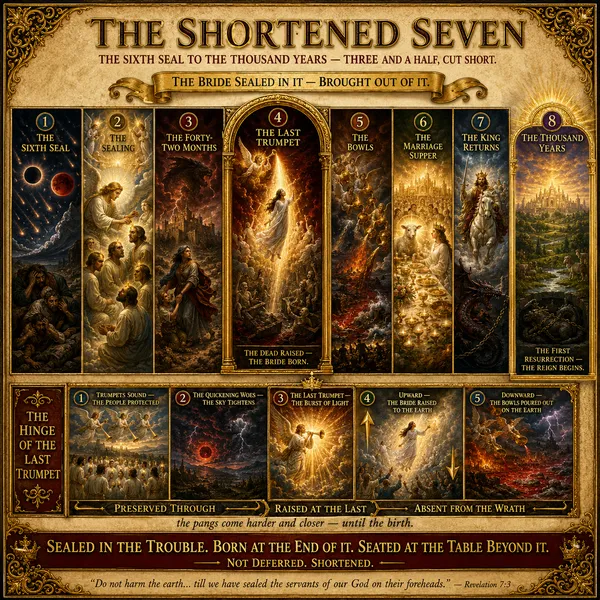
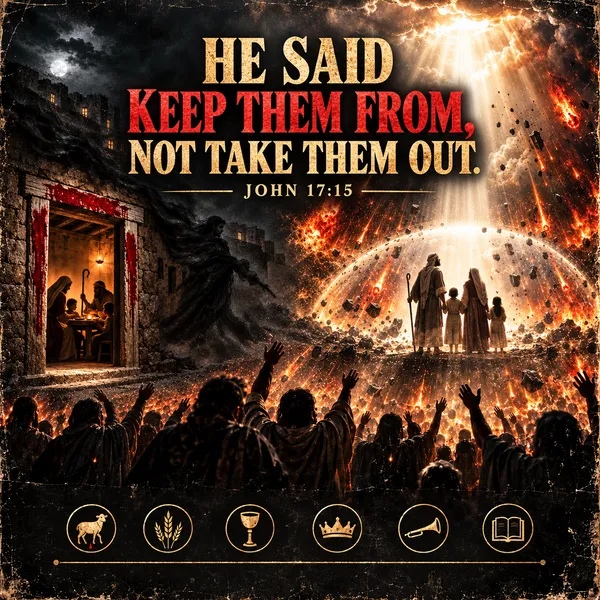
The age is not a countdown to a secret rapture. There is no verse that removes the Bride before the seals are opened; the seals open into the age she already inhabits. The resurrection and gathering of the Bride is placed by Scripture at the last trumpet — "we shall all be changed, in a moment, in the twinkling of an eye, at the last trumpet" (1 Corinthians 15:51–52) — and the last trumpet is the seventh, sounding late in the sequence, not a silent departure before the first seal. The Bride is sealed for preservation through the coming judgments on the pattern of Israel sealed by the blood on the doorpost and carried through the plagues (Exodus 12), not extracted before them.
The age is not measured by the founding of any modern state. The reading that takes a twentieth-century political event as the prophetic starting-gun and calculates a generation from it has watched its own deadlines arrive and pass without the promised events — a repeated falsification that is itself the evidence the underlying reading was mistaken. The Olivet warning "look at the fig tree, and all the trees" (Luke 21:29) refuses the unique-symbol reading on which the whole calculation depends. The covenantal ingathering the prophets foretold is Yahweh's own work at the sixth seal, by the breath of His mouth, climaxing when the natural branches look on the One they pierced (Zechariah 12:10; Romans 11:25–27) — not a headline, not a vote, not a treaty.
And the age is not a lull to be waited out. The riders are not idling in some future stable; they are on the road now. The mistake of the countdown reading is not merely that it gets the timing wrong — it is that it lets the Bride believe her own age is quiet. It is not quiet. Counterfeit conquest rides under a stolen white; peace is taken from the earth; the scales are tilted; Death gathers his fourth; the altar fills. This is the age. To wait for it to begin is to sleep through it.
Section VIIIHow the Bride Rides Among the Riders
If the horsemen are the character of our age, then the Bride's calling is not escape but faithfulness in the saddle-thunder. Three things follow.
First, she is not alarmed. Yeshua's own instruction in the face of the riders was "see that you are not troubled" (Matthew 24:6). The Bride who understands the seals is inoculated against both the panic of the doom-watcher and the false comfort of the escapist. She knows the riders ride; she knows they ride on a permission; she knows the hand that holds the leash. Fear is not the appropriate response to a leashed rider whose Master is her Bridegroom.
Second, she keeps her witness. The fifth seal tells her the altar is not yet full, which means the age is still calling for testimony — still calling for those who hold the word of God and the testimony even to the point of the sword. The Bride's task in the age of the horsemen is not survival at any cost but faithful witness at any cost, adding her voice to the ones already crying "how long" and trusting the answer already given: rest a little longer; the count is nearly complete.
Third, she lives toward the threshold. The sixth seal is not yet broken. When it breaks, the sky recedes, the mountains move, and the kings of the earth cry to the rocks to fall on them (Revelation 6:12–17) — the great and terrible Day for which the riders have been the long overture. But the Bride's horizon is not finally the sixth seal or even the trumpets. Her horizon is the Marriage Supper of the Lamb (Revelation 19:9), the Table where the Bridegroom and the Bride share the fellowship the whole Covenant arc has been building toward. The horsemen are the character of the age between the empty tomb and that Table. They are terrible, and they are temporary. They ride the whole length of the age, but the age has an end, and the end is a wedding.
So the Bride does not read Revelation 6 as a stranger reading someone else's future. She reads it as her own life. The white rider and his stolen crown are on her road. The red rider has taken peace from her earth. The black rider's scale is tilted against her neighbor. The pale rider has taken those she loved, and the Grave has followed. The altar holds her brothers and sisters, and their cry is hers. This is the age. The riders are not coming. They are here — and so is the Lamb who opened every seal, who holds the keys of Death and the Grave, and who will not fold the sky until the last of the Bride has been sealed and the wedding is ready.
Until then: not troubled, still faithful, riding toward the Table.
Ten Words Press
Comments
No comments yet. Be the first.