The Tribulation Cut Short
The Sixth Seal to the Thousand Years
From the sealing of the servants to the binding of the dragon — the order the Canon actually gives.
·
Section IThe Half-Week Was Already Fulfilled
A prior study set the ground and must be restated before the rest can stand: the seven-year tribulation of the popular charts does not exist. It was manufactured by lifting Daniel's seventieth seven out of Messiah's own ministry and floating it two millennia downstream into a supposed treaty between a coming deceiver and a modern political state. Remove that invention and the prophetic map clears.
The seventy sevens are finished. The six accomplishments decreed in Daniel 9:24 — to finish the transgression, to make an end of sins, to make reconciliation for iniquity, to bring in everlasting righteousness, to seal up vision and prophecy, to anoint the Most Holy — were each accomplished by the Bridegroom Himself. The transgression was finished when the curse of the broken Covenant fell on Him; sins were ended by one offering; reconciliation was made in His Blood; everlasting righteousness was brought in and given to the Bride; vision and prophecy were sealed when the Ruach HaKodosh was poured out; the Most Holy was anointed when the gathered Bride became the dwelling of Yahweh. The "covenant confirmed with many" is the New Covenant, not an antichrist's contract. The end of sacrifice "in the middle of the seven" is the Cross, where the veil tore from top to bottom, from heaven's side.
What Scripture holds forward, therefore, is not Daniel's postponed week but a different measure entirely: the forty-two months of the Revelation — three and a half years, twelve hundred and sixty days, a time and times and half a time. Not the back half of a seven-year deal. A shortened, self-contained season with its own opening and its own close. This study describes that season from its threshold at the sixth seal to the moment the thousand-year reign begins.
Section IIWhere the Sixth Seal Finds Us
The order of the Revelation is fixed and cannot be rearranged: Seals, then Trumpets, then Bowls. That sequence is the spine of the prophecy, and every scheme that shuffles it distorts the whole.
The first five seals are not closed events in the past. They are the standing conditions of the entire age the Bridegroom opened at His first coming. The white horse rides, the red horse of warfare rides, the black horse of scarcity rides, the pale horse of death rides — and beneath the altar the souls of the slain cry "How long?" while the count of their fellow servants is filled. Wars, rumors of wars, famines, pestilences, earthquakes: these the Bridegroom named the beginning of sorrows, not the end. The Bride does not live at a single point between the fifth seal and the sixth. She lives in the era when all five are simultaneously open, with the sixth as the threshold not yet crossed.
When the sixth seal opens, the earth is convulsed. The sun is blackened, the moon turns as blood, the stars fall, the heaven departs as a scroll, and kings and slaves alike cry for the rocks to fall and hide them from the face of the One on the throne. This is not a secret removal of the Bride. It is public, terrifying, cosmic upheaval — the great day announced. And then the sequence pauses.
Section IIIThe Sealing of the Servants
Into that pause steps the angel of the seal. Four angels hold back the four winds so that no wind blows on the earth or the sea or any tree, and the command goes out:
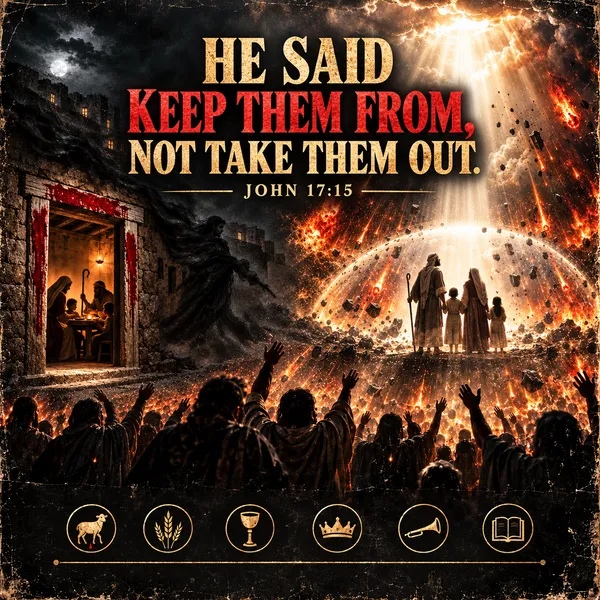
The harm is restrained until the servants are marked. The seal is set first; only then may what follows proceed. This is the Exodus pattern, and it must be read as Exodus or it will be misread entirely. Israel was not lifted out of Egypt before the plagues fell. Israel was sealed — blood struck on the doorpost — and kept through the night while the destroyer passed over. The seal is not extraction. The seal is Covenant preservation under conditions of ongoing testimony. The servants remain in the world, marked as belonging to the King, and the mark is what carries them through what is coming, not around it.
This overturns the entire instinct of escapism. The Bride is never promised a rescue before the trouble. She is promised a seal in it. She is the woman fed in the wilderness precisely because she has first been sealed — nourished through the season, not evacuated from it. The doorpost was struck before the destroyer walked; the servant is sealed before the winds are loosed.
Section IVThe Hundred and Forty-Four Thousand
The number of the sealed is given as a hundred and forty-four thousand out of every tribe. It is no census. It is code — twelve squared brought to fullness by a thousand: every tribe joined to every apostolic witness, the covenantal completeness of the Bride multiplied to its full measure. Read the arithmetic and the intent is plain: twelve times twelve times a thousand, the whole sealed people named as a Kingdom of priests.
John proves it himself. He hears the number counted by tribe, and when he looks again he sees what the count concealed:
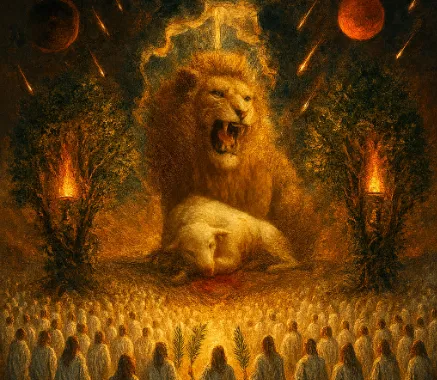
One Bride, seen from two angles — counted by tribe to mark her Covenant identity, then seen beyond counting to mark her gathered fullness. And the tribal list itself confesses the symbolism: Dan is absent, Joseph and Manasseh both appear, Levi is folded back in. That is not a genealogy; it is a symbolic reconstitution of the whole house. The sealed hundred and forty-four thousand and the innumerable multitude are the same people. And that same multitude is later named as those who "came out of the great tribulation" — sealed in it, kept through it, brought out of it. Hold that phrase. It is the hinge of everything that follows.
Section VThe Two Marks
The beast answers the sealing with a forgery. He marks his own on the forehead and on the hand — a deliberate mockery of the seal set on the servants' foreheads, a rival kingdom stamping its subjects, a counterfeit claiming. But the order is mercy, and the order is everything. The Bride is not marked by the beast and then made to resist. She is already sealed, already His, already spoken for. She is not available to be claimed. The counterfeit has no purchase on one who has already been struck with the doorpost blood.
And the beast's mark carries its own sentence written into the same stroke. The one who receives it, Scripture warns, "shall drink of the wine of the wrath of God, poured out full strength into the cup of His indignation." That cup is the bowls. The very act that claims a man for the beast appoints him to the wrath the Bride is gathered out of. The two marks run in opposite directions: the beast's mark places its bearers under the wrath that follows the tribulation; the seal of God brings its bearers out of the tribulation altogether.
One seal saves by claiming first. One mark damns by claiming late. And what cannot be forged is the doorpost blood already struck.
Ten Words Press
This is why the warnings against the mark are so absolute. To take it is not merely to submit to a tyrant; it is to be sealed for the cup. There is no neutral forehead in that hour. Every brow bears one mark or the other, and the mark decides which side of the wrath a soul stands on.
Section VIThe Forty-Two Months — The Great Tribulation Itself
Now the great tribulation finds its measure. The span appears five times in the Revelation, always as one period seen from different sides: the holy city trampled forty-two months; the two witnesses prophesying twelve hundred and sixty days; the woman nourished in the wilderness twelve hundred and sixty days, and again "for a time, and times, and half a time"; the beast given authority to act forty-two months. Forty-two months, twelve hundred and sixty days, three and a half years, time-times-and-half-a-time — one span, described five ways.
Read against the sealing, the span declares itself. It is not a stopwatch counting to a date the Bride is meant to calculate. "A time, times, and half a time" is the deliberately broken seven — a season of testing never permitted to complete itself, bounded and sovereignly shortened. It is the measure of the sealed Bride's testimony under pressure: the same period in which the beast is permitted his authority, in which the outer court is trampled, and in which the woman is fed in the wilderness because she has been sealed. The trampling, the beast's licensed rage, and the wilderness nourishment are one span from three directions — the world's assault, the adversary's permitted hour, and the Presence keeping His own through it.
And the span is cut short by decree. "Unless those days were shortened, no flesh would be saved; but for the elect's sake those days will be shortened." The three and a half is itself the shortening — the half of the seven, the seven broken in the middle so that testimony is bounded and the season cannot run to its full and consume the Bride. The great tribulation is real, and it is severe, and it is limited. It runs to the seventh trumpet and no further.
Forty-two months: the city trampled (Rev 11:2); the beast's authority (Rev 13:5). Twelve hundred and sixty days: the two witnesses (Rev 11:3); the woman in the wilderness (Rev 12:6). Time, times, and half a time: the woman kept from the dragon (Rev 12:14). One shortened season — the broken seven, cut short for the elect.
Section VIIThe Seventh Seal and the Trumpets
The seventh seal does not bring a new set of disasters; it opens into the seven trumpets. And the trumpets must never be confused with the wrath that comes after them. The trumpets are warning judgments. They fall, and men are summoned to repent, and it is recorded plainly that they did not: "the rest of mankind... did not repent." The sealed Bride is present through the trumpets and untouched by them — the locusts of the fifth trumpet are expressly forbidden to harm anyone who has the seal of God on the forehead. Sealed for the trumpets, preserved through the trumpets: the Exodus pattern holding all the way down.
The cadence of the trumpets is not metronomic. Divide forty-two months by seven and the arithmetic yields a blast every six months — but the text refuses even spacing. The first four sound as a rapid cluster: earth, sea, rivers, the lights of heaven struck in quick succession. Then an eagle cries "Woe, woe, woe," setting the final three apart as the three woes, each heavier than the last. The fifth carries its own clock — five months of torment, not six. The sixth is stamped to "the hour and the day and the month and the year," an appointed moment, not an even slot. And the seventh is no slot at all but an instant.
This is the shape of travail, not of a clock. Birth pangs do not come at even intervals; they come harder and closer together until the birth. The trumpets compress as they approach the seventh, quickening toward a delivery. The seventh trumpet is that delivery — sudden, at the end of a tightening rhythm, not the last of seven evenly-spaced ticks.
Section VIIIThe Last Trumpet and the Resurrection
Here the whole prophecy turns on its hinge. Watch the two witnesses. They finish their twelve hundred and sixty days, they are killed, their bodies lie in the street, and after three and a half days the breath of life enters them and they stand and are called up. And in the very next breath the record reads, "the seventh angel sounded" — the seventh trumpet, and loud voices in heaven declare the Kingdom of the world become the Kingdom of our Lord and of His Messiah. The witnesses' resurrection and the seventh trumpet are laid side by side because they are one moment. What is true of the two witnesses is the pattern of the whole Bride: the twelve-hundred-and-sixty-day testimony ends in resurrection, and that resurrection is the last trumpet.
Three witnesses seal it beyond dispute:
The Lord Himself descends "with the trumpet of God," and the dead in Messiah rise (1 Thessalonians 4:16). The seventh trumpet sounds, "the time of the dead has come" (Revelation 11:15–18). The last trumpet of the apostle, the trumpet of God, and the seventh trumpet of the Revelation are one trumpet. There is no earlier, quieter removal — the secret pre-tribulation rapture is a nineteenth-century import without canonical footing. The Bride is sealed for the trumpets, raised at the last of them, and so she comes "out of the great tribulation": not spared the labor but delivered through it. This is her birth — the woman's man-child caught up to God and to His throne, the resurrection that is the end of her travail.
Section IXThe Bowls — The Wrath That Follows
Immediately after the resurrection come the bowls, and the bowls are a different thing from the trumpets. They are named "the seven last plagues, for in them the wrath of God is complete." No call to repentance accompanies them; the season of warning is over. The trumpets were mercy under judgment; the bowls are judgment without appeal. And the Bride is not appointed to this wrath — that promise, rightly read, has the bowls precisely in view, for the Bride has already risen and is no longer on the ground where the wrath falls.
The bowls fall in rapid succession, and they must. The sea to blood, the rivers to blood, the sun given power to scorch men with fire, the throne of the beast plunged into darkness, the great earthquake such as never was since men were on the earth, hail of a talent's weight. No world could survive a sustained pouring of these; they are not a climate but a demolition. And the seventh bowl ends with a single word from the throne — "It is done." Completed, finished, done: the grammar of swift consummation, not a drawn-out era.
This is the second travail, and it falls on a different body. The Bride's labor ended at the resurrection; now the old creation groans. As it is written, the whole creation "groans and labors with birth pangs together until now," waiting to be delivered from its bondage to decay. The bowls are that final labor — the hardest, fastest contractions of a dying order convulsing as it passes, making way for what is coming. The pangs come harder and closer, exactly as travail does, and the first birth was the Bride caught up while the bowls are the death-throes of the world she was born out of.
| Judgment Series | Character | The Bride |
|---|---|---|
| Seals 1–5 | The standing sorrows of the age | present, enduring |
| Sixth Seal | Cosmic upheaval; the sealing | sealed |
| Trumpets 1–6 | Warning judgments, calling to repent | preserved through |
| Last Trumpet | Resurrection and gathering | raised — brought out |
| Bowls 1–7 | Wrath complete — "it is done" | absent — at the feast |
Section XThe Feast and the Eighth Day
While the earth endures its final labor, the Bride is at the table. She is not on the ground where the wrath falls; she has already risen, already been gathered, already come out. The voice from heaven proclaims, "Blessed are those who are called to the marriage supper of the Lamb" — the Bride and the Bridegroom in the fellowship the whole Covenant arc has moved toward from Mamre to Sinai to the upper room. Oath, Blood, and Table, now brought to their wedding.
The feast has a shape the appointed times propose. Sukkot, the Feast of Ingathering, is the wedding feast — seven days of celebration, and then Shemini Atzeret, the eighth-day assembly that stands apart from the seven. The correspondence is offered as pattern, for Scripture does not clock the bowls to a calendar and no date is to be set from it: seven bowls emptied on the earth while the Bride keeps her seven-day marriage feast within, and then the eighth day breaking — the day beyond the seven — opening onto the reign that does not end. The seven-day feast is the inaugural wedding celebration; the thousand-year reign is what the eighth day opens onto. The feast is not stretched to fill the reign, and the bowls are not fixed to seven days as though the number were given. The pattern is tethered to the Covenant and offered as such — the ingathering wedding while the wrath completes, and the eighth-day dawn beyond it.
Section XIThe Return, the Binding, and the Threshold of the Thousand Years
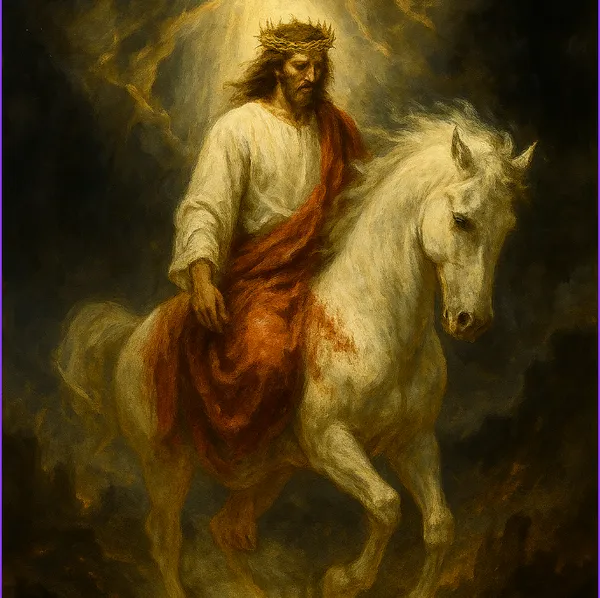
The bowls climax in the gathering of the kings to the place called Armageddon, and then the heavens open. The Bridegroom comes forth in glory, no longer the sealed Lamb of the throne-room but the King on the white horse, the armies of heaven behind Him, the sword of His mouth striking the nations. The beast and the false prophet are seized and judged, cast into the lake of fire. The counterfeit kingdom that mocked the sealing with its mark is ended in an hour.
Then the dragon is bound. His legal defeat was accomplished at the Cross — his authority broken, his accusation silenced, the Gospel loosed upon the nations — but that was the first phase, and he remained active still, prowling, deceiving. Now comes the second: an angel lays hold of him, binds him, and casts him into the abyss, sealed for a thousand years that he should deceive the nations no more. The two phases must never be collapsed. Calvary broke his authority; this is his imprisonment. The one was already; the other, at this threshold, is accomplished.
And here the study reaches its horizon. John sees thrones, and the raised Bride seated on them:
The Bride's place, after the last-trumpet rising and the marriage feast, is the literal thousand-year reign — she reigns as a Kingdom of priests with the Bridegroom while the dragon is bound and the earth is ruled in righteousness. The thousand years is no allegory to be dissolved into the present age; it is the reign the first resurrection inaugurates. What lies beyond it — the little season of the dragon's release, the last assault of Gog and Magog, the second resurrection of judgment, the great white throne, and the new heavens and new earth — belongs to another study. This one ends where the reign begins.
The whole order stands whole. Seals spread across the age; the sixth seal breaking as the threshold; the servants sealed on the Exodus pattern; the forty-two months of sealed testimony, the broken seven cut short for the elect; the trumpets quickening like travail toward the last; the Bride raised and brought out at the last trumpet; the bowls falling in swift and complete wrath on a world she has been gathered out of; the marriage feast within while the old creation labors; the King returning, the dragon bound, and the thousand years begun. There is no seven-year tribulation. There is a shortened three and a half, a seal that cannot be forged, a resurrection that is the Bride's birth, and a wrath that never touches her — for she was sealed in the trouble, born at the end of it, and seated at the table on the far side of it.
Comments
No comments yet. Be the first.