He Said Keep Them From,
Not Take Them Out
Twenty-nine reasons for a secret rapture, answered one at a time from the written Word.
·
Section IThree Assumptions Carrying Twenty-Nine Reasons
A list of fifty reasons sounds like fifty arguments. It is not. Nearly every item on the list is a true statement about our hope that is then asked to do work it cannot do, because the timing is never in the verse cited. The weight is carried underneath, by three assumptions that are never argued and never stated in Scripture.
The first assumption is that wrath means the whole seven years rather than the bowls. The Canon locates the wrath of God precisely: "seven angels having the seven last plagues; for in them is filled up the wrath of God" (Revelation 15:1). The trumpets that precede those bowls are warning judgments, and the text says so by telling us how men respond to them: "and the rest of the men which were not killed by these plagues yet repented not" (Revelation 9:20). Judgments that summon repentance are not the outpoured wrath from which the Bride is exempt. Once wrath is read where the text puts it, the promise in 1 Thessalonians 5:9 is kept in full without a secret removal.
The second assumption is that Daniel's seventieth week is future and empty. Daniel 9:24 states what the seventy sevens were decreed to accomplish: to finish the transgression, to make an end of sins, to make reconciliation for iniquity, to bring in everlasting righteousness, to seal up the vision and prophecy, and to anoint the Most Holy. Those are Cross and Pentecost accomplishments. If the seventieth week is still ahead of us, then sin has not yet been ended and reconciliation has not yet been made, and the system has purchased its timeline at the price of the finished work.
The third assumption is that there are two peoples running two programs, so that promises made to one may be quarantined from the other. Paul dismantles that in the very letters the list quotes. The middle wall is broken down, the two are made "one new man" (Ephesians 2:15), and there is one olive tree in which natural branches are broken off and grafted back into the same root alongside the wild (Romans 11:17 to 24). Not two trees. Not two brides. Not two gatherings.
Strip those three and the list has no timing argument left. What remains is a set of precious and true statements about the blessed hope, none of which tells us when.
Section IIWrath, and What the Promise Actually Says
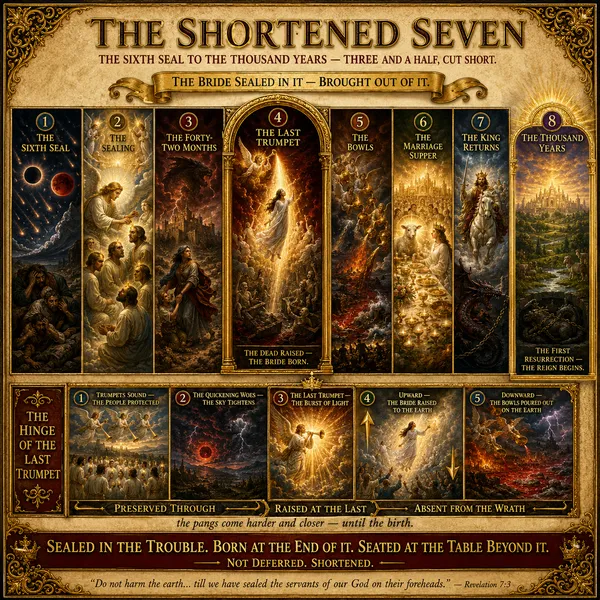
Granted, and it stands without amendment. A word about the term used throughout what follows: the Bride is the one people God is gathering, the believing remnant of Judah, the house of Israel returning, and every believer from the nations brought near in Christ. The question is not whether the promise is true but where Scripture puts the wrath. Revelation 15:1 says the wrath of God is filled up in the seven last plagues, and the Bride is not present for them. She is sealed before the trumpets, preserved through them, and gathered at the last one, which sounds before a single bowl is poured. The promise is kept exactly as written, and nothing in it requires an exit seven years early.
Note carefully what the verse says He delivers from. It says the wrath to come. It does not say the tribulation to come. Substituting the second phrase for the first is the entire argument, and it is performed silently. Tribulation is promised to the Bride in the plainest terms: "in the world ye shall have tribulation" (John 16:33), and "we must through much tribulation enter into the kingdom of God" (Acts 14:22). Wrath is what she is spared. Tribulation is what she is kept through.
This is the strongest verse on the list, and it cuts the other way. The Greek construction is tereo ek, to keep from. Jesus Himself uses that identical construction in His high priestly prayer: "I pray not that Thou shouldest take them out of the world, but that Thou shouldest keep them from the evil" (John 17:15). There the phrase is defined for us by explicit contrast. Kept from, and expressly not taken out. The Lord who prayed those words did not reverse Himself two chapters into Revelation.
The promise is also given to a named local assembly that has kept the word of His patience, which is the ground stated for the keeping. Whatever it extends to, it extends on the terms the text gives: preservation for those who endure, not evacuation of those who would rather not.
Section IIIThe Comfort and the Blessed Hope
Read verse 13 for the occasion of the comfort. The Thessalonians were grieving over believers who had died, and Paul writes so that they will not sorrow as those who have no hope. The comfort he gives is the resurrection: your dead are not lost, they rise first, and you will be with them and with the Lord. That is the comfort in the passage, stated in the passage.
Comfort in Scripture has never meant exemption from hardship. The souls under the altar in Revelation 6:9 were slain for the word of God, and the comfort given them was a white robe and the assurance that the count would be completed. Stephen was comforted with an open heaven while the stones were in the air. If comfort required rescue from suffering, the martyrs were never comforted at all.
Granted, and gladly. We wait for the Son. But Paul himself takes up the timing question in his very next letter to the same congregation, and he opens by naming the subject in words no one can mistake: "Now we beseech you, brethren, by the coming of our Lord Jesus Christ, and by our gathering together unto Him" (2 Thessalonians 2:1). Then he says that day shall not come "except there come a falling away first, and that man of sin be revealed" (2 Thessalonians 2:3).
That is the apostle placing two events in front of our gathering together unto Him. It is the one passage in Scripture that addresses the gathering and its timing in the same breath, and it does not appear anywhere in the twenty-nine.
True, and unchallenged. The verse establishes the object of our hope and says nothing whatever about its timing. Every believer in every century has looked for Him. Looking for Him is not evidence of when He comes.
Read the whole phrase: "that blessed hope, and the glorious appearing of the great God and our Saviour Jesus Christ." The word is epiphaneia, a manifestation in glory. Paul uses that same word for the appearing that destroys the lawless one: "whom the Lord shall consume with the spirit of His mouth, and shall destroy with the brightness of His coming" (2 Thessalonians 2:8). One appearing, one vocabulary, and it is the opposite of secret. The blessed hope is glorious precisely because it is seen.
Section IVThe Gathering Itself
This argues against the position it was offered to support. A shout, an archangel's voice, and the trumpet of God is not a quiet disappearance; it is the loudest announced event in Scripture. And Paul identifies which trumpet elsewhere in the same doctrine: "at the last trump" (1 Corinthians 15:52). A last trumpet presupposes prior trumpets. Revelation names them, seven of them, and the seventh is where the Kingdom is proclaimed.
Granted, and Scripture dates it. John sees those who were beheaded for the witness of Jesus, who had not worshipped the beast nor received his mark, and says "they lived and reigned with Christ a thousand years. This is the first resurrection" (Revelation 20:4 to 5). The first resurrection therefore includes people who refused the mark, which means it is not complete before the beast appears. And at the seventh trumpet the announcement is explicit: "the time of the dead, that they should be judged" (Revelation 11:18).
Granted, and the operative word is together. One gathering, one Bride, one body. To make this a pre-tribulation event the system must invent a second gathering later for a second class of saints, since Revelation is full of believers on the earth during the trouble. That second gathering is never described, never promised, and never named. A doctrine that requires an unmentioned resurrection to hold together is being supplied by its adherents rather than read from the text.
The word Paul chooses for the meeting is apantesis, and in the first century it named a specific civic act: the citizens go out from the city to meet an arriving dignitary and escort him back in. The New Testament uses it exactly that way twice more. The brethren from Rome come out along the Appian Way "to meet us" and then return with Paul into the city (Acts 28:15). The virgins "go ye out to meet him" and enter with the bridegroom to the marriage (Matthew 25:6). In neither case does the welcoming party leave and stay gone.
Meeting the descending King in the air is the reception of a King already on His way down. It is not a round trip with a seven year interval inserted at the top.
Granted that they went up, and no gap of seven years is needed to get them there. Revelation's own sequence is seals, then trumpets, then bowls. The gathering occurs at the seventh trumpet in chapter 11, which stands before the bowls of chapter 16 and well before the rider of chapter 19. The argument proves that the Bride precedes the Advent, which no one disputes. It does not establish how long she precedes it, and the book itself answers that question in chapter 11.
Granted, and John defines the linen for us in the same chapter: "for the fine linen is the righteousness of saints" (Revelation 19:8). The armies also include the heavenly host, since Christ comes "with all the holy angels with Him" (Matthew 25:31) and is "revealed from heaven with His mighty angels" (2 Thessalonians 1:7). This establishes that the saints return with Him. It contributes nothing to the question of when they were gathered.
Section VDaniel's Seventieth Week
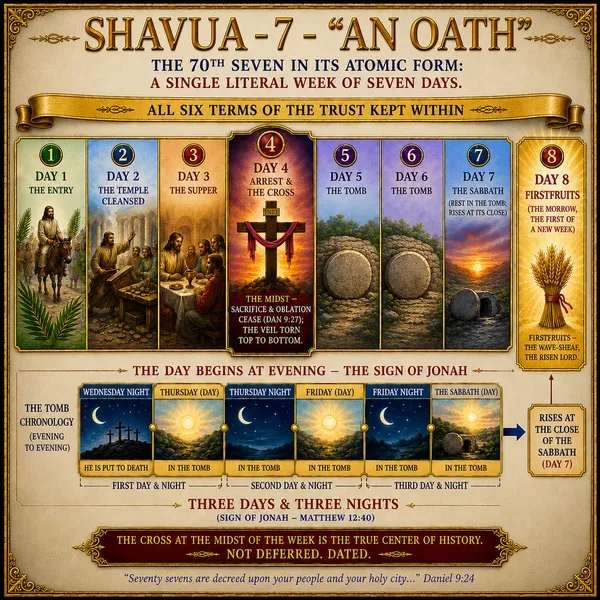
Granted, and this is where the futurist reading pays its heaviest price. The same verse states what the seventy sevens were decreed to accomplish for that people and that city: to finish the transgression, to make an end of sins, to make reconciliation for iniquity, to bring in everlasting righteousness, to seal up the vision and prophecy, and to anoint the Most Holy. Six purposes, all of them covenantal, all of them accomplished at the Cross and at Pentecost.
If the seventieth week has not yet occurred, then by the decree's own governing clause an end has not been made of sins and reconciliation has not been made for iniquity. The system cannot hold its timeline and the finished work at the same time.
Correct, and Daniel 9 never identifies Antichrist as the subject either. That figure is imported. The nearest antecedent to the "he" of verse 27 is Messiah the Prince, named in verses 25 and 26. And the One who "shall confirm the covenant with many for one week" is the One who lifted the cup and said, "this is My blood of the new testament, which is shed for many for the remission of sins" (Matthew 26:28). That is Daniel 9:27 spoken aloud at the Table, covenant and many together, by the Prince the prophecy named.
The clock that stops and restarts is not in the prophecy. Daniel gives seven sevens, then sixty-two sevens, then Messiah cut off, then one seven. There is no clause placing an interval between the sixty-ninth and the seventieth, and the interval the system requires is now longer than the entire prophecy it interrupts. A gap of two thousand years inserted into a sealed decree is the single largest claim in the whole scheme, and it is the one claim never argued from the text. It is worth noting that the no-gap reading, with Messiah as the one who confirms the covenant, is not novel; it is the reading of E. J. Young and the older Reformed exegetical line, and it was the ordinary Christian reading long before the nineteenth century.
Read Paul's own definition in the next verse, because he supplies it: the mystery is "that the Gentiles should be fellowheirs, and of the same body, and partakers of His promise in Christ by the gospel" (Ephesians 3:6). The mystery is not that God quietly began a second people with a separate destiny. The mystery is that the two became one. One chapter earlier Paul says He "hath made both one, and hath broken down the middle wall of partition," to "make in Himself of twain one new man" (Ephesians 2:14 to 15). The chapter enlisted to prove two programs is the chapter that abolishes them.
Granted in full. Blindness in part, until a stated terminus. Nothing in the verse concerns the timing of a gathering, and nothing in it establishes two peoples. It establishes a sequence within one people.
He does, and by the picture Paul actually draws. There is one olive tree. Natural branches were broken off through unbelief, wild branches were grafted in contrary to nature, and the natural branches will be grafted back "into their own olive tree" (Romans 11:24). Same tree, same root, same fatness. Paul does not describe a second tree kept in reserve, and he warns the wild branches specifically against the boasting that treats the two as separate stocks. Romans 11 is the end of the two-program system, not its charter.
Section VIJacob's Trouble and the Olivet Discourse
Finish the verse. "Alas! for that day is great, so that none is like it: it is even the time of Jacob's trouble; but he shall be saved out of it." Saved out of it, which is to say brought through it from the inside. The prophet does not say Jacob is removed before it or spared its arrival. He says Jacob goes into the great day and comes out the other side alive. That is the pattern in a single clause.
Granted, and the setting is even more specific than that. The disciples asked about the stones of the temple they were standing beside (Matthew 24:2 to 3). Judaea, the housetop, the flight in winter, and the compassing armies of Luke 21:20 all landed inside that generation, which is exactly why Jesus could say "this generation shall not pass, till all these things be fulfilled" (Matthew 24:34). The destruction of the temple in AD 70 is a real fulfillment and a genuine foreshadowing of what remains.
Granted, and it points the same direction. A sabbath-day flight from Judaea is a first-century Judean concern, which supports the AD 70 setting the chapter announces for itself. It does not establish a future seven year program from which the Bride is absent.
It does, and Daniel 9:27 finds its covenantal end at the Cross, where the sacrifice and the oblation ceased in truth and "the veil of the temple was rent in twain from the top to the bottom" (Matthew 27:51). Torn from the top, from heaven's side, by the hand that ended the shadow. The physical desolation of the house followed within the generation. The type is real, the antitype remains, and neither requires a future seven year contract.
Here the quarantine collapses under its own preachers. The same chapter contains "he that shall endure unto the end, the same shall be saved" (Matthew 24:13), the charge to watch because you know not what hour your Lord comes (24:42), and the parable of the faithful and wise servant. Those passages are preached to congregations every week by the very teachers who assign the chapter to a different people and a different age. A chapter cannot be quarantined on Monday and applied on Sunday.
And verse 31 places the gathering precisely: "immediately after the tribulation of those days" the sun is darkened, the sign of the Son of man appears, and He sends His angels "with a great sound of a trumpet" to gather His elect from the four winds. Cosmic signs, then a great trumpet, then the gathering, in that order, out of the mouth of Jesus Himself.
Fully granted, and Scripture goes considerably further than the objection. There is no third temple in the program at all. Jesus said of His own body, "destroy this temple, and in three days I will raise it up" (John 2:19 to 21). By the indwelling Holy Spirit the Bride herself becomes the temple: "know ye not that ye are the temple of God" (1 Corinthians 3:16), and "your body is the temple of the Holy Ghost" (1 Corinthians 6:19). Watching Jerusalem for cornerstone announcements is watching for the return of a shadow the Resurrection retired.
Section VIIPaul's Own Sequence, and the Trumpet in the Verse
Paul names his source in the passage itself: "for this we say unto you by the word of the Lord" (1 Thessalonians 4:15). He is handing on what the Lord taught, not launching a separate program that supersedes it. And when Paul does address the timing of the gathering directly, in 2 Thessalonians 2, he sequences it exactly as Jesus did: apostasy and the revealing of the man of sin first, then the day, then the destruction of that man by the brightness of His coming.
Set the witnesses side by side and the distinction disappears. Matthew 24:29 to 31 gives cosmic signs, a great trumpet, and the gathering of the elect. First Corinthians 15:52 gives the last trumpet and the change. First Thessalonians 4:16 gives a shout, the voice of the archangel, the trump of God, and the gathering. Revelation 11:15 to 18 gives the seventh trumpet, the Kingdom proclaimed, and the time of the dead. Four passages, one trumpet, one gathering, and the same order every time.
The mystery is named inside the clause. The mystery is that not every believer will die, which was the genuine novelty. It is not that the event will be unobserved. Paul then dates the mystery in the very next breath, and the list stops reading one word short of the date.
Here is the verse in full: "In a moment, in the twinkling of an eye, at the last trump: for the trumpet shall sound, and the dead shall be raised incorruptible, and we shall be changed." The quotation on the list ends at the comma. The timing stamp is the next four words, and it has been sitting in the verse the whole time. Speed is not secrecy. The change is instantaneous, and it occurs at the last trumpet, which Revelation 11:15 identifies as the seventh, sounded long after the seals have opened and the trumpet judgments have run.
Observation: The timing markers in this doctrine are not hidden in obscure passages. They stand inside the very verses the list cites, one clause past the point where the quotation stops. First Corinthians 15:52 is quoted up to the comma. First Thessalonians 4:16 is quoted for its trumpet but never asked which trumpet. Revelation 3:10 is cited for keeping but never read against John 17:15, where the Lord defines the phrase Himself.
Section VIIIThe Pattern of Preservation
What Scripture does teach, from the first pages to the last, is a settled pattern of divine dealing. It is not extraction. It is preservation through.
Noah was not removed from the earth before the flood. He was sealed inside a vessel and shut in by the hand of God, and the waters that destroyed the world lifted him above it. Israel was not evacuated from Egypt before the plagues. She was marked with blood on the lintel and the two side posts, and the destroyer passed over the house while judgment fell on the land around it. Goshen sat inside Egypt, untouched, during the darkness that could be felt. The three men were not spared the furnace; they were walked into it and a fourth stood with them, and what burned was the rope. Daniel was not spared the den. Job was hedged, not exempted.
Revelation follows the same order, and states it as a command. Between the sixth seal and the trumpets, an angel cries, "Hurt not the earth, neither the sea, nor the trees, till we have sealed the servants of our God in their foreheads" (Revelation 7:3). The sealing enables the trumpets to proceed. It does not remove anyone. Two chapters later the seal is shown operating exactly as intended, when the locusts are commanded to harm only "those men which have not the seal of God in their foreheads" (Revelation 9:4). The Bride is marked before the trumpets fall, kept through them, and gathered at the last one, and she is not present when the bowls of wrath are poured out.
That is the Bridegroom's own prayer for His Bride on the night He was betrayed, and it is the plainest statement of the doctrine in Scripture. He was asked in that hour to spare His people, and He asked the Father not to take them out. To insist that He nevertheless intends to take them out is to correct His prayer with a system.
It is worth saying plainly that the position argued here is not novel and its company is not obscure. Preservation through the trouble was the ordinary expectation of the historic premillennial reading and of the church broadly for the first eighteen centuries. The pre-tribulation removal entered systematic teaching through J. N. Darby in the 1830s, spread through the Scofield Reference Bible in 1909, and reached the American pulpit in force through the popular prophecy literature of the 1970s and after. Age does not settle truth, and neither does novelty settle error. But a doctrine that no one taught for eighteen hundred years should be asked to prove itself from the text with unusual care, and this one is asked to prove itself from verses that stop one clause short of their own timing.
Section IXConclusion
Twenty-nine reasons were offered, and not one of them supplies a timing statement that the text does not immediately contradict or leave unaddressed. Several are true and precious statements about the blessed hope that no one contests. The rest depend on three unstated assumptions: that wrath means seven years rather than the bowls, that a decree whose six purposes were fulfilled at the Cross and at Pentecost is still empty and waiting, and that God is running two peoples on two programs after Paul declared the wall between them broken down.
The timing was never hidden. It sits in the same verses the list quotes, one clause past where the quotation ends. In a moment, in the twinkling of an eye, at the last trump. The last trumpet is the seventh, and when it sounds the kingdoms of this world become the Kingdom of our Lord and of His Christ, and the time of the dead has come. Immediately after the tribulation of those days, the sign appears and the great trumpet gathers the elect. Kept from, and expressly not taken out.
The Bride is not appointed to wrath, and she will not see the bowls. That promise is kept in full, exactly as written, without inventing a coming Scripture never describes. She is sealed before the trumpets, preserved through them, and gathered at the last one. Blood on the doorpost, the door shut from the outside by the hand of God, and the destroyer passing by. That has always been the pattern, and it is a better comfort than evacuation, because it is the one He actually promised.
A doctrine that must stop reading in the middle of a verse to survive is not resting on the written Word.
Ten Words Press
Comments
No comments yet. Be the first.