The 144,000
Counted, Then Beyond Counting
How seventy names on one page in Genesis become the whole sealed Bride in Revelation
·
Section IThe Number John Heard
Revelation 7 opens with four angels holding back the four winds, and a fifth angel rising from the east with the seal of the living God. The order given is plain: nothing on earth is to be harmed until the servants of God are sealed on their foreheads. Then John reports what came next, and his verb matters.
John did not see 144,000 people. He heard a number, and he heard it read out by tribe, twelve thousand at a time, the way a roll is called. Five verses later his verb changes.
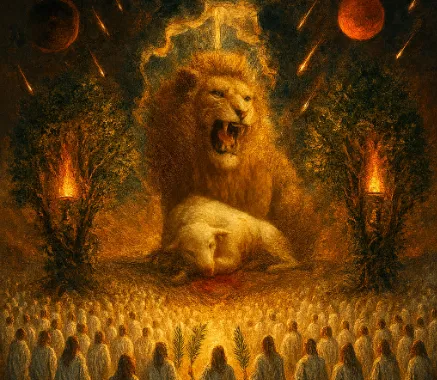
He heard a count, and then he looked and saw a crowd that defeats counting. Revelation has already taught its reader how to handle that sequence. In chapter 5 John hears that the Lion of the tribe of Judah has overcome, and when he turns to look he sees a Lamb standing as though slain (Revelation 5:5-6). The Lion and the Lamb are not two figures. What John hears names the identity, and what John sees shows the same one in full. Chapter 7 works the same way. The number and the multitude are one people, told first and then shown.
To see why that people is told as a number of "the sons of Israel," we have to go back to the place where the counting began.
Section IIA Song That Counts
Near the end of his life Moses taught Israel a song, and in it he said that God measured the whole world against one household.
The number is not hard to find. Count the names in the table of nations in Genesis 10 and there are seventy. Count the household of Jacob that went down to Egypt and the text gives the sum itself: "all the souls of the house of Jacob who came into Egypt were seventy" (Genesis 46:27; Exodus 1:5). There were seventy nations spread across the earth, and seventy souls in the family God kept as His own portion. The family is the measure, and the map was drawn to fit it.
There is a second Hebrew reading of the line. A Hebrew scroll of Deuteronomy recovered at Qumran reads "according to the number of the sons of Elohim," using the Hebrew word for God, where the received Hebrew text reads "the sons of Israel." The Greek translators took that phrase to mean angels and wrote "angels of God." Within the song itself, the phrase means the covenant family, and the song says so in its own words.
Section IIISons of Israel, Sons of Elohim
Nothing has to be brought in from outside the text to settle who the sons of Elohim are in Deuteronomy 32, because the song defines its own terms. It speaks of Israel as "His sons" when it charges them with their blemish (32:5). It asks them, "Is He not your Father, who acquired you?" (32:6). It calls Him "the Rock who begot you" (32:18). And when Yahweh, the covenant Name of God, looks on their unfaithfulness, the song names the offenders with a pairing we will meet again: "His sons and His daughters" (32:19).
The rest of Scripture speaks the same way. At the start of the Exodus, God sends Pharaoh the message: "Israel is My son, My firstborn" (Exodus 4:22). Moses tells the people directly, "You are sons of Yahweh your Elohim" (Deuteronomy 14:1). Hosea puts both phrases in a single sentence.
In that one verse the sons of Israel are the sons of the living God, and the people who have a number are also the people who cannot be numbered. Paul quotes this verse in Romans 9:26, and he applies it to those God has called "not from the Jews only, but also from the nations" (Romans 9:24). The sons of the living God are the covenant family, entered by His call.
So the two Hebrew readings of Deuteronomy 32:8 name the same people. Read "sons of Israel" and the nations are measured by the household of Jacob. Read "sons of Elohim" the way the song itself uses the words, and the nations are measured by the household of God. It is one household, and the two readings say one thing.
Section IVThe Household Has an Order
Genesis 46 begins its list with the words, "These are the names of the sons of Israel who came into Egypt" (46:8). It reads like a family record, and it is one. It is also the register of the household of God, and that household has an order. God is at its head. The twelve sons, who become the twelve tribes, stand under Him. The seventy stand under the twelve, each name entered beneath the son it belongs to.
The text takes care to say that the seventy are sons and daughters. Jacob brought "his sons and his sons' sons with him, his daughters and his sons' daughters" (46:7). The tally of Leah's line counts "his sons and his daughters" (46:15). Serah is entered by name among the children of Asher as "their sister" (46:17). This is how God made mankind at the beginning, "male and female He created them" (Genesis 1:27), and it is the same pairing Moses sings in Deuteronomy 32:19, "His sons and His daughters." The register of God's household was never a roll of men only.
Once the order is seen in Genesis 46, it appears again wherever God gathers His people.
| Place | The Twelve | The Seventy |
|---|---|---|
| Genesis 46 | The twelve sons of Israel | Seventy souls of the house of Jacob |
| Elim (Exodus 15:27) | Twelve springs of water | Seventy palm trees |
| Sinai (Exodus 24:4, 9) | Twelve pillars for the twelve tribes | Seventy elders who eat before God |
| The Gospels (Luke 9:1; 10:1) | Twelve apostles | Seventy sent out two by two |
When Jesus the Messiah chose twelve and then appointed seventy, He was not inventing a structure. He was restoring the household to the order in which it was first written down.
Section VCounted, Then Beyond Counting
Moses sets the two views of this people side by side in a single sentence.
He gives seventy souls and then the stars of heaven, a family small enough to list on one page and then a people only God can count. Both statements are true of the same people at the same time. The promise had been made to Abraham in those terms: "Look toward the heavens and count the stars, if you are able to count them. So shall your seed be" (Genesis 15:5). The count is how God marks who they are, and the multitude is what His promise makes of them.
John is shown the same people in the same two ways. First he hears the number of the sealed, told by tribe, one hundred forty-four thousand. Then he sees "a great multitude that no one could number" (Revelation 7:4, 9). The number is the covenant people told by its tribes, twelve by twelve and multiplied to fullness. The multitude is that people seen whole. John is looking at what Moses described, carried to its end.
The count marks whose they are. The multitude shows how many He has made them.
Deuteronomy 10:22 · Revelation 7:4, 9
Section VITwelve by Twelve, Multiplied to Fullness
The number itself carries its meaning in its parts. Twelve is the number of the tribes. Revelation tells us what the second twelve is when it shows the city that is the Bride: twelve gates bearing "the names of the twelve tribes of the sons of Israel," and twelve foundations bearing "the names of the twelve apostles of the Lamb" (Revelation 21:12, 14). The wall of that city measures one hundred forty-four cubits (21:17). Twelve times twelve is every tribe joined to every apostolic witness, the whole household under its full order.
The thousand is the language of muster and of fullness. Israel was organized by its thousands, and its leaders were "heads of the thousands of Israel" (Numbers 1:16). When Moses mustered the people for war he called "a thousand from every tribe," and the sum was "twelve thousand armed" (Numbers 31:4-5). Twelve thousand from a tribe in Revelation 7 is that same muster raised to completeness. Moses also used the thousand as the measure of God's increase: "May Yahweh, the God of your fathers, make you a thousand times as many as you are" (Deuteronomy 1:11).
The list of tribes confirms that John is hearing a register of covenant identity. Judah is read first, ahead of Reuben the firstborn, because the Lion of the tribe of Judah has overcome. Dan is absent. Joseph and Manasseh are both named, and Ephraim is not. Levi, who was left out of the wilderness census of fighting men, is counted here among the rest. No census of Israel in the Old Testament reads this way. It is the household of God reconstituted under its King, every tribe full and even, none larger than another, and no place left empty.
Twelve: the tribes of the sons of Israel, the gates of the city (Revelation 21:12).
Twelve again: the apostles of the Lamb, the foundations of the city (Revelation 21:14).
A thousand: the muster of the tribes and the measure of God's increase (Numbers 31:4-5; Deuteronomy 1:11).
144,000: the whole covenant people, told by its tribes and multiplied to fullness.
Section VIISealed Before the Trumpets
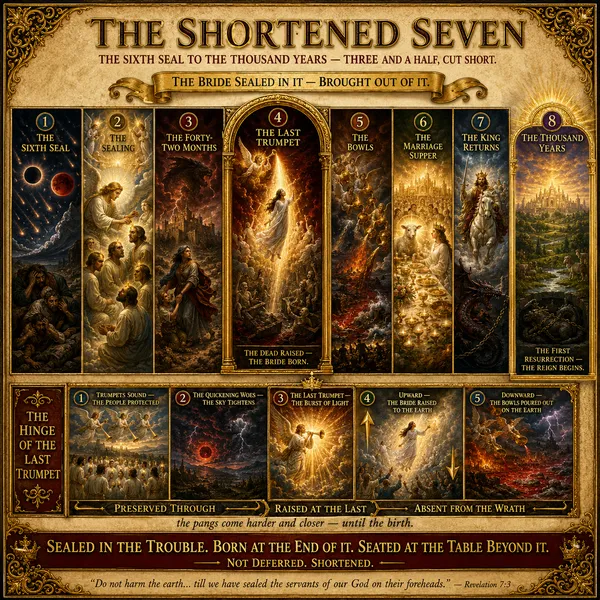
The placement of the sealing tells us what it is for. It stands between the sixth seal and the seventh, and the seventh seal opens into the trumpets. The command is, "Do not harm the earth or the sea or the trees until we have sealed the servants of our God on their foreheads" (Revelation 7:3). The household is sealed first, and then the trumpets sound. When the fifth trumpet releases its torment, the locusts are told to harm "only those who do not have the seal of God on their foreheads" (Revelation 9:4).
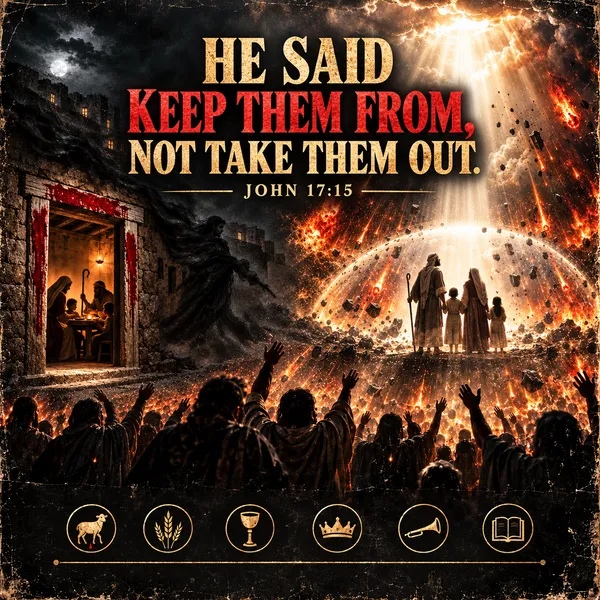
This is the pattern of the Exodus. Israel was not taken out of Egypt before the plagues fell. The blood was on the doorposts, and the household inside was kept while judgment passed through the land (Exodus 12:13). The seal marks the people God preserves through the trumpet judgments, and it marks all of them. Revelation 14:1 shows the 144,000 standing with the Lamb on Mount Zion with "His name and the name of His Father written on their foreheads." Revelation 22:4 says the same of every servant of God in the city: "His name shall be on their foreheads." There are not two marked peoples. There is one.
The 144,000, then, is not a special company of twelve thousand men from each of twelve bloodlines, set apart from the rest of the redeemed. It is the covenant family read out by name and rank, sons and daughters, natural branches and those grafted in from every nation, every one of them known to the God who counted seventy souls into Egypt and counts the stars.
Moses sang that God set the borders of the nations by the number of His sons. John heard that number read for the last time, and then he turned and saw what it had become. What begins in Genesis 46 as seventy names on one page ends as the whole sealed Bride.
Comments
No comments yet. Be the first.