Stones Instead of Verses Who Is Worthy, and Who Gets to Ask
A reply to a public charge of false teaching, and a fresh look at Revelation 5 from the text itself
Charles Vance · October 2026 · tenwordspress.com
·
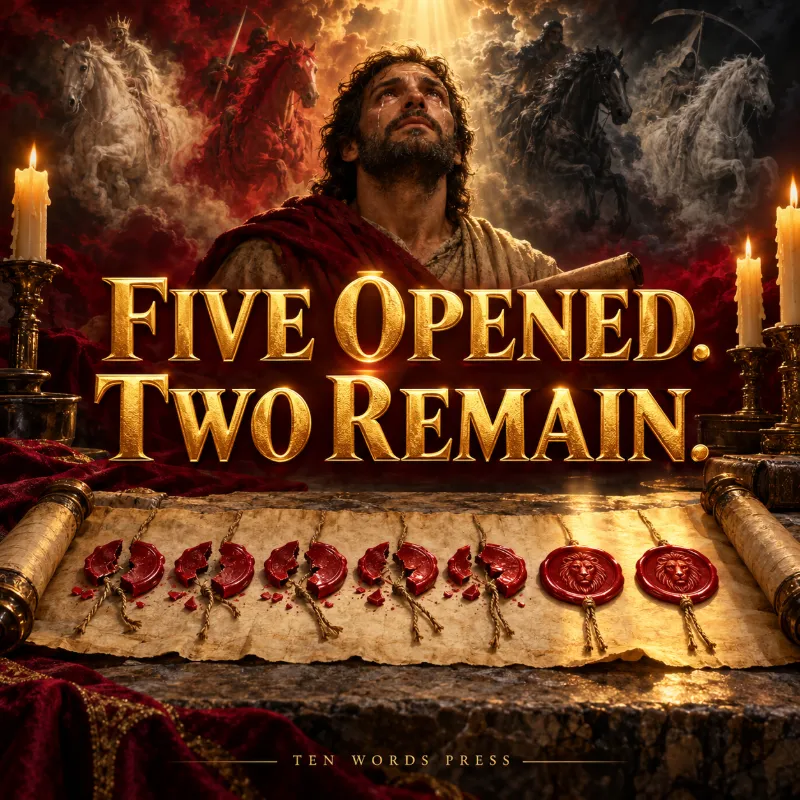
Seven seals, as John counted them (Revelation 5:1). The horsemen of the first four are riding through this age, and the souls under the altar of the fifth still cry out (Revelation 6:9–10). Two remain unbroken: the sixth, and the seventh that opens into the trumpets.
When a brother is shown a different reading of Scripture, he has two honest choices. He can open the Book and show where the reading bends it, or he can thank you and keep studying. Throwing stones is not on the list.
Section IWhat Was Said
A teacher who posts on Gab as @agiois ("Luther") published a short study on Revelation 5:1–2 under the title Who Is Worthy to Open the Scroll? In a single paragraph his post moves from the scroll in the right hand of the One on the throne, to the Lion of Judah who is the Lamb, and then on to a rapture of the Church, the regathering of Israel, the rise of ten kings, and a seven-year treaty with the man of lawlessness. You can read the post in full and in its original context here.
A reply was posted under his study with a link to our article, The Sixth Seal and the Sealed Bride, offered simply as food for thought. This was his answer, quoted in full so that no one can say his words were trimmed to make a point:
@agiois, in reply
"This article employs allegory to impose an interpretation upon Scripture that is grounded in theology and personal belief rather than in the explicit content of Scripture. It exemplifies the methods used by false teachers, whom the apostles repeatedly warn the Church about, to manipulate Scripture for personal interpretation. Such teachings should be thoroughly rejected, and engagement with those who propagate these views should be avoided."
Read it carefully. There is not one verse in it. There is no chapter he says we bent, no Greek word he says we mishandled, no sentence from the article that he quotes and corrects. There are three moves only: a label (allegory), a verdict (false teacher), and an instruction to everyone listening (do not engage). That is the whole of it.
Section IIHow Typical This Is
Anyone who has spent time in prophecy conversations has met this reply. It is so common that it almost has a liturgy. First, the other reading is named something ugly. Then the person holding it is placed among the deceivers of 2nd Peter 2. Then the door is shut, so that the question can never actually be examined. The shutting of the door is the part that matters most, because it means the label never has to be proven.
I do not write this to return the stone. Luther loves the Lord's appearing, and so do I. He says the Lamb alone is worthy, and so do I. He says the Church is not appointed to wrath, and on that we stand shoulder to shoulder. But Scripture does not let any of us settle a disagreement by name-calling, and it is worth seeing why.
The Ten Words are the vows the King spoke with His own Voice at Sinai, and the ninth of them reads plainly: "You shall not bear false witness against your neighbor" (Exodus 20:16). To call a brother a false teacher is a witness. It is a public testimony about his standing before God. Paul knew how heavy such a testimony is, which is why he wrote, "Do not receive an accusation against an elder except on the word of two or three witnesses" (1st Timothy 5:19). In a dispute over the meaning of Scripture, the witnesses are verses. A charge of false teaching that brings no verses brings no witnesses at all.
The apostles did warn the Church about false teachers, often. But look at what they told faithful shepherds to do about error:
"Holding fast the faithful word as it was taught, so that he is able both to encourage by sound teaching and to convict those who speak against it."Titus 1:9
The Greek word behind "convict" is elenchō. It means to bring something into the light and prove it, the way evidence convicts in a courtroom.1 Paul did not tell Titus to label error and walk away. He told him to answer it from the word, so that everyone watching could see. And to Timothy he added the manner: "The Lord's servant must not quarrel but be gentle to all, able to teach, patient when wronged, in gentleness correcting those who oppose" (2nd Timothy 2:24–25). Avoiding engagement is the one thing the shepherd is never told to do with a brother who is asking about the text.
And when the people of Berea heard a teaching they had never heard before, Luke did not praise them for refusing to listen. He praised them because "they received the word with all eagerness, examining the Scriptures daily to see whether these things were so" (Acts 17:11). The Bereans are the model. Examine first. Judge after.
Section IIIThe Charge of Allegory, Turned Around
So let us do what Luther did not, and examine. The charge is that our article imposes a reading on Scripture rather than drawing it out. That is a fair test, and it should be applied to both readings.
Here is everything Revelation 5 actually contains: a scroll written inside and on the back, sealed with seven seals; a strong angel asking who is worthy; John weeping because no one is found; an elder telling him the Lion of the tribe of Judah has prevailed; a Lamb standing as though slain, with seven horns and seven eyes; the Lamb taking the scroll; the elders and living creatures falling down with harps and bowls of incense; a new song; and every creature in heaven and on earth blessing Him who sits on the throne and the Lamb.
Here is what Luther's summary added: a rapture, a regathering of Israel, ten kings, and a seven-year treaty with the man of lawlessness. Not one of those four is in Revelation 5. They come from a prophecy chart that was assembled elsewhere and laid over the chapter. If imposing a framework on the text is the sin, his post committed it in the first paragraph.
Nor is reading signs a sin in itself. Revelation tells us how it was given: God "made it known by signs" to His servant John (Revelation 1:1). The verb is sēmainō, from sēmeion, a sign.2 Revelation is meant to be read in signs. Luther reads them too. He says the seven horns and seven eyes depict the Holy Spirit, and he is right, because Revelation 5:6 says the seven eyes are the seven Spirits of God sent out into all the earth. That is not allegory. That is the text interpreting its own sign. Paul himself, describing Hagar and Sarah, used the actual Greek word: "these things are spoken allegorically" (Galatians 4:24).3 The question was never whether Scripture uses figures. The question is whether the figure is explained by Scripture or by us.
A Small Detail in the Picture
His post carries an AI-rendered image of a man weeping beside a sealed scroll. Count the seals on that scroll. There are five. John counted seven: "a scroll written inside and on the back, sealed with seven seals" (Revelation 5:1). The number is not decoration. Seven runs through the whole chapter: seven seals, seven horns, seven eyes, seven Spirits of God. A teacher who charges others with departing from "the explicit content of Scripture" published a scroll that does not match the explicit content of the verse he was teaching.
I mention this gently. Images are easy to rush, and AI tools get details wrong all the time. But guarding the text means guarding it in the small things too. "The one who is faithful in very little is faithful also in much" (Luke 16:10). And there is a quiet irony in it. If the picture is meant to show the scroll as it stands today, it is wrong in the other direction. The horsemen of the first four seals have been riding through this whole age, and the souls under the altar of the fifth seal are still crying, "How long, O Lord, holy and true?" (Revelation 6:9–10). Five seals already lie broken. What remains unbroken on the scroll is two: the sixth, and the seventh that opens into the trumpets.
Section IVWho Is Worthy? Let John Show Us How to Read
Revelation 5 itself gives us the key to the very passage Luther objected to. Watch what happens to John. He is told to look for a Lion:
"Do not weep. Behold, the Lion of the tribe of Judah, the Root of David, has prevailed to open the scroll and its seven seals."Revelation 5:5
And when John turns, what does he see? "A Lamb standing, as though it had been slain" (5:6). John heard one thing and saw another, and both are true of the same Person. The Lion is what the Lamb is. The Lamb is how the Lion conquered.
Now carry that pattern two chapters forward, which is where our article lives. In Revelation 7, John hears a number: "I heard the number of those who were sealed, a hundred and forty-four thousand, sealed from every tribe of the sons of Israel" (7:4). And when he looks, what does he see? "A great multitude that no one could number, from every nation and tribe and people and tongue" (7:9). Same pattern. Heard, then seen. Counted by tribe to show covenant identity, then seen beyond counting to show covenant fullness. One sealed Bride, seen from two sides.
That is not a theory we brought to the text. It is the reading pattern John gave us in the chapter Luther himself chose to teach. And the new song in chapter 5 tells us exactly who that multitude is:
"You are worthy to take the scroll and to open its seals, for You were slain, and by Your blood You purchased for God people from every tribe and tongue and people and nation, and You made them a kingdom and priests to our God, and they will reign on the earth."Revelation 5:9–10
Why is the Lamb worthy? Because He was slain, and His blood bought a people out of every tribe and made them priests. The worthiness of the Lamb and the gathering of His Bride from every nation are one song. Our article on the sixth seal and the sealed Bride is simply that song carried forward into chapter 7, where the same people are sealed on their foreheads before the trumpets sound.
Section VThe Seven-Year Treaty Is Not in the Book
Luther's post says the opening of the scroll begins with a seven-year treaty with the man of lawlessness. That teaching rests on Daniel 9:27, so let us read it:
"And he will make a covenant strong with many for one week, and in the middle of the week sacrifice and drink offering will be taken away."Daniel 9:274
Daniel says nothing about a treaty, nothing about an antichrist signing anything, and nothing about a gap of two thousand years between the sixty-ninth week and the seventieth. What he describes is a covenant confirmed with many. Now listen to Jesus at the Table on the night He was betrayed:
"For this is My blood of the covenant, which is poured out for many for the forgiveness of sins."Matthew 26:285
A covenant. With many. And in the middle of the week, sacrifice and offering brought to their end, when the Lamb of God was offered once for all and the veil was torn from top to bottom. Daniel 9:24 had already told us what the seventy weeks would accomplish: to finish the transgression, to make an end of sins, to make atonement for iniquity, to bring in everlasting righteousness, to seal up vision and prophecy, and to anoint the Most Holy. Every one of those is the work of Messiah, not the work of a man of lawlessness. Paul's description of the man of lawlessness in 2nd Thessalonians 2 says he exalts himself and sits in the temple of God, but it never says he signs a covenant with anyone. The treaty is not in Daniel, not in Paul, and not in Revelation 5.
Section VISealed Through, Not Removed Before
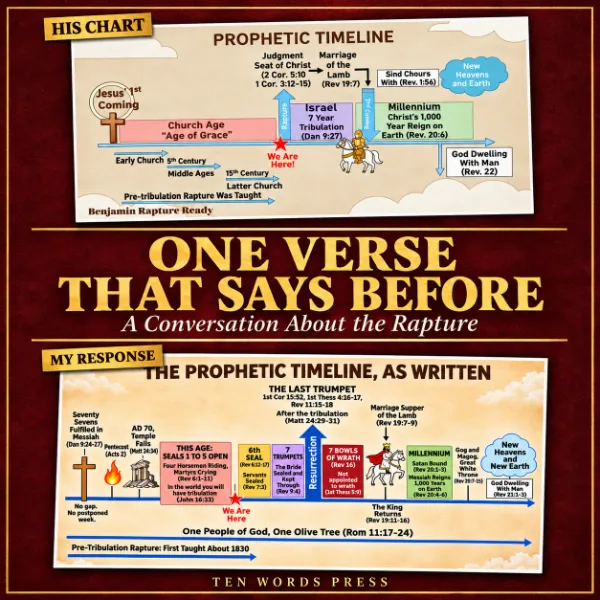
The post also places a rapture of the Church before the seals are opened. But the gathering of the saints has a sound attached to it, and Paul tells us which sound it is:
"In a moment, in the blink of an eye, at the last trumpet. For the trumpet will sound, and the dead will be raised incorruptible, and we will be changed."1st Corinthians 15:52
The last trumpet. In 1st Thessalonians 4:16 it is called the trumpet of God. And Revelation gives us a numbered series of trumpets, seven of them, ending when the seventh angel sounds and loud voices declare that "the kingdom of the world has become the kingdom of our Lord and of His Christ" and that the time has come for the dead to be judged and for His servants to be rewarded (Revelation 11:15, 18). A trumpet that sounds before the first of those seven cannot be the last one.
What does God do with His people before the trumpets fall? Revelation 7 answers: "Do not harm the earth or the sea or the trees until we have sealed the servants of our God on their foreheads" (7:3). He seals them. And when the fifth trumpet sounds, the locusts are told to harm "only those people who do not have the seal of God on their foreheads" (9:4). The sealed are still there, and they are kept.
This is the oldest pattern in the Book. God did not lift Israel out of Egypt before the plagues. He set apart the land of Goshen where His people lived, so that the swarms would not come there (Exodus 8:22), and He marked their doors with the blood of the lamb. Israel was preserved through the judgments and then led out. Jesus prayed for His disciples in the same way: "I do not ask that You take them out of the world, but that You keep them from the evil one" (John 17:15).
Section VIIWhere We Agree: Not Appointed to Wrath
Luther closes his study with a promise every believer should hold tightly: the Church is not appointed to wrath (1st Thessalonians 5:9). Amen. We do not argue with that verse. We only ask that it be allowed to mean what Revelation means by wrath.
Revelation tells us exactly where the wrath of God is poured out: "seven angels with seven plagues, which are the last, for in them the wrath of God is brought to completion" (Revelation 15:1). Those are the bowls, and they come after the seventh trumpet, after the gathering. The Bride is sealed for the trumpets, raised at the last trumpet, and is not present for the bowls. Not appointed to wrath, exactly as Paul said.
But wrath and tribulation are not the same word. Jesus promised His own, "In the world you will have tribulation; but take heart, I have overcome the world" (John 16:33). And the great multitude of Revelation 7 is described this way: "These are the ones coming out of the great tribulation, and they have washed their robes and made them white in the blood of the Lamb" (Revelation 7:14). Out of it, not out from before it.
Luther calls this the happy hope, and so it is. Paul names it in Titus 2:13: "the blessed hope and appearing of the glory of our great God and Savior Jesus Christ." The word is epiphaneia, a shining forth, a visible appearing.6 Our hope is not a secret departure. It is the King appearing in glory at the last trumpet, with every eye seeing Him.
Section VIIIThe Door Stays Open
I would rather be shown wrong from the Book than be left alone in a mistake. That is the whole reason Ten Words Press publishes its reasoning in the open, with chapter and verse. So the invitation to Luther, and to anyone who shares his concern, is simple: name the verse we bent. Quote the sentence from the article. Show where Scripture says something other than what we said it says. We will answer it here, in public, with the same care.
"Test all things; hold fast to what is good."
1st Thessalonians 5:21
Paul did not say, test the things your chart already agrees with. He said test all things. A label is not a test, and a closed door is not a verdict. The Lamb who was slain is worthy to open the scroll, and He is patient enough to let His people open the Book together and reason from it. We can surely extend each other the same patience.
Fair Use Statement
Excerpts from public posts by the Gab user @agiois are quoted in this article for the purposes of commentary, criticism, and teaching, consistent with the fair use provisions of the United States Copyright Act, 17 U.S.C. § 107. Only the text necessary for response is quoted; no images from the original post are reproduced. The original post is linked so that readers may read it in full and in its own context: gab.com/agiois/posts/117496160568437073. All quoted material remains the property of its author. Ten Words Press claims no ownership of it and offers it here only to engage the argument.
Notes
Elenchō is the same verb Jesus uses in John 16:8, where the Holy Spirit convicts the world concerning sin, righteousness, and judgment. It describes exposure by evidence, not dismissal by label. ↩
Revelation 1:1, esēmanen. Older English Bibles render it "signified," which preserves the sense: shown by signs. ↩
Galatians 4:24, hatina estin allēgoroumena. This is the only appearance of the word in the New Testament, and it is Paul who uses it. ↩
Daniel 9:27 is rendered here from the Greek of Daniel, which reads thusia kai spondē, "sacrifice and drink offering," where the Hebrew reads "sacrifice and grain offering." The Greek is followed. Both name the offerings of the altar, and both say they are brought to an end in the middle of the week. ↩
Matthew 26:28 reads to haima mou tēs diathēkēs, "My blood of the covenant," in the earliest Greek manuscripts. Some later copies add "new" before "covenant," drawing on Luke 22:20. Either way, it is the covenant poured out "for many," peri pollōn, the very phrase Daniel 9:27 anticipates. ↩
Titus 2:13, epiphaneia. Paul uses the same word in 2nd Thessalonians 2:8 for the appearing of the Lord's coming that brings the man of lawlessness to nothing. ↩
Comments
No comments yet. Be the first.