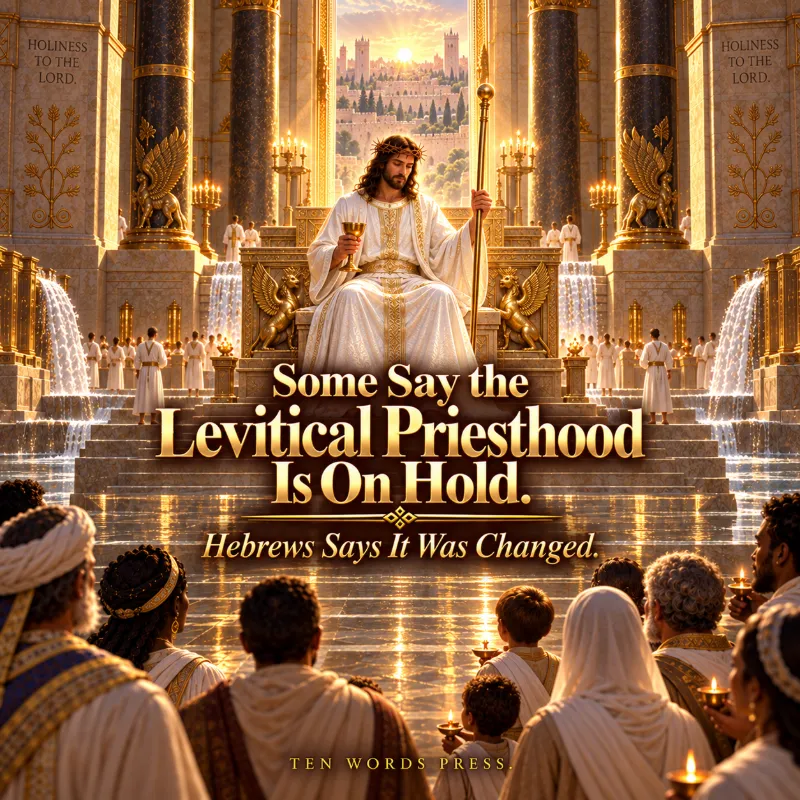
Some Say the Levitical Priesthood Is On Hold
Hebrews Says It Was Changed
A pastoral study on Jesus, Melchizedek, and the people who will reign with Him for a thousand years
·
Section IWhat We Hold in Common
Before coming to the one place where this teaching goes wrong, it is worth saying clearly how much of it is right, because most of it is.
Jesus is coming back. He is coming in glory, as Israel's Messiah and as King over the whole earth, and He will reign from Zion. The thousand years of Revelation 20 are real years, not a figure for the church age. The Old Testament prophets were not writing poetry to be admired from a distance; they were describing a future that will arrive. And when it is over, the devil, the beast, the false prophet, and every person who refused the mercy of God, religious or not, will be thrown into the lake of fire (Revelation 19:20; 20:10, 15; 21:8).
Every line of that is held here. This is not a disagreement about whether Jesus reigns. It is a disagreement about one sentence: that Aaron's priesthood is "merely on hold."
We do not need a commentary or a chart to test that sentence. There is a book in the New Testament written to answer exactly this question, and it is called Hebrews. Let us read it together.
Section IIA Word About the Name
In the Hebrew Scriptures the personal Name of God is written with four letters, YHWH, usually pronounced Yahweh. Most English Bibles print it as "the LORD" in small capitals. In this study the Name will be written Yahweh whenever the Name itself is what a verse is pointing at, because several of the passages below turn on it. It is not exotic. It is simply His Name.
Section IIIWhat Hebrews Says Happened to Levi
Hebrews 7 is one long, patient argument comparing two priesthoods. One is the priesthood of Aaron, from the tribe of Levi, with its robes, its altar, and its Day of Atonement. The other is the priesthood of Melchizedek, the king and priest who meets Abraham in Genesis 14 with bread and wine, blesses him, and receives his tithe. Then he disappears from the record until David hears something remarkable in Psalm 110. Yahweh swears an oath to David's Lord: "You are a priest forever after the order of Melchizedek."
The writer of Hebrews sets the two priesthoods side by side and asks a question worth hearing slowly. If Levi's priesthood could have brought people home to God, why would God promise a different priest from a different order?
Notice the verbs, because the whole question lives in them. The priesthood was changed. A few verses later the commandment that established it is annulled "for the weakness and unprofitableness thereof" (7:18). In the next chapter the old covenant is called obsolete, "old," and "ready to vanish away" (8:13). In chapter 10 the writer states it plainly: "He taketh away the first, that he may establish the second" (10:9).
Changed. Annulled. Obsolete. Vanishing. Taken away. The word "paused" does not appear. When something is taken away so that something else may be put in its place, it has not been set aside to wait. It has been replaced.
The reason it was replaced is the part that should move us. Levi's priesthood did not end because Rome burned the temple or because Israel lost the land. The reason was built into what the priesthood was. Hebrews says Aaron's sons "were many priests, because they were not suffered to continue by reason of death" (7:23). Every one of them died, and the next one put on the robe. Jesus, "because he continueth ever, hath an unchangeable priesthood" (7:24). He holds His office "not after the law of a carnal commandment, but after the power of an endless life" (7:16).
So the question for this teaching is this. Levi's priesthood existed because priests die and must be replaced. How is a priesthood built on death to be reinstated during the reign of the One who defeated death?
Section IVWhat Hebrews Says Happened to the Sacrifices
A Levitical priest with nothing to offer is not a priest. So the next thing to settle is whether the sacrifices are coming back.
"No more offering for sin" is a sentence with a door closed at the end of it. The writer has just spent two chapters explaining that the old sacrifices were repeated every day and every year precisely because they could never finish the work (10:1-4). Then he says the one sacrifice of Jesus finished it. Once a thing is finished, we do not return and perform the unfinished version again. That would not honor the Cross. It would say, quietly, that the Cross was not enough.
Daniel saw this ending centuries ahead. In the middle of the final seven of his seventy sevens, the Messiah would "cause the sacrifice and the oblation to cease" (Daniel 9:27). That happened on the afternoon Jesus died, and heaven marked it so that no one could miss it. The veil of the temple was torn "from the top to the bottom" (Matthew 27:51). From the top. No man did that. God did it, from His side of the curtain. The Levitical system did not die when the Roman legions arrived forty years later. Rome burned a building whose office heaven had already closed.
Section VWho Will Be the Priests During the Thousand Years
Revelation 20 is where the thousand years are found, and it is also where we learn who the priests will be during those years. It does not say the sons of Aaron.
Consider who "they" is. It is everyone who has part in the first resurrection, every believer raised at the last trumpet. Not one tribe. Not one family. John had already heard it twice: Jesus "hath made us kings and priests unto God and his Father" (1:6), and the song before the throne says He "hast made us unto our God kings and priests: and we shall reign on the earth" (5:10). That is the millennial priesthood, named in the very chapter that gives us the millennium.
The prophets saw the same thing. Isaiah, describing the gathering of the nations at the end of the age, hears Yahweh say, "And I will also take of them for priests and for Levites" (Isaiah 66:21). The "them" is the nations. Gentiles, made priests, by the word of Yahweh Himself. Zechariah's picture of the kingdom age is not a priestly order behind a curtain. It is "HOLINESS UNTO THE LORD" engraved on the bells of the horses, and every cooking pot in Jerusalem as holy as the bowls before the altar (Zechariah 14:20-21). The whole land becomes what only the tabernacle used to be. The holy and the ordinary are no longer two separate rooms.
Zechariah also tells us who sits in the temple of the age to come. "Behold the man whose name is The BRANCH ... he shall build the temple of the LORD; and he shall bear the glory, and shall sit and rule upon his throne; and he shall be a priest upon his throne" (Zechariah 6:12-13). One throne. One priest. And Hebrews reminds us which tribe He came from: "it is evident that our Lord sprang out of Juda; of which tribe Moses spake nothing concerning priesthood" (Hebrews 7:14). The Priest of the millennium is from Judah, after the order of Melchizedek, not from Levi.
Section VI"Behold, I Make All Things New"
The "on hold" view is often defended with the Lord's promise to make all things new. That promise says the opposite.
"Behold, I make all things new" (Revelation 21:5) is spoken after the thousand years, after the lake of fire, in a city where John "saw no temple therein: for the Lord God Almighty and the Lamb are the temple of it" (21:22). The whole direction of Scripture is shadow giving way to substance. "The law having a shadow of good things to come, and not the very image of the things" (Hebrews 10:1). Once the Lamb has come, we do not rebuild the shadow and call it the Kingdom.
Paul calls the law given after the golden calf a schoolmaster, a tutor, "added because of transgressions, till the seed should come" (Galatians 3:19, 24-25). Aaron's priesthood was part of that tutoring. It was faithful, it was needed, and it was temporary from the first day it existed. It was never the original design, and it was never where the story was headed.
Section VIIMelchizedek Was the Design All Along
This is the part most worth carrying away, because the "on hold" view treats Melchizedek as a strange exception and Aaron as the normal priesthood. Scripture has it the other way around.
In Eden, God placed Adam in the garden "to dress it and to keep it" (Genesis 2:15). Those are the same two Hebrew verbs used later for the priests who serve and guard the tabernacle. Adam and Eve together stood as royal priests in the direct presence of God, with no veil, no mediator, and no sacrifice, because nothing had yet gone wrong. That is a Melchizedek kind of priesthood: royal, direct, and open. The Fall forfeited it.
At Sinai, Yahweh offered it back to the whole nation. "Ye shall be unto me a kingdom of priests, and an holy nation" (Exodus 19:6). All of them, men and women alike, heard the Ten Words spoken by the Voice from the mountain. Then came the golden calf, and the offer was forfeited a second time. Aaron's priesthood, one tribe, male, mortal, standing between the people and God behind a curtain, was the substitute put in place after the breach. It was a mercy. It was also a step down from what God had just offered.
Then came Jesus, "a priest for ever after the order of Melchisedec" (Hebrews 7:17). His resurrection did not pause Aaron's order. It reached back past Aaron and restored the original one, and this time He gave it to everyone who is in Him. Peter writes to ordinary believers scattered across Asia Minor and calls them exactly what Sinai offered: "a royal priesthood, an holy nation" (1 Peter 2:9). That is the priesthood that will reign with Christ for a thousand years, and it belongs to every believer. Levi served faithfully in the gap and was honorably retired when the Seed came.
Section VIIITwo Men Who Stood Outside Aaron's Order
If the Melchizedek priesthood really was the design all along, we should expect to find it showing through the Old Testament even while Aaron's order stood. We do. Two men in particular stood in the presence of God outside the house of Aaron, and Scripture treats neither of them as a scandal. It treats them as a preview.
Moses, King in Jeshurun
In his last blessing over the tribes, Moses is described this way: "he was king in Jeshurun, when the heads of the people and the tribes of Israel were gathered together" (Deuteronomy 33:5). Jeshurun is a tender name for Israel, the upright one. Moses was Israel's king before Israel had a throne. And he was also its priest before Israel had a priesthood.
Consider the order of events at Sinai. In Exodus 24 Moses builds the altar, offers the sacrifices, reads the Book of the Covenant to the people, and sprinkles the blood of the covenant on them (24:4-8). Then he goes up the mountain into the glory and stays forty days. Aaron's priesthood does not yet exist. It is instituted later, after the golden calf, and it is Moses who consecrates Aaron and his sons, washes them, clothes them, and anoints them (Leviticus 8). The lesser is blessed by the greater. The entire Aaronic order was installed by a man standing in a priesthood older than itself, a man who spoke with God "face to face, as a man speaketh unto his friend" (Exodus 33:11). Moses was of the tribe of Levi, but he was never of the house of Aaron, and the psalmist still names him among the priests: "Moses and Aaron among his priests" (Psalm 99:6). King and priest in one man, before the tutor was ever appointed.
David and the Tent on Zion
Centuries later David did something that should have gotten him struck down, if Aaron's order were the only priesthood God recognized. He brought the ark to Jerusalem wearing a linen ephod, the priest's garment. He offered burnt offerings and peace offerings. He blessed the people in the Name of Yahweh of hosts. He handed out bread to every man and woman in Israel (2 Samuel 6:14-19). Bread and blessing in the Name, from a king of Judah. That is Melchizedek meeting Abraham, repeated on Zion.
Then he pitched a tent for the ark on Mount Zion, with no veil, where the Levites sang before the Presence day and night, while the tabernacle of Moses with its altar and its Aaronic priests continued at Gibeon (1 Chronicles 16:1-6, 37-40). For a generation Israel had two sanctuaries. One was the shadow going about its appointed business. The other was an open tent on the mountain of Salem, Melchizedek's own city (Psalm 76:2), where a king of Judah ministered before the ark. It was in that setting that David wrote Psalm 110 and heard Yahweh swear a priesthood to his Lord "after the order of Melchizedek."
David's tent was a granted mercy, not a license. When King Uzziah later walked into Aaron's temple to burn incense at Aaron's altar, he was struck with leprosy at the door (2 Chronicles 26:16-21). David never entered the Levitical house. He ministered at the ark on Zion under a mercy God extended to him, and that mercy was a picture. Amos saw the picture and gave it a name: "In that day will I raise up the tabernacle of David that is fallen" (Amos 9:11). And when the apostles gathered in Jerusalem to decide whether Gentiles could be welcomed without first becoming Jews, James stood and quoted that very verse as the answer (Acts 15:16-17). The thing God promised to raise up was not Aaron's temple. It was David's open tent, with the nations streaming in.
So the Old Testament is not silent about Melchizedek between Genesis 14 and Psalm 110. It shows the office held in trust by a king in Jeshurun and a king on Zion, two men of the scepter and not of the altar, each standing in the Presence without a veil, each pointing to the Son of David who would hold the office forever.
Changed, not paused: Hebrews 7:12, 7:18, 8:13, 10:9.
Finished, not suspended: Hebrews 10:14, 18; Daniel 9:27; Matthew 27:51.
The millennial priests are named: Revelation 20:6, 1:6, 5:10; Isaiah 66:21; Zechariah 14:20-21.
The millennial Priest is from Judah: Zechariah 6:12-13; Psalm 110:4; Hebrews 7:14.
Melchizedek was the design all along: Genesis 2:15; Exodus 19:6; Hebrews 7:17; 1 Peter 2:9.
Moses, king and priest before Aaron: Deuteronomy 33:5; Exodus 24:4-8; Leviticus 8; Psalm 99:6.
David's tent on Zion: 2 Samuel 6:14-19; 1 Chronicles 16:37-40; Psalm 76:2; Amos 9:11; Acts 15:16-17.
Section IXA Closing Word
If you have taught the "on hold" view, or sat under it for years, nothing here is meant to embarrass you. Those who hold it are trying to honor the prophets, and that instinct is right. The prophets must be kept. The only question is whether we keep them by rebuilding Aaron's altar or by seeing what Aaron's altar was always pointing at.
Hebrews was written to Jewish believers who were tempted, under real pressure, to drift back toward the temple and its priests. The writer did not tell them the temple was on pause. He told them something better had already come, and he invited them in. "Having therefore, brethren, boldness to enter into the holiest by the blood of Jesus, by a new and living way, which he hath consecrated for us, through the veil, that is to say, his flesh ... let us draw near" (Hebrews 10:19-22).
That invitation is not on hold. Neither is the priesthood it gave you.
Levi is not on hold. He is home. And so are you.
Ten Words Press
Comments
No comments yet. Be the first.