Once Saved, Always Saved?
A Covenant Reply to a Good Question
A commentary on a teaching that calls eternal security a worthless lie of our fathers. The teacher is right about his target and wrong about the ground he is standing on.
·
Fair UseOn the Quotations in This Article
This article quotes short passages from the video “Once Saved, Always Saved” published by the Finding the Ancient Path YouTube channel, for the purposes of commentary, criticism, and teaching. The quotations are limited to what is needed to identify and respond to the teacher’s claims, and the full teaching is available at the link in Section I below. This use is made in good faith under the fair use provisions of 17 U.S.C. § 107. All rights in the original video remain with its creator, and readers are encouraged to watch it in full and weigh both sides.
Section IWhat the Teacher Is Doing
The teaching under review is “Once Saved, Always Saved” from the Finding the Ancient Path channel on YouTube. Watch it first; this commentary assumes you have.
The teacher opens with the lifetime perk: free Burger King for life, Kramer’s lifetime coffee, the locked-in rate that holds no matter what. He says the church has turned salvation into that kind of deal. His target is narrow and he names it. Not the believer who holds that the saved will persevere, but the one who says a prayer once, abandons faith and obedience, and expects the reservation to hold. He answers with a chain of conditions, Hebrews 3, John 15, Colossians 1, and ten more “if” verses, then swings Matthew 7 as the hammer and closes with 2nd Corinthians 13:5, examine yourselves.
He is right about his target. The believer with a no-cancellation policy does not exist in Scripture. He is wrong about the ground. His closing line, that eternal security “is really only for those people who are faithfully enduring until the very last day of their life,” makes security the wage of endurance and turns the Covenant into a performance contract. Scripture says something different about who keeps whom. This commentary follows the Covenant through his lesson point by point, with the verses rendered from the Greek and Hebrew so that nothing rests on a translation habit.
Section IIOn His Opening: The Deal Is Not Too Good to Be True
The teacher’s hook is “a deal too good to be true isn’t true.” He aims it at the lifetime perk, but it cuts closer to the gospel than he intends, because the gospel is the one deal that really is that good. The names are in the book before anyone earns a place in it. After the golden calf Moses does not ask Yahweh to write the people in. He asks, “If not, blot me out of Your book which You have written” (Exodus 32:32). The book is written, the people are already in it, and Yahweh names who comes out.
The default is written. The blotting is earned. John puts the book under “the Lamb slain from the foundation of the world” (Revelation 13:8). The Lamb’s blood is older than any man’s sin, and every child is born under it. “Behold, the Lamb of God, who takes away the sin of the world” (John 1:29). “He is the propitiation for our sins, and not for ours only but also for the whole world” (1st John 2:2). “The living God, who is the Savior of all men, especially of those who believe” (1st Timothy 4:10). Not only of those who believe. Especially. The children of the generation that refused the land walked in under the same promise, “who today have no knowledge of good or evil, they shall go in” (Deuteronomy 1:39). David said of his dead infant, “I shall go to him” (2nd Samuel 12:23), and Jesus said “of such is the kingdom of heaven” (Matthew 19:14).
So the teacher’s listener should hear this before anything else. You did not get written in by praying a prayer. You were written in by The Lamb. The whole question is what takes a name out.
Section IIIOn Hebrews 3: He Reads It Right, and Should Press It Harder
The teacher’s best work is here. He notices the warning is addressed to brethren, that the danger is “an evil heart of unbelief in departing from the living God,” and that partaking of Christ is conditioned on holding firm. He is right on all three, and he is right that the “they” are the redeemed people of the exodus.
He should add the two witnesses that read the same history the same way. Paul says that generation was baptized into Moses, ate the same spiritual food, drank from the rock, “and the rock was Christ. But with most of them God was not pleased, for they were laid low in the wilderness” (1st Corinthians 10:1-5). Jude says it in one line, and in the oldest Greek copies he says it with the Savior’s own name: “Jesus, having saved a people out of the land of Egypt, afterward destroyed those who did not believe” (Jude 5).1 These were redeemed people, and their redemption was real.
But look at what they did, because it is not what the teacher’s framing suggests. They did not fail to keep their salvation. They walked out of it: “Let us appoint a captain and go back to Egypt” (Numbers 14:4). They asked to leave the marriage. That is the covenant shape of every warning he lists.
Section IVOn “Keeping”: The Keeping Is His
This is where the lesson needs correcting rather than supplementing. The teacher says the believer must endure, continue, abide, and hold fast, and so he must. But he frames it as the believer keeping his salvation, and Scripture frames it as God keeping the believer. Jude uses the verb both ways in one short letter, “keep yourselves in the love of God” (verse 21) and “to Him who is able to keep you from stumbling” (verse 24), and Peter says which carries the weight: “kept by the power of God through faith” (1st Peter 1:5). Jesus says it in His prayer: “I kept them in Your name; those You gave Me I have guarded, and not one of them is lost except the son of destruction” (John 17:12).
It is not even our faith that saves. Paul writes the faith of Christ four times (Galatians 2:16, 20; Romans 3:22; Philippians 3:9), and Habakkuk in the Greek Scriptures Paul read says “the righteous shall live by My faithfulness” (Habakkuk 2:4).2 Salvation begins with a death, and the life after it is His.
The seal is His, “sealed with the promised Holy Spirit, the pledge of our inheritance” (Ephesians 1:13-14),3 and the perfecting is His finished work applied without end: “by one offering He has perfected forever those who are being sanctified” (Hebrews 10:14). Perfected, past tense and finished. Being sanctified, present tense and ongoing. That one verse is the paradox the teacher’s lesson cannot hold, and it is why John can write “that you may know that you have eternal life” (1st John 5:13). It is one hundred percent His keeping. Our part is not to leave.
Section VOn John 15: The Right Picture and the Wrong Verb
The teacher reads abide as remaining, continuing, staying, and that is correct. The word is menō. But he hears it as something the branch does to stay saved. Jesus describes a branch that does nothing but rest.
A branch produces nothing. It carries what the vine sends up. The power not to sin is the Holy Spirit’s operation in the branch, “for it is God who works in you both to will and to work” (Philippians 2:13). Branches go dry. We quench the Spirit (1st Thessalonians 5:19) and grieve the Spirit (Ephesians 4:30), and we feel the sap slow. The Spirit is not thrown out and neither are we. We confess, “He is faithful and just to forgive us our sins and to cleanse us from all unrighteousness” (1st John 1:9), and the branch is brought back to full sap by the offering that never stopped working.
The teacher distinguishes “simply committing a sin” from departing, and that is right. Paul draws the same line in two sentences, and the teacher quoted only the first.
Faithlessness, the weakness of a believer, meets the faithfulness of God. Denial meets denial. Confession is a dead man staying dead and leaning back into the Vine. The man in danger is the one who climbs down off the cross he was crucified on and takes his life back.
Section VIOn Romans 11 and John 15 Together: Two Pictures, Not One
The teacher lists “Romans 11, if you continue in His goodness” and “John 15, if anyone does not abide” as one argument. They are two. Romans 11 is the Olive Tree, the cultivated tree of Israel into which believers from the nations are grafted, and the warning there is about standing among the people of God: “they were broken off because of unbelief, and you stand by faith, if you continue in His kindness; otherwise you also will be cut off” (Romans 11:20-22). John 15 is the Vine, Christ Himself, and the warning is about living in Him. Standing in the one and living in the other depend on the same thing, not leaving, but they are different realities, and the lesson is stronger when it says so.
Section VIIOn Romans 8: The Verse He Never Answers
The teacher says everyone leans on Romans 8:38-39 and then moves past it. The answer is in the list. Death, life, angels, rulers, powers, present, future, height, depth, “any other created thing.” Every item is a force outside the believer. Paul is telling a church facing the sword that no persecutor and no power can pry them out of the love of Christ, and that is true without qualification. The list does not include the believer. A covenant cannot be broken from the outside; only one of the two who made it can break it. Jesus says the same of His sheep: “no one will snatch them out of My hand” (John 10:28), spoken of sheep that hear and follow (10:27). No one snatches. The verse was never about a sheep that walks away.
Section VIIIOn Matthew 7: His Hammer, Swung at the Wrong Nail
The teacher says the people turned away in Matthew 7 “could have very well been originally saved.” Jesus does not say “I knew you once.”
These were sure they belonged and never did.4 Matthew 7 is about false assurance, and the lesson needs it for that reason: calling Jesus “Lord,” working in His name, and feeling secure are not the same as being known by Him. But it is not a picture of a saved man lost. The text for that is the one the teacher only listed, Hebrews 10.
Section IXOn the One Sin: What Actually Takes a Name Out
The teacher’s lesson leaves the listener with the impression that steady disobedience slowly uses up grace. Scripture is more precise, more frightening in one place and more merciful everywhere else. John’s own letter holds both sides. 1st John 1:9 for every sin, confess and be cleansed, and then this.
Jesus defines the sin and Mark gives the reason: “whoever blasphemes against the Holy Spirit never has forgiveness, but is guilty of an eternal sin,” and then, “because they said, ‘He has an unclean spirit’” (Mark 3:29-30). The scribes watched the Spirit of God cast out demons and called it Beelzebul. Hebrews describes the apostate with the same words.
This is the man the teacher is looking for.5 He was sanctified by the Blood of the Covenant; the text says so. He was not a pretender. And his sin is not a long slide. It is naming the work of the Spirit the work of the evil one. It cannot be forgiven because forgiveness comes through repentance, and repentance is the Spirit’s work: “the Spirit will convict the world of sin” (John 16:8). The man who calls that conviction demonic has refused the only hand that could bring him back. Heaven did not lock the door. He named the door a trap. So he stays unrepentant, and the unrepentant heart is the “evil heart of unbelief” of Hebrews 3:12, the “hard and impenitent heart” of Romans 2:5, and the name blotted from the book. Everything short of that is a branch gone dry, and the remedy for a dry branch is confession.
Stumbling is faithlessness, and it is met by His faithfulness and healed by confession. Leaving is denial, the repudiation of the Covenant, and its final form is calling the Spirit’s work the devil’s. The first is every believer on a bad week. The second is Hebrews 10.
Section XOn “Wicked” Saul, Whom the Teacher Would Have Condemned
The lesson’s logic, applied to King Saul, puts him in hell. Scripture does not. Saul broke the command at Gilgal, spared Agag, slaughtered the priests at Nob, hunted David, and consulted a medium; the Chronicler says he died for his unfaithfulness (1st Chronicles 10:13). Yet Samuel, called up at Endor, told him, “Tomorrow you and your sons will be with me” (1st Samuel 28:19),6 and David sang over him as “the anointed of Yahweh, beloved and pleasant” (2nd Samuel 1:21-23).
Saul lost the dynasty at Gilgal and the kingship at Amalek. What departed in 1st Samuel 16:14 was the Spirit’s empowerment of the office, not the soul of the man. He never bowed to another god. He purged the mediums in obedience to the Covenant. On his last night he inquired of Yahweh first and went to Endor only after heaven refused him. Saul was a faithless king, never an apostate; 2nd Timothy 2:13 in a crown. The wilderness generation turned its face to Egypt. Saul died facing Yahweh and lost everything but Yahweh. The loss of an office or an anointing is judgment on the office-holder, not the forfeit of covenant standing, and the teacher’s lesson needs that distinction or it will frighten the wrong people. Paul feared the same loss for himself: “lest, having preached to others, I myself should be disqualified” (1st Corinthians 9:27).
Section XIOn His Closing: Examine Yourselves, and the Will
The teacher ends with 2nd Corinthians 13:5, and he is right to. The word is adokimos, failing the test, and Paul uses it of himself in 1st Corinthians 9:27. But the examination is not “have I endured enough.” It is “is Christ in me, or have I taken my life back.” What removes a name is the will: “men loved the darkness rather than the light” (John 3:19); “you are not willing to come to Me, that you may have life” (John 5:40). Sheol “has enlarged its appetite and opened its mouth without measure” (Isaiah 5:14). There is always room for one more. And in the same breath, “I have no pleasure in the death of the wicked, but that the wicked turn from his way and live. Turn, turn from your evil ways! For why will you die?” (Ezekiel 33:11); “not willing that any should perish, but that all should come to repentance” (2nd Peter 3:9). Hell grows because men keep walking into it against His will, not because He fills it.
The freed servant stays because he loves his master. His ear was pierced at an open door. He is not chained, and he is not leaving.
Exodus 21:5-6 · Ten Words Press
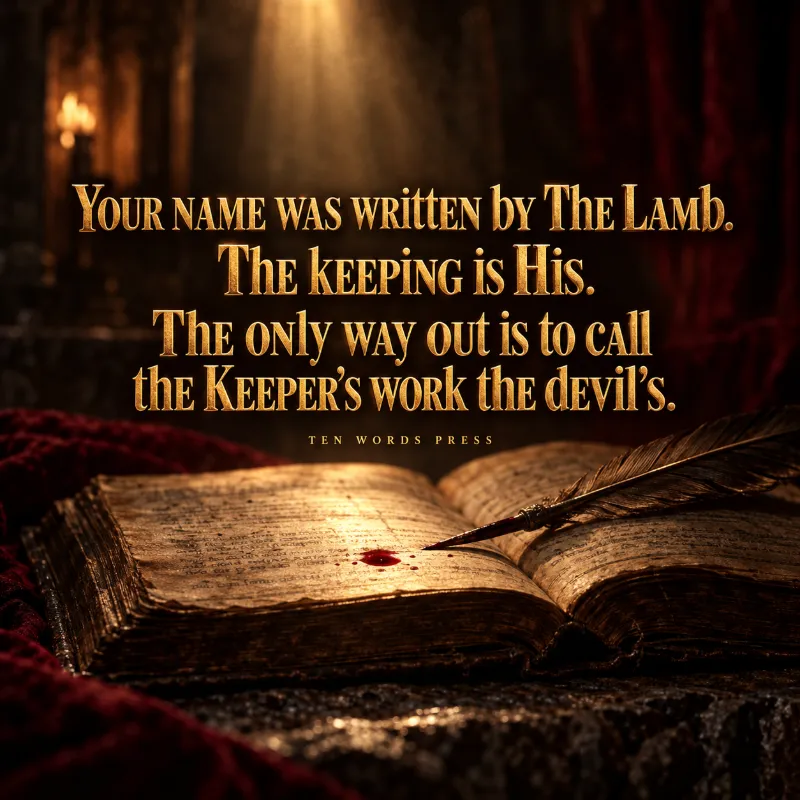
So the sentence the teacher should have ended with is not “security belongs to those who endure.” It is this: your name was written by The Lamb, the keeping is His, and the only way out is to call the Keeper’s work the devil’s.
Section XIIBe a Berean
The believers in Berea “received the word with all readiness, and searched the Scriptures daily to find out whether these things were so” (Acts 17:11), and Luke calls them more noble for it. That is the only standard this article asks of you. Do not take the teacher on his word, and do not take me on mine. Open the texts cited here, read the Greek where the footnotes point to it, and weigh every claim against the Ten Words and the plain sense of the Covenant. If you find that I have read a verse wrong, or rested a conclusion on something the text does not carry, write to me. Leave a comment below and show me the passage. I would rather be corrected by a reader with an open Bible than agreed with by a reader who did not check.
NotesRenderings and Textual Notes
1. Jude 5. The oldest Greek witnesses (Vaticanus, Alexandrinus) read Iēsous, “Jesus,” where later copies read “the Lord”; the critical Greek text adopts “Jesus.” It matches Paul’s “the rock was Christ” (1st Corinthians 10:4).
2. Habakkuk 2:4, Septuagint: ho de dikaios ek pisteōs mou zēsetai, “the righteous shall live by My faithfulness.” The Hebrew reads “by his faith.” Rendered here after the Greek. Paul’s pistis Christou (Galatians 2:16, 20; Romans 3:22; Philippians 3:9) is rendered “the faith of Christ,” the genitive read of the Son’s own faithfulness.
3. Ephesians 1:14, Greek arrabōn, a down payment given as the guarantee of full payment to come. The betrothal picture is drawn from Hosea 2:19-20 and 2nd Corinthians 11:2, not from the word itself.
4. Matthew 7:23, Greek anomia. The standard Jesus names is the will of the Father (verse 21), the Ten Words; rendered “transgression of the Covenant,” on the same judgment as 1st John 3:4.
5. Hebrews 10:29, “the Blood of the Covenant,” Greek to haima tēs diathēkēs, the New Covenant in Christ’s Blood (Matthew 26:28). Verse 28, nomon Mōüseōs, is the civil statute of Deuteronomy 17:6, the Book of the Law.
6. 1st Samuel 28:19. Hebrew immi, “with me.” The Septuagint reads “you and your sons with you shall fall.” Rendered after the Hebrew here, since the Greek has no clause at this point to render; the case for Saul’s rest is made in the body from the wider record.
Comments
No comments yet. Be the first.