Not Three Years
How We Know the Ministry of Jesus Was One Circuit of the Feasts
One clause built the three-year ministry. The Gospels, the feasts, the priestly age, and the prophecy of Daniel all say otherwise.
·
Section IWhere the Three Years Came From
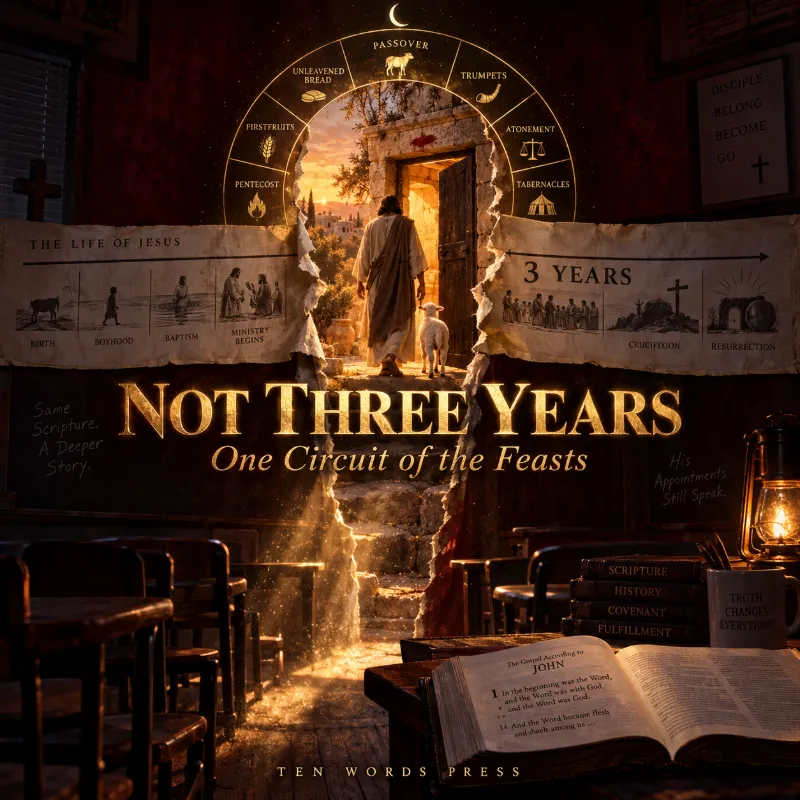
Open Matthew, Mark, and Luke and look for a Passover in the public ministry of Jesus. You will find exactly one: the Passover at the end, the night of the Last Supper. The first three Gospels walk from the Jordan to Galilee to Jerusalem and the Cross without a single spring feast in between. Read on their own, they describe a ministry that fits inside one turning of the year.
The three-year teaching comes from the Gospel of John, and it comes from counting. John names a Passover at the first cleansing of the temple (John 2:13). He names the final Passover of the Cross (John 11:55; 12:1; 13:1). And in the middle, as Jesus sits on a Galilean hillside before feeding the five thousand, one short sentence appears:
Three Passovers make two full years and the months before the first one. Add the unnamed feast of John 5:1, read it as another Passover, and the count stretches toward three and a half. That is the whole foundation. Every confident "three years" in the modern church traces back to John 6:4, and when the timeline is extended past it, to a guess about John 5:1. Remove the one clause and John gives us two Passovers, an opening and a closing, one feast cycle apart. John then agrees with Matthew, Mark, and Luke.
So the question is not whether we trust John. We trust him completely. The question is whether these nine words in chapter six belong to what he wrote, and the place to begin is not with manuscripts but with the man the verse describes.
Section IIThe Clause That Puts Jesus in Breach
God commanded every man of Israel to appear before Him three times a year, and the first of those three was the Feast of Unleavened Bread, which begins with Passover.
This was not a suggestion for the devout. It was a standing term of the covenant God made with His people at Sinai (Exodus 23:14-17; 34:23), and Jesus was born under it (Galatians 4:4). He kept it as a boy, going up with His family every year (Luke 2:41-42). He opened His ministry by keeping it (John 2:13). He closed His ministry by keeping it. And He told His hearers plainly that He had not come to loosen the smallest stroke of what God had spoken (Matthew 5:17-19).
Now read John 6:4 as it stands. Passover is near. Jesus is on the far side of the Sea of Galilee, a journey of several days from Jerusalem. He feeds the crowd, crosses the lake, teaches in the synagogue at Capernaum (John 6:59), and the very next chapter opens with Him still walking in Galilee (John 7:1). John never records Him going up. The verse places the sinless Son of God in Galilee at the one feast every man of Israel was commanded to keep in Jerusalem.
The usual explanation is safety: the Judeans sought to kill Him (John 7:1). But God had already answered that fear in the covenant itself. When He commanded the three pilgrimages, He promised that no man would even desire Israel's land while her sons went up to appear before Him (Exodus 34:24). The pilgrimage carried its own protection. And John shows us Jesus going up to the very next feast, Tabernacles, while the same people still wanted Him dead (John 7:10, 25). A danger that did not keep Him from Tabernacles cannot explain His absence at Passover.
The old preachers felt this. John Chrysostom, preaching on this passage in the fourth century, could only answer that Jesus was quietly setting the Law aside. That answer costs more than it saves. A Messiah who sets aside a command in silence, and then resumes keeping it a few months later, is no longer the spotless Lamb who could say, "Which of you convinceth me of sin?" (John 8:46). The Lamb had to be without blemish (Exodus 12:5; 1 Peter 1:19). The plain reading of John 6:4 puts a blemish on Him. The covenant judges the word placed against it; the word never judges the covenant (Deuteronomy 13:1-4).
Section IIIThe Six Months Nobody Can Fill
Keep the verse and something stranger follows. If a Passover falls at John 6, then the next date John gives is the Feast of Tabernacles in chapter seven, six months later. Between those two chapters lie Passover and the Feast of Weeks, two commanded pilgrimage feasts, and John records nothing at all. No journey, no teaching, no miracle, no word.
Where did Jesus go? Where did the twelve go, every one of them under the same command to appear before God? John, the Gospel writer who organizes his whole account around the feasts, goes silent for half a year and then picks the story up as if no time had passed. The Synoptic Gospels cannot fill the hole either, because they have no Passover to set beside it.
Look also at the crowd. Five thousand men, with women and children besides, are sitting on a hillside in Galilee on the eve of the feast that should have emptied Galilee onto the roads to Jerusalem (John 6:10). The Passover crowd belongs on the road south. This one stays, eats, and the next day follows Jesus to Capernaum to argue about bread. Nothing in the scene behaves like Passover week.
A hole in the record is itself evidence. When one clause forces us to invent an unrecorded year, an unrecorded absence from two feasts, and an unrecorded reason for a sinless man to break a covenant command, the clause has become the problem.
Section IVWhat the Earliest Writers Counted
The men who wrote closest to the apostles did not all teach three years. A one-year ministry was taught openly in the early church. Clement of Alexandria, writing around AD 200, said the Lord preached for one year, reading Isaiah's "acceptable year of the LORD" (Isaiah 61:2; Luke 4:19) as a literal year. Origen, his successor in Alexandria, gave the ministry a year and a few months. Eusebius, the church's first historian, conceded in the fourth century that Matthew, Mark, and Luke record only the deeds of a single year after John the Baptist was imprisoned.
The most telling witness is the one who argued the other way. Around AD 180, Irenaeus of Lyons set out to refute teachers who held that Jesus ministered for only one year. He had every reason to count as many Passovers as he could find in John. He counted the Passover of John 2:13. He pressed the unnamed feast of John 5:1 into service as a second. He counted the Passover of the Cross. He never mentioned John 6:4.
Think about what that silence means. Here is a skilled debater, holding the Gospel of John, hunting for Passovers to win an argument, and he skips the one verse that names a Passover outright and would have closed the case. The simplest explanation is that the copy of John in his hands did not have it there to count.
The later copyists left their own marks. Among the medieval Greek manuscripts of John, a small number pass straight from 6:3 to 6:5 with no Passover between, one carries the clause in the margin, and several mark it with the obelus, the scribe's ancient sign for a line under doubt. These are late witnesses, and they do not settle the question alone. But they show the scribes themselves noticed what the earliest counters left uncounted. In the eighteenth century Bishop Zachary Pearce raised the question again from Deuteronomy 16:16, and F. J. A. Hort, as C. K. Barrett reports in his commentary on John, questioned the words as well. This is not a new idea dressed in old clothes. It is an old question the church never finished answering.
The man who most wanted a long ministry, counting with John open in front of him, never counted John 6:4.
Ten Words Press
Section VAbout Thirty: The Age of the Priest
Luke gives us the only age Scripture ever gives Jesus: "And Jesus himself began to be about thirty years of age" (Luke 3:23). Luke states it at His baptism, as a credential, the way the law stated the age a priest entered his service.
Thirty is the age of entry throughout Scripture. Joseph was thirty when he stood before Pharaoh (Genesis 41:46). David was thirty when he began to reign (2 Samuel 5:4). Ezekiel received his call in his thirtieth year (Ezekiel 1:1). At the Jordan, Jesus was washed and anointed, as priests were washed and anointed at their consecration (Exodus 29:4-7), and the Holy Spirit descended upon Him in the sight of all (Luke 3:22). The eternal High Priest after the order of Melchizedek (Hebrews 7:17) entered His public service at the age the priests of Aaron entered theirs.
A ministry of one circuit of the feasts places the Cross within His thirtieth year, or at the earliest His thirty-first. The higher age that hangs in stained glass and holiday sermons is not a word of Scripture. It is arithmetic: Luke's "about thirty" plus the three-year count. Remove the count and the arithmetic falls with it. Irenaeus himself shows how loose that arithmetic could become; to defend a long ministry he argued that Jesus passed forty and approached fifty (John 8:57). An age that can be stretched that far was never delivered by the apostles. It was derived. The age Scripture gives is thirty, and the church should be content with what Scripture gives.
Section VIThe Prophecy That Counts the Ministry to the Day
Six centuries before the Jordan, the angel Gabriel told Daniel that a set span had been decreed for his people and his holy city, and he named what it would accomplish.
The Hebrew word translated "weeks" is shavua, a seven. Scripture itself teaches that God's sevens can run at two scales, a day for a year and a year for a day (Numbers 14:34; Ezekiel 4:6). Counted in years, from the decree of Artaxerxes in Ezra 7 (457 BC), sixty-nine sevens of years run out in the spring of AD 27: Messiah the Prince, newly returned from the wilderness, and John the Baptist pointing to Him, "Behold the Lamb of God" (John 1:29-36). Counted in days, the same decree measures the ministry itself, and it measures it to the day.
The day-count below rests on three judgments, and they stand together: first, that John records two ministry Passovers, not three; second, that the year crossed was a leap year in God's calendar, with a thirteenth month, making it 384 days; third, that the fourteenth day of the first month in the final spring fell on the fourth day of the week, a Wednesday. Each one is argued from the text. None is hidden. If any one of them fails, the count fails with it, and the reader deserves to know that before the counting starts.
| Days | Daniel's Sevens | What Happens |
|---|---|---|
| 1 | The count opens | Baptism in the Jordan, "about thirty" (Luke 3:21-23) |
| 1 to 40 | Within the sixty-two | The wilderness: Israel's forty failing years retaken a day for a year, and won (Matthew 4:1-11) |
| 41 | The hinge | First of Aviv, AD 27: the years-count hands off to the days-count; "Behold the Lamb" |
| 41 to 434 | Sixty-two sevens | Opening Passover and first cleansing (John 2:13), one full circuit of the appointed feasts, crossing a 384-day year |
| 434 | The sixty-two close | Tenth of Aviv, the selection day and the Sabbath: come to Bethany on the ninth, at sunset He crosses into the house of Mary, Martha, and Lazarus, the lamb taken into the house (Exodus 12:3), and rests there through the Sabbath |
| 435 | The one seven opens | Eleventh of Aviv, the first day of the week: He enters Jerusalem to cries of Hosanna, then returns to Bethany for the night (Mark 11:11) |
| 435 to 441 | The one seven | The oath-week: four nights in the house at Bethany, the lamb kept until the fourteenth (Exodus 12:6); the covenant confirmed with many at the Table the night before the fourth day (Matthew 26:28; Daniel 9:27); risen on the seventh day, the week complete |
| 438 | The midst of the seven | Fourteenth of Aviv, the fourth day: the Cross; sacrifice and offering brought to their end; the veil torn |
| 442 to 490 | Seven sevens | Firstfruits: the risen Lord, with the saints who rose with Him (Matthew 27:52-53), presented as the sheaf waved and accepted (Leviticus 23:10-11; 1 Corinthians 15:20), then the seven Sabbaths of the count |
| The fiftieth day | The crown beyond the count | Pentecost: the Holy Spirit poured out, the gathered people of God made His temple (Acts 2) |
Sixty-two sevens, then one seven, then seven sevens: 434 plus 7 plus 49 makes 490 days of the decree, and Pentecost stands just beyond them as the crown. Every one of Gabriel's six purposes is fulfilled inside that span. The transgression is finished and sins are ended at the Cross. Reconciliation is made by His blood. Everlasting righteousness is brought in by His resurrection. Vision and prophecy are sealed, and the Most Holy is anointed, when the Holy Spirit descends on the gathered believers and makes them the living temple (1 Corinthians 3:16).
Notice what Jesus said at the Table on the night of the oath-week: "This is my blood of the new testament, which is shed for many" (Matthew 26:28). Daniel had written that "he shall confirm the covenant with many for one week: and in the midst of the week he shall cause the sacrifice and the oblation to cease" (Daniel 9:27). Jesus spoke Daniel's words over the cup on the night before the fourth day. On the fourth day, in the midst of that week, the once-for-all sacrifice was offered (Hebrews 10:14). And on the seventh day He rose, the week complete and the oath kept. Nothing was left over for a future seven years. Gabriel's span was spent, every day of it, on the Lamb.
A three-year ministry cannot keep this count. It has no place for it, and so it has had to push Daniel's final seven out of the ministry and into the distant future. A ministry of one circuit of the feasts receives the prophecy whole.
Section VIIOne Circuit of the Appointed Times
With John 6:4 set aside, John's Gospel falls into an order that follows God's own calendar from one spring to the next. Jesus cleanses the temple at the opening Passover (John 2:13). He goes up for an unnamed feast in chapter five, best read as the Feast of Weeks, where He tells His accusers that Moses wrote of Him (John 5:1, 46). He feeds the multitude in Galilee in the summer and sends them home with bread from heaven (John 6). He cries out at the Feast of Tabernacles that any who thirst should come to Him and drink, and declares Himself the light of the world (John 7:37; 8:12). He walks in Solomon's porch at the Feast of Dedication in winter (John 10:22-23). And He comes to Bethany on the ninth day of the first month, six days before the final Passover (John 12:1). As the sun sets and the day turns to the tenth, the selection day, He crosses into the house of the family He loved, Mary, Martha, and Lazarus (John 11:5; 12:2-3), the lamb taken into the house exactly as Moses commanded (Exodus 12:3).
Many teach that Jesus rode into Jerusalem to cries of Hosanna on the selection day. Scripture does not support it. The tenth fell on the Sabbath that year, and He rested in the house at Bethany through the Sabbath. He would not break the Sabbath to travel the road and ride a beast of burden into the city; the fourth of the Ten Words forbids the work of the cattle as surely as the work of the man (Exodus 20:10), and He was born under the Law (Galatians 4:4). He entered Jerusalem on the first day of the week, the eleventh, the day the oath-week opened (John 12:12-13). He cleansed the temple a second time (Matthew 21:12-13). And notice where He slept. Each evening He went back out to Bethany (Matthew 21:17; Mark 11:11, 19; Luke 21:37). Four nights in the house, from the tenth until the fourteenth, the lamb kept in the house until the day of its killing (Exodus 12:6). Then, on the night before the fourth day, He came to the Table, and on the fourth day He went to the Cross as the Lamb.
This matters more than the calendar. The command was never to present the lamb in the temple. It was "take to them every man a lamb, according to the house of their fathers, a lamb for an house" (Exodus 12:3). In Egypt there was no temple and no tabernacle. There was only the house, the blood on its doorposts, and the family gathered inside. The Lamb of God was taken into a house and kept there, and the New Covenant tells us whose house it is now: "whose house are we" (Hebrews 3:6). Believers are the house, built up as living stones (1 Peter 2:5). Take the Lamb into your house.
Two cleansings of the temple, one at each end, mark the two Passovers of His ministry, one feast cycle apart. Every feast between them is accounted for. There is no six-month silence, no missing pilgrimage, no year without a word. The Gospel that seemed to demand three years, read without the one troubled clause, describes a single sacred year walked feast by feast by the Lord of the feasts.
He kept every appointed time His Father set, and He finished His work in the span His Father decreed.
Ten Words Press
Section VIIIWhen Readers Disagree
The claim as this article states it: the public ministry of Jesus ran one circuit of the feasts, two Passovers, from His baptism at about thirty to Pentecost, 490 days in all, and the three-year ministry rests on John 6:4, a clause that does not belong to what John wrote. Here are the strongest objections, each at full strength, each with its answer.
"John 6:4 is in every Greek manuscript we have, including the oldest."
This is true, and it is the heaviest fact against the case. The clause stands in the earliest papyri of John, P66 and P75, both from around AD 200, and no early Greek copy omits it. If the clause was added, it entered very early, before the copy from which every surviving manuscript descends. That is a rarer event than an ordinary scribal addition, and it should be said so plainly.
The answer is that the record shows exactly what an early entry would leave behind. Irenaeus, counting John's Passovers some two decades before those papyri, never counts this one. The one-year ministry was still taught openly in Alexandria at the same time. Later scribes marked the clause with the obelus. And the clause, read plainly, places the sinless Messiah in breach of a covenant command, with no journey, no reason, and six months of silence after it. Early copies tell us the clause is old. They cannot make the breach it creates disappear.
"Jesus stayed in Galilee because His enemies wanted to kill Him."
John 7:1 does say Jesus walked in Galilee because the Judeans sought His life. The answer is in the covenant and in the next verses. God promised protection for every pilgrim who went up to appear before Him (Exodus 34:24), and Jesus went up to Tabernacles under the same threat a few weeks later (John 7:10). John 7:1 explains where He walked in the summer. It does not explain an absence from Passover.
"John says there was much green grass, and grass is green in spring."
This is the verse's best internal support, and it should be owned. Green grass (John 6:10) does point toward spring on the open hills. But the feeding took place by the shore of the lake, in watered lowland where grass stays green well past spring, and John was a fisherman who knew that ground. One adjective about grass stands against a whole scene that does not behave like Passover week: the crowd at home, the synagogue instead of the temple, the silence that follows. The tension is real, and it is weighed, not hidden.
"The unnamed feast of John 5:1 could also be a Passover, so the ministry was longer still."
John names Passover every other time he means it, and here he does not. The feast of chapter five fits the Feast of Weeks, the feast of the giving of the covenant at Sinai, where Jesus answers His accusers that Moses wrote of Him. Irenaeus treated it as a Passover because he needed one for his argument, not because John called it one.
What changes if a reader lands the other way
Nothing of the gospel. A reader who keeps John 6:4 still has a sinless Savior, a finished Cross, an empty tomb, and the Holy Spirit poured out. No doctrine of salvation is touched. What is lost is the chronology: the breach at Passover must be explained, the six months must be filled, and Daniel's final seven must be pulled out of the ministry of Jesus and set somewhere in the future. We think that cost is too high, and we have shown why. The case would break if a third ministry Passover were found standing on its own witness, if the year crossed had no thirteenth month, if the fourteenth of the final first month did not fall on the fourth day, or if the apostles were shown to defer any of Gabriel's six purposes to a future seven years. We have looked, and we have not found any of these.
This is not a test of fellowship. Brothers and sisters who learned three years learned it in good faith from teachers who loved the Lord. We only ask what the believers in Berea did with Paul: open the Scriptures and search them daily, whether these things are so (Acts 17:11).
Go DeeperA Feast Out of Season

This article is the short road. A Feast Out of Season: The Problem with John 6:4, and the Year It Adds to the Ministry of Jesus is the long one, a full illustrated deep dive in nineteen chapters and thirty-eight plates that takes the verse apart clause by clause and follows every thread this article could only touch.
Part One sets the verse beside the covenant Jesus lived under and shows everything it breaks: the missed pilgrimage, the crowd in the wrong place, the six months nobody can fill, and the old preachers who felt the problem and could not answer it. Part Two traces the damage downstream: the year with nothing in it, the priestly age of thirty, Daniel's count kept to the day, and one full circuit of the appointed times walked feast by feast. Part Three opens the manuscript record: the earliest papyri at full strength, the medieval copies that omit the clause, carry it in the margin, or mark it with the obelus, the company it keeps with other doubted passages, and the footnote that quietly vanished from the modern Greek apparatus. Part Four weighs it all: what the earliest writers counted and what they never counted, why a Passover would be added, every serious objection stated at full strength and answered, and a working conclusion held openly with its open questions on the table.
It is written for the believer in the pew, not the seminary. No Greek is required to follow it, nothing is asked of the reader on credit, and every claim is laid out so you can check it for yourself. If this article raised a question, the book was written to answer it.
A Feast Out of Season by Charles Vance, Ten Words Press. Illustrated 6x9 paperback and ebook. Get the book at the Ten Words Press bookstore.
ReferencesSources Cited
Irenaeus, Against Heresies 2.22. Read at New Advent.
Clement of Alexandria, Stromata 1.21.
Origen, De Principiis 4.5.
Eusebius, Church History 3.24. Read at New Advent.
John Chrysostom, Homilies on the Gospel of John, Homily 42 (on John 6:1-4). Read at New Advent.
Kurt Aland, Barbara Aland, and Klaus Wachtel, eds., Text und Textwert der griechischen Handschriften des Neuen Testaments, V. Das Johannesevangelium, ANTF 35-36 (Berlin: de Gruyter, 2005).
C. K. Barrett, The Gospel According to St. John, 2nd ed. (Philadelphia: Westminster, 1978), on John 6:4, reporting F. J. A. Hort.
Scripture quotations are from the King James Version.
Comments
No comments yet. Be the first.