The House of the Lamb
What Bethany Holds Beyond Martha's Kitchen
A covenant study of Jesus with Martha, Mary, and Lazarus
·
Section IA Lamb for Each House
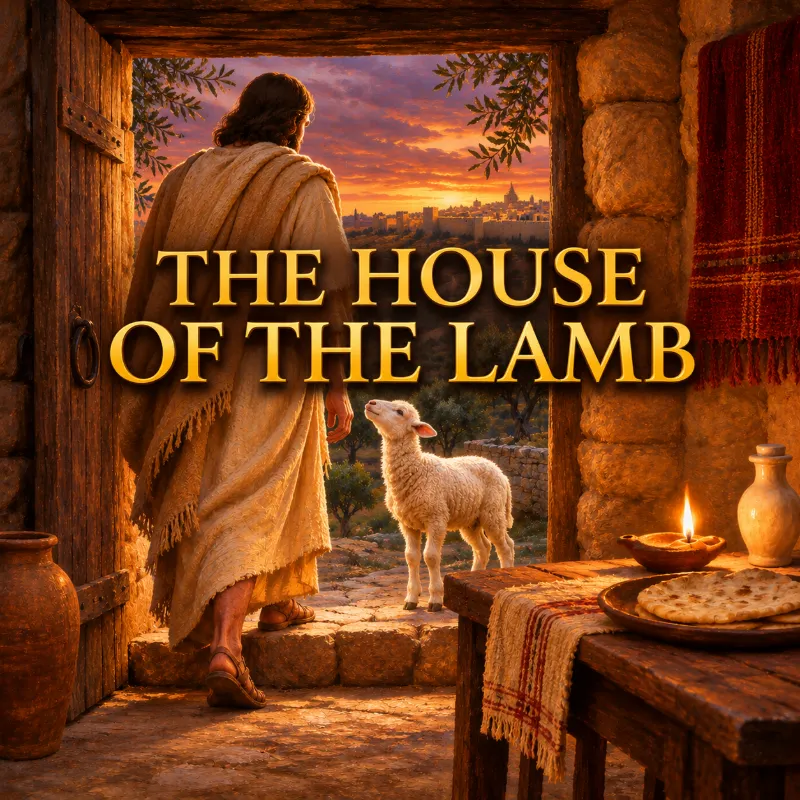
To understand Bethany, begin in Egypt. On the night before Israel walked out of slavery, God gave every family the same instruction. On the tenth day of the first month each household was to choose a lamb, a lamb for each house. They were to bring it in and keep it until the fourteenth day. It had to be without blemish. On the fourteenth day it was killed at twilight, and its blood on the doorposts covered everyone inside (Exodus 12:3-7, 13).
Notice the four days. The lamb did not go straight from the flock to the sacrifice. It lived in the house first. The family fed it, watched it, and looked it over, and by the fourteenth day they knew whether it was sound. They also knew the lamb itself.
Hold that pattern in your mind: a lamb chosen, brought into a house, kept four days, examined, and found without blemish. Fifteen centuries later it happened again, and the house was in Bethany. Everything else in this study follows that one thread.
Section IIThe House That Knew Him
Before the Lamb came to stay, this household had already learned who He was. The Gospels show each of the three coming to know Him in a different way.
Mary learned Him by listening. She sat at the Lord's feet and heard His word while her sister was pulled in every direction by the serving, and Jesus said she had chosen the one thing needful (Luke 10:38-42). That is the posture of Israel at Mount Sinai, where the people sat down at God's feet and received His words (Deuteronomy 33:3).
Martha learned Him at a graveside. When Lazarus had been four days in the tomb, she went out to meet Jesus on the road, and He told her who was standing in front of her.
Peter made that confession at Caesarea Philippi (Matthew 16:16). Martha made hers with her brother still behind the stone. The woman we remember for her kitchen is one of only two people in the Gospels who say it so plainly.
Lazarus learned Him by hearing his own name called into the dark, and walking out (John 11:43-44). That sign is also what set the Cross in motion. The council met because of it, and the high priest said more than he understood: it was better for one man to die for the people than for the whole nation to perish (John 11:47-53). The Lamb had been chosen. What remained was for Him to be brought into the house.
Mary knew Him by listening, Martha by trusting Him in grief, Lazarus by answering His call. Which of the three is closest to how you have come to know Him?
Section IIIFour Days Under Their Roof
Six days before the Passover, Jesus came back to Bethany. Martha served, Lazarus sat at the table, and Mary took a pound of pure nard, anointed His feet, and wiped them with her hair. When Judas complained about the cost, Jesus answered that she had kept it for the day of His burial (John 12:1-7). Mary had listened, and she was the one in the room who understood what kind of week this would be.
Then He rode into Jerusalem, and the pattern from Egypt began to unfold. Each morning He went into the city, and each evening He went back out to Bethany (Mark 11:11, 19; Matthew 21:17). By day the priests, the scribes, the Pharisees, and the Sadducees examined Him in the temple, until no one dared to ask Him another question (Matthew 22:46). At the end the governor gave the finding: "I find no fault in Him" (John 19:4).
When the days of His ministry are counted out, the entry into the city falls on the tenth day of the month and the Cross on the fourteenth. I will say plainly that this count is a careful reconstruction and rests on judgments about the calendar, chiefly that John records two Passovers in the ministry, one year of feasts apart. The pattern itself is in the text for you to check. The Lamb was presented, He lodged in a house, He was examined for four days, and He was found without blemish.
Think of what that meant inside the house. Martha set bread in front of Him each night knowing what the council had decided. This family did what every family in Israel had done since Egypt. They kept the Lamb under their roof until the fourteenth day.
Israel kept the lamb in the house and came to know it before the blood was ever on the door. What would it mean for your household to live that closely with the Lamb of God?
Section IVWhat the Lamb Finished
On the fourteenth day the Lamb left the house and did what He had come to do. Five hundred years earlier, the angel Gabriel had told the prophet Daniel exactly what that would be. He named six purposes.
Take them one at a time, and hold each against what the apostles wrote.
1. To finish the transgression
The transgression is the breaking of the covenant, the golden calf and every breach that followed it. The curse of that broken covenant came to rest on the One who never broke it, and there it ended (Galatians 3:13).
2. To make an end of sins
He offered one sacrifice for sins for all time, and then He sat down (Hebrews 10:12). By one offering He has perfected those who are being made holy (10:14). The temple veil tore from the top to the bottom, and the daily offerings had nothing left to say (Matthew 27:51).
3. To make atonement for iniquity
God was in Christ reconciling the world to Himself (2nd Corinthians 5:19). The Father did not need to be talked out of anger at the Cross. He was the One making peace through it (Romans 5:10).
4. To bring in everlasting righteousness
A righteousness from God has been revealed through Jesus Christ for all who believe (Romans 3:21-22). The prophet called Him "The Lord Our Righteousness" (Jeremiah 23:6). What He gives to His people He does not take back.
5. To seal up vision and prophet
Everything written about Him in Moses, the Prophets, and the Psalms was fulfilled (Luke 24:44). God, who spoke in many portions through the prophets, has now spoken in His Son (Hebrews 1:1-2). The Holy Spirit now writes the covenant on hearts directly (Jeremiah 31:33).
6. To anoint a Most Holy
At Pentecost, tongues like fire rested on each one gathered (Acts 2:3). God's people became His dwelling place: "You are the temple of God, and the Spirit of God dwells in you" (1st Corinthians 3:16).
The Cross purchased all six, and Pentecost crowned what the Cross purchased. Not one of the six is waiting on some future seven years. When Jesus said "It is finished" (John 19:30), everything Gabriel told Daniel had been kept in full. In Egypt the blood of a lamb covered one house for one night. The blood of this Lamb finished the whole matter for every house that will have Him.
Which of the six do you most need to hear as finished today? Read that one aloud and thank Him for it.
Section VWho Provided for the Lamb?
In Egypt each family supplied its own lamb and bore the cost of keeping it. So ask the same question of Bethany. Who bore the cost of this Lamb and His mission?
The text puts the question on the table at that very supper. There was a pound of pure nard in the house worth three hundred denarii, close to a year's wages (John 12:5). The disciples kept a common money bag with a treasurer, and it held enough to buy for the feast and give to the poor (John 12:6; 13:29). Women of means provided for Jesus out of their own possessions (Luke 8:2-3). From the Cross He placed His mother in John's care without a word about how she would live (John 19:26-27). A builder's son from Nazareth carried a public mission across the whole land, and He lacked nothing.
Scripture also gives us these pieces. Daniel, the man who received the six purposes, was made chief over all the wise men of Babylon and was given many great gifts (Daniel 2:48). Because he was given the count of seventy sevens, those who came after him knew when to watch. Wise men from the east arrived on time, asking for the newborn King, and they opened treasures of gold, frankincense, and myrrh (Matthew 2:1-2, 11).
What follows is an informed reconstruction. No verse states it, and nothing else in this study depends on it. I offer it for you to weigh.
Consider that Daniel did more than write the prophecy down. Consider that the chief of the wise men set wealth aside against the day of the Messiah's coming, that those who followed him kept it and grew it across the centuries, and that the wise men came to Bethlehem to deliver a trust into the hands of the family. On this reading His mother kept it, His mission was provided for by it, and Jesus Himself owned nothing and asked for nothing beyond what the work required. It paid for bread on the road, a room for the Passover, and a household in Bethany that could welcome thirteen men at short notice.
Every trust has terms. If Daniel's house provided for the mission, then the six purposes Daniel wrote down are the terms it was meant to see accomplished. The Son kept every one of them. When He said "It is finished," the trust was discharged.
You are free to set this aside. The six things finished stand on the text without it. If you take it up, I think you will find that it answers questions the Gospels raise and do not stop to explain.
Section VIThe Story From Inside the House
A study can lay the pattern out. It cannot let you sit at the table. I wanted to know what those days were like for the woman who cooked the meals, so I wrote the story from where she stood.
A Lamb For Each: A Novel of Martha, Mary, and Lazarus is told by Martha in her old age, to a traveler who has come asking about the year Jesus stayed in her home. She tells of her brother's sickness and the four days she waited, the road where she made her confession, the supper and the nard, and the nights He came back from the city during His last week. The novel stays close to Scripture. Jesus speaks only the words the Gospels record for Him. The Passover lamb and the covenant frame the telling from the first page to the last, and the provision considered in Section V is part of the household's story.
If you have always seen yourself in Martha, the one who serves while others sit, this book was written with you in mind.
A Lamb For Each at Ten Words Press Books, available now as an ebook, with the paperback coming soon.
A lamb for each house. Bring Him in.
Father, thank You for the house at Bethany and for the Lamb who rested there. Teach us to sit at His feet before we serve. Give us Martha's confession at our own gravesides. Let our homes be houses that have received the Lamb, and let us rest in what He finished. We ask it in the name of Jesus. Amen.


Comments
No comments yet. Be the first.