King in Jeshurun
The Priesthood That Was Never Levi's
A priest stood in a garden before there was a tribe to be born into. He is the first name on a list that runs through Seth, Shem, Moses, and David, and the list ends in Jesus.
·
Section IA Verse Hiding in Plain Sight
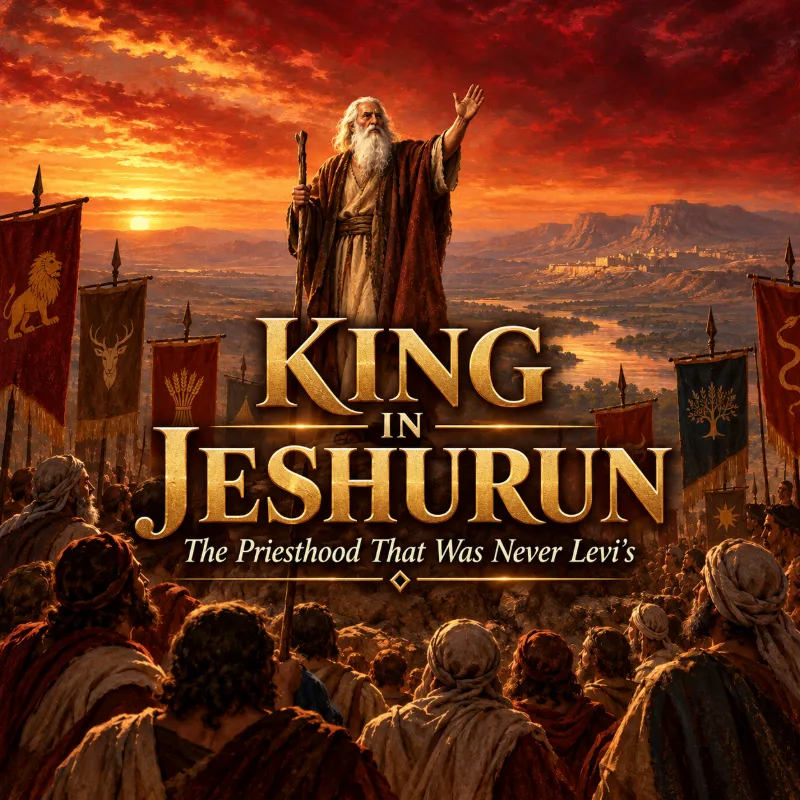
Deuteronomy 33 is the blessing of Moses over the tribes. He is on the far side of the Jordan, in the last days of his life, and before he blesses a single tribe the text pauses to say who is speaking and what he is.
A word about the Scripture you will read in this study. Every passage here is rendered fresh from the Hebrew and Greek rather than quoted from an English Bible, because the English tradition has smoothed over some of the very things we need to see. In these renderings you will meet the word Elohim, which is the Hebrew word our Bibles translate as God. It is a plural form, and it is kept as it stands. You will also meet the Name of God, Yahweh, where our Bibles print LORD in capitals. Nothing else changes. God is still God, and the Lord is still the Lord.
Most English Bibles quietly steer the word king away from Moses. The pronoun gets capitalized, or a footnote appears, and the reader is told the King is the Lord. The Hebrew does not say that. The nearest subject in the sentence is Moses, and the verse is describing the moment the whole nation stood assembled before one man who gave them their inheritance of instruction. He was king in Jeshurun. Jeshurun is "the upright one," a tender name for Israel as she was meant to be.
Read it plainly and a question falls out. Moses was from the tribe of Levi, but he was never a priest of Aaron's order. He never wore the ephod. He never served at the altar. Yet he went up into the cloud on the mountain, he sprinkled the blood of the covenant on the people, he ate at the table before God with the seventy elders, and he stood in the gap when the whole nation deserved to die. That is a priest's work, and it is a king's work, and it was done by a man who belonged to no priestly line that Scripture ever names. So what office was he holding?
Section IIA Man in a Garden with a Job
The answer begins in Eden, with two little verbs that a Hebrew reader cannot miss.
Serve and guard. Those are the two words God uses of the Levites at the tabernacle in Numbers 3 and Numbers 8. Before there was a tabernacle, before there was a Levi, a man was placed in a sanctuary with the two verbs of a priest attached to him. Adam was not a gardener who later found religion. He was a priest and a king in a garden sanctuary, naked and unashamed, standing before God with no veil and no go-between.
This is the key that opens Hebrews 7. The writer says of Melchizedek that he was "without father, without mother, without genealogy." People have stretched that line into a vision of Jesus before Bethlehem, or into a man who dropped out of the sky. There is a simpler reading. The first holder of the office literally had no father and no mother. He was formed from dust. The phrase is not describing one strange birth in Genesis 14. It is the signature of an order that never ran on parentage. Aaron's priesthood depends on who your father was. The priesthood of Eden depends on God's appointment, and it starts with a man who had no father to inherit it from.
Adam held the office and lost it. The coats of skin in Genesis 3:21 are a picture of the fall, not the robe of the office; he was a priest before the fall, naked, and the tunic came with the curse. Cain and Abel lose the line twice over, one by murdering and one by being murdered. But the office does not die with them, because it was never theirs by birth. It goes where God sends it.
Before you move on, sit with what Adam had. He walked with God in the cool of the day with nothing between them. That is not a picture of what religion later built; it is a picture of what God wanted from the beginning. Everything that follows in this study is the story of God refusing to let that go. If you have ever felt that you need someone more qualified to stand between you and God, remember that the first priest God ever made was simply a man He had set in a garden.
Section IIIThe Appointed Line
Eve names her third son with a word the rest of the Bible will keep coming back to.
Seth is the appointed one. The new line starts with him, and in the next generation people begin to call on the Name of God in the earth. Goodness begins again under Enosh. The long genealogy of Genesis 5 is not filler between Eden and the flood. It is a succession list, and the men on it are holders of an office. Kenan, Mahalalel, and Jared are the quiet holders; Scripture gives us their years and little else, but the office passes through their hands. Enoch is the exception, and the text tells you why: God took him. No death, no handing off. Methuselah carries the office in his place, through to Lamech, and Lamech to Noah.
Peter counted this line, and he counted it the same way.
The King James adds the word person, and the eight souls on the ark have distracted readers for centuries. Peter is not counting passengers. He is counting Noah's place in a line. Start at Seth, leave out Enoch because God took him, and Noah is the eighth. "Herald of righteousness" is not a compliment to one man's preaching. It is the title of the office. Every holder of it is a herald of righteousness, which is exactly what Hebrews says the name Melchizedek means: king of righteousness, king of peace. Melchizedek is a title, not a surname.
Notice how the office moved. It did not go to the oldest son, or the strongest, or the one with the best bloodline. It went to the one God appointed. Seth is named "appointed." Noah is named by his place in a count that skips a man God took home. From the beginning this priesthood has been a matter of God's choosing and a man's faith, never of pedigree. That is the pattern you are going to see all the way to the cross, and it is the pattern that makes room for you.
Section IVThe Ninth Man and the Sojourner
Shem is the ninth from Seth and the last of the holders from before the flood to walk the new world. He outlives Abraham. So when Abram comes back from rescuing Lot and a king of Salem comes out with bread and wine to bless him in the name of the Most High God, you are not watching a stranger appear from nowhere. You are watching the ninth holder of the priesthood of Eden hand the blessing to a sojourner, a man from outside his own family. Shem does not pass it down his own line to Arpachshad and on through his descendants. He gives it by faith to Abram, and Abram pays him the tenth.
This is the whole point Hebrews 7 is built to make. Levi was still in Abraham's loins when Abraham bowed to Melchizedek. The lesser is blessed by the greater. Aaron's entire order, before it ever existed, acknowledged an older and higher priesthood that did not depend on who your father was. Abraham is the first man to receive the priesthood of Eden by faith, and it is faith, not blood, that carries it forward from here.
The priesthood of Eden depends on God's appointment. Aaron's depended on who your father was. Only one of them survives the golden calf.
King in Jeshurun · Ten Words Press
Section VMoses, King in Jeshurun
Now Deuteronomy 33:5 reads the way it was written. At Sinai the whole nation was offered what Eden had: direct access to God, every man a priest.
The covenant was proposed, accepted, cut in blood, and confirmed with a meal in the presence of God. Then the people, Aaron included, broke it at the foot of the mountain before the ink was dry. What that nation of priests would have been in its fullness we can never know, because it was thrown away within forty days. The Book of the Covenant was withdrawn and the Book of the Law was laid on the people as a tutor. The Levitical priesthood was a prosthesis, a temporary measure strapped onto one tribe so that a broken nation could still approach a holy God at all.
Moses never broke it. He was on the mountain when the calf was made. He kept the Book of the Covenant when no one else did, and he kept his standing as prophet, priest, and king. He set up Aaron's priesthood without ever belonging to it, and he did that from inside the older office, the one first offered after the breach in Eden and carried through Seth and Shem to Abraham. He is a herald of righteousness in the line of Shem. That is why the text can call him king in Jeshurun without blinking, and why the English translators have been so uncomfortable with it.
Here is the hard part, and the hopeful part. The people were offered everything at Sinai and lost it in a month. If that were the end of the story, Aaron's priesthood with its veil and its one high priest once a year would be the best anyone could hope for. But one man kept the covenant, and the office did not fail with the people. God's offer of direct access was not revoked. It was carried, by one faithful man, through a generation that could not carry it. That should tell you what God does with the promise when His people let it drop.
Section VIThe Scepter and the Open Tent
Where did the royal priesthood go after Moses? It was kept in the scepter. Judah held it, not Levi, and the man from Judah who shows it to the world is David.
David was never of Aaron's line. Under the Book of the Law he had no right to go near the ark. Yet he brought the ark to Zion, pitched a tent for it with no veil, set singers before it day and night, wore the linen ephod, offered sacrifices, and blessed the people in the Name of the Lord. The tabernacle of David stood on Zion for a generation while the Levitical order kept the bronze altar going at Gibeon. Two priesthoods, side by side, in plain sight, and no fire fell on David.
That open tent is a preview of Eden. It was a grace granted for a season, and it was proof that God had not forgotten what He offered at Sinai or what He planted in the garden. The seed of the priesthood of Eden flowed through Judah to David, and from David to his greater Son.
Hebrews is not embarrassed that Jesus comes from the wrong tribe for Aaron's priesthood. It is the whole argument. He is from the right tribe for the older one.
Picture David's tent. No veil. Singing around the clock. A king from the wrong tribe standing before the ark in a linen ephod, and God pleased with it. For a generation, Israel got to see what worship looks like when the prosthesis comes off. If you have wondered whether the free, unveiled access you read about in the New Testament is something new, it is not. It is something very old, shown once on a hill in Jerusalem so that no one could say God had changed His mind.
Section VIIOffered Again
Jesus holds the office that Adam lost, that Seth was appointed to, that Noah heralded, that Shem handed to Abraham, that Moses held alone when a whole nation let it go, and that David showed on Zion for one generation. He holds it with no one before Him to take it from and no one after Him to hand it to, because the oath says forever.
And then He does what every holder before Him was pointing toward. He offers it to His people. Peter, the same Peter who counted Noah as the eighth, writes to the scattered believers of the New Covenant and tells them they are a royal priesthood and a holy nation. That is Exodus 19:6, given back. The New Covenant does not renew Sinai; it restores what Sinai offered and what Eden had. Direct access. No veil. Every believer a priest, standing before God by His appointment and by faith, exactly as Abraham did when Shem brought out the bread and wine.
Deuteronomy 33:5 is not a stray verse. It is a window onto a priesthood that was never Levi's, that was never meant to be Levi's, and that is yours in Jesus the Messiah.
If you belong to Jesus, you are not waiting in the outer court for someone else to go in on your behalf. You are in the line. Not by blood, not by denomination, not by how long you have been a Christian, but by the same appointment and the same faith that carried the office from Seth to Abraham. Read Hebrews 10:19-22 tonight and notice the word boldness. That boldness is not presumption. It is the posture of a priest who knows whose order he belongs to.
Section VIIIThe Book
This study is the short form of a book now in production at Ten Words Press. King in Jeshurun walks the whole line from the garden to Zion, one holder at a time: the priesthood of Moses, the priests from before the flood, and the priesthood of Eden that stands behind both.
What it is: A study written for ordinary Christians in an easy, pastoral register, with no page limit; it will run as long as the text requires.
Scripture: Every passage is the Ten Words Press rendering from the Hebrew and Greek. No English translation is quoted. Elohim is rendered as Elohim, and the Name of God as Yahweh, with the terms introduced gently as the book goes.
Structure: Five parts. Part One is Adam and the garden. Part Two walks the appointed line from Seth through Noah. The book continues through Shem and Abraham, Moses, and David's tent on Zion, and closes on the Son of David. A back appendix explains the Book of the Covenant and the Book of the Law for readers meeting the distinction for the first time.
Illustrations: One plate per chapter, placed as the chapter header, alternating scene and diagram.
Status: Part One is complete through Chapter 5, "Driven Out." Part Two is under way, with Chapter 6, "Seth, Appointed," and Chapter 7, "Enosh and the Calling on the Name," written and edited. Chapter 8, "The Quiet Holders," is next.
The book is being written and edited one chapter at a time, with each chapter reviewed before the next is started. When it is finished it will join the other Ten Words Press titles at books.tenwordspress.com, in print and digital editions. Readers who want the longer argument behind Hebrews 7, the count in 2nd Peter 2:5, and the open tent of David will find each of them given a full chapter there.

Comments
No comments yet. Be the first.