Who Was Melchizedek?
The Order That Was Older Than Levi
A commentary occasioned by a post from Shahriq Khan on Genesis 14, Psalm 110, and the priesthood that does not end
·
Section IThe Post That Occasioned This
This commentary was occasioned by a post that came across X, written by Shahriq Khan as a recollection of what struck him when he first came to faith. He did not write it to Ten Words Press and has no connection to this press; it simply deserved a longer answer than the platform allows. It is reproduced here in whole, because the article is a response to it and no one should have to take a summary on trust.
When I was newly Christian, this blew my mind when I learned it! The parallel between Melchizedek and Jesus:
Melchizedek shows up for three verses in Genesis and then vanishes, and he's one of the clearest previews of Christ in the Bible. Genesis 14.
Out of nowhere, a king appears: Melchizedek, "king of Salem" (king of peace), and "priest of God Most High."
He brings out bread and wine and blesses Abraham. Genesis 14:18-19.
A king AND a priest in one man. That never happened in Israel, kings came from Judah, priests from Levi. You were one or the other. Never both.
He has no recorded birth, no death, no genealogy. He just appears and blesses.
A thousand years later, David prophesies of the Messiah: "You are a priest forever after the order of Melchizedek." Psalm 110:4.
Not after the order of Aaron, whose priests all died. After the order of the king-priest who seemingly never did.
Hebrews 7 unpacks it: Jesus is the King of Peace who is also our eternal Priest, one who "holds His priesthood permanently, because He continues forever." Hebrews 7:24.
A King of Peace. A Priest forever. Handing out bread and wine. In Genesis 14, God flashed the preview.
At the Last Supper, Jesus handed His disciples bread and wine and said: this is My body, My blood. Luke 22:19-20.
Melchizedek only ever made sense once I met Jesus.
Shahriq Khan · Posted on X, August 2026 · Reproduced in full
The instinct behind it is sound, and the man who wrote it saw something most Christians read past. Melchizedek arrives from nowhere, does three things, and disappears, and somehow this obscure figure becomes the pattern for the priesthood of Jesus Christ. That is worth honoring before anything else is said.
But there is a turn in the story the post does not make, and it changes the shape of the whole thing. Melchizedek is not the strange exception standing in the middle of a normal priestly history. He is the normal one. Aaron is the exception. Once that is seen, Genesis 14 stops being a curiosity and becomes the hinge on which the covenant swings.
Section IIWhat the Text Actually Says
Genesis 14 is a war chapter. Four kings from the east come down and defeat five kings of the plain. Sodom is sacked. Lot, who had chosen the well-watered valley, is carried off with everything he owns. Abram arms three hundred eighteen trained men born in his own house, pursues the coalition as far as Dan, attacks by night, and brings back the people and the goods.
He comes home a victorious commander with plunder in his hands, and two kings are waiting for him in the Valley of Shaveh. One of them is the king of Sodom, who wants to negotiate. The other is Melchizedek.
Three verses, and then he is gone from the narrative and never returns. Consider what is packed into them.
His Name
Malki-tzedek in Hebrew: my king is righteousness, or king of righteousness. Hebrews 7:2 gives exactly that translation. It may function as a throne name rather than a birth name, in the way Pharaoh and Abimelech served as dynastic titles. Either way the meaning is not decorative. This is a man whose name is a theological claim.
His City
Salem, from shalem, the root behind shalom: peace, wholeness, completeness. Psalm 76:2 identifies Salem with Zion, which is Jerusalem. The first priest named in Scripture is therefore the king of the city where the Temple would one day stand, holding that seat centuries before David took the stronghold from the Jebusites and centuries before Solomon laid a stone.
His God
He is priest of El Elyon, God Most High. And here is the detail the post had no room for. When Abram answers the king of Sodom four verses later, he says, "I have lift up mine hand unto the LORD, the most high God, the possessor of heaven and earth" (Genesis 14:22). Abram takes Melchizedek's title for God and joins it to the personal Name of God, the Name written in Hebrew with four letters and usually rendered Yahweh, the Name revealed at the burning bush and printed in most English Bibles as the LORD in small capitals. He is not being diplomatic toward a pagan. He is confessing that the God Melchizedek serves is the God who called him out of Ur.
That single act of naming discloses something the rest of Genesis assumes but rarely states outright: true worship of the true God was alive outside Abram's family. It had not died with Noah. Someone was still standing at an altar in Canaan, and Abram recognized him on sight.
What Is Missing
No father. No mother. No genealogy. No birth, no death, no successor. In a book whose entire architecture is toledot, "these are the generations of," a book that will tell the reader how old Arphaxad was when he fathered Shelah, the priest of God Most High arrives with no paperwork at all. That absence is not an accident of the record. It is the point, and Section IV will show what the writer of Hebrews does with it.
Section IIIWho He Was
Three answers have been given across the centuries. Two of them must be set aside.
He was not an angel. A community at Qumran produced a document, 11QMelchizedek, that turned him into a heavenly deliverer presiding over a final jubilee. It tells us a good deal about how one community read their Bible two centuries before Christ, and very little about Genesis 14 itself. The chapter presents a king with a city, bringing out food to a returning army. Cities do not have angelic mayors.
He was not the pre-incarnate Christ. This reading is common in good churches, and anyone holding it came to it by trying to honor Christ, which is the right instinct pointed at the wrong verse. It cannot survive Hebrews 7. The text says Melchizedek was "made like unto the Son of God" (Hebrews 7:3). Made like. Resembling. If Melchizedek were the Son, the sentence is circular and the argument of the entire chapter collapses, because no one can establish that Jesus holds a priesthood after the order of a man by revealing that the man was Jesus. The force of Hebrews depends on Melchizedek being someone other than Christ whose office nevertheless prefigures Him.
He was a man. A real king of a real city, holding a real priesthood, standing in a real succession older than Abram and older than Levi. Which succession is the question worth pressing, and Scripture leaves a trail rather than a signpost.
The priesthood did not begin at Sinai. It began in a garden. Adam was placed in Eden "to dress it and to keep it" (Genesis 2:15). The two Hebrew verbs are abad and shamar, and they are the identical pair used afterward for the service the Levites perform in the tabernacle (Numbers 3:7-8). Adam was given dominion (Genesis 1:26-28) and given sanctuary service in the same breath. He was king and priest in one man, and Eve stood in that service beside him, formed from his side, not beneath his foot.
That is the original order: royal, unmediated, exercised in unbroken Presence, with no veil, no altar of repeated blood, and no separate priestly caste, because there was nothing to mediate. God walked in the garden in the cool of the day.
The Fall forfeited it. The garden was closed, the way barred, and by Genesis 4 two brothers are approaching God with offerings and one of them murders the other. The transmission breaks in a single generation. Then the line is reappointed: "And to Seth, to him also there was born a son; and he called his name Enos: then began men to call upon the name of the LORD" (Genesis 4:26). Genesis 5 carries that line forward through Enosh, Kenan, Mahalalel, Jared, Enoch, Methuselah, Lamech, and Noah, whom Peter calls "the eighth person, a preacher of righteousness" (2 Peter 2:5), a phrase that fits a line of preachers far better than a passenger count on the ark. After the flood the blessing runs through Shem (Genesis 9:26), and Shem's line carries it on.
So when a priest of God Most High walks out of Salem to meet Abram, the question is not where he came from. The question is why anyone assumed the priesthood started with Aaron.
The oldest Jewish tradition, preserved in the Targums and in the Talmud, names Melchizedek as Shem. The chronology permits it: on the numbers of Genesis 11, Shem was still living throughout Abram's lifetime. A surviving patriarch of the pre-flood witness, holding an office no one had interrupted, ruling a city named Peace, coming out to bless the man who now carries the promise. It fits, and it accounts for the missing genealogy, since Shem's descent is recorded elsewhere and its presence here would have spoiled the very silence Hebrews needs.
The identification is inference, not statement, and it is not load-bearing. What is not inference is the succession itself. Someone stood in that office before Levi existed, and Scripture makes no attempt whatever to explain his credentials, because his credentials were never in question.
Section IVThe Silence Is the Argument
The post says Melchizedek has no recorded birth, no death, no genealogy, and calls him "the king-priest who seemingly never did" die. That word "seemingly" is doing careful work and deserves reinforcement, because this is exactly where well-meaning teaching slips.
Melchizedek died. He was a man, and men die. What Hebrews performs here is a form of argument the first readers understood instantly: reasoning from the deliberate shape of the record. In a book obsessed with lineage, in a system that would soon require documented descent, so strictly that Ezra 2:62 shows priests removed from office for failing to produce their genealogy, the one priest who matters most is introduced with the file left blank.
Scripture does not say he had no parents. Scripture declines to mention them. That refusal, in that book, is a portrait. The portrait is of a priesthood that does not depend on ancestry, does not transfer at a funeral, and does not end. The silence is not a metaphysical claim about Melchizedek. It is a prophetic claim about the office. God arranged the record so that one office would stand in Scripture unmarked by birth or death, an outline waiting for the One who would hold it that way in fact.
Section VThe Order That Was Older Than Levi
Here is the turn.
The post says a king and a priest in one man never happened in Israel: kings from Judah, priests from Levi, one or the other, never both. That is exactly right about Israel under the Levitical system. But it invites a conclusion that is exactly backward. It sounds as though the separation of crown and altar is the normal, God-ordained arrangement, and Melchizedek a beautiful anomaly dropped into it.
The reverse is true. Adam was king and priest. That was the design.
At Sinai, God offered to restore it, and not to a tribe. To everyone.
Every man and every woman standing at that mountain heard the Ten Words, what most Bibles call the Ten Commandments, spoken by the Voice of God directly, with no mediator standing in between. That is Eden offered back: a whole nation of king-priests in the pattern of Melchizedek, unmediated, in the Presence of God. They asked for a mediator instead (Exodus 20:19). And then, while Moses was still on the mountain, they made a calf.
The Levitical priesthood is what came after that. It is mortal, because its priests die. It is tribal, because it is restricted to one family of one tribe. It is male, because that is how the substitute was constituted. It is mediated, because the people had asked for a man to stand between themselves and the Voice. Paul calls the whole arrangement a tutor, a household guardian assigned to a child until the child comes of age (Galatians 3:24), added "because of transgressions, till the seed should come" (Galatians 3:19).
Aaron is the parenthesis. Melchizedek is the sentence.
Ten Words Press
Once that is seen, the strangeness relocates. Genesis 14 is not an odd flash of light in a dark chapter. It is a glimpse of the office still functioning normally, four centuries before the substitute was installed, in a city called Peace, held by a man whose name means Righteousness. The line "kings from Judah, priests from Levi, never both" does not describe how God set the world up. It describes what was lost.
Section VIThe One Who Tried and the One Who Was Allowed
Two figures test this, and both sharpen the point rather than blunting it.
Uzziah tried. A good king of Judah, strong and successful, and then: "when he was strong, his heart was lifted up to his destruction: for he transgressed against the LORD his God, and went into the temple of the LORD to burn incense upon the altar of incense" (2 Chronicles 26:16). Eighty priests followed him in and told him to stop. He raged at them, and leprosy rose in his forehead, and he was a leper until the day of his death. Under the Levitical system, a king who reaches for the censer is struck. The wall between throne and altar is real, and it is guarded.
David was allowed. This is the strange one. David wore a linen ephod, priestly clothing, when he brought up the ark (2 Samuel 6:14). He ate the showbread that was lawful only for priests, and Jesus later defended him for it (Matthew 12:3-4). He pitched a tent on Zion for the ark with no veil hung in it, and set singers before it in continual praise. Second Samuel 8:18 says, in the plain Hebrew, that David's sons were kohanim, priests. No leprosy. No fire. No rebuke.
The difference is not favoritism. Uzziah reached for an office that was not his and took hold of it by force. David was not reaching for Aaron's office at all. He was standing, by a mercy granted to him rather than claimed by him, in the older office, in the very city where Melchizedek had held it. Zion remembered what Sinai had covered over. And that is precisely the man God chose to write Psalm 110.
Section VIIThe Oath of Psalm 110
A thousand years after Genesis 14, and a thousand years before Hebrews, David reaches back past Aaron entirely. Three things in that verse carry the weight.
It is an oath. Not an appointment, not an ordination, not an inheritance. Yahweh swears. In the entire Levitical system no priest ever took office under a divine oath; Aaron was installed by ceremony. This priest is installed by the sworn word of God, and Hebrews 7:20-22 makes that contrast the foundation of a whole argument about which covenant is the better one.
It is forever. Not until death, not until the next generation, not until the Temple falls.
It comes from a king. David, who wore the ephod and ate the showbread and pitched the open tent, writes the oracle about the priest-king. Of course he does.
Psalm 110 becomes the most frequently cited passage from the Hebrew Scriptures in the whole of the Apostolic Writings. Jesus Himself uses the first verse to silence the Pharisees (Matthew 22:41-46). And the fourth verse, that single line about Melchizedek, sits in the Psalms for a millennium like a key in a lock nobody had turned.
Section VIIIThe Argument of Hebrews 7
The writer of Hebrews turns the key, and the chain of reasoning is tighter than most readers notice. It runs as follows.
| Text | The Claim Established |
|---|---|
| 7:7 | The greater blesses the lesser. Melchizedek blessed Abram; Abram, who carries the promise, is on the receiving end. |
| 7:9-10 | Levi was still in Abraham's body when Abraham handed over a tenth. The Levitical priesthood, in its ancestor, acknowledged Melchizedek's superiority before it existed. |
| 7:11 | If perfection had come through the Levitical priesthood, no other order needed naming. The existence of Psalm 110 proves that arrangement was never the destination. |
| 7:12 | A change of priesthood requires a change of law. The whole Levitical administration was tied to its priesthood and goes with it. |
| 7:14 | Jesus came from Judah, "of which tribe Moses spake nothing concerning priesthood." Under the tutor He is disqualified; under Melchizedek the tribe was never the qualification. |
| 7:16 | Not after the law of a carnal commandment but after the power of an endless life. The old priest qualified by descent; this one by indestructible life. |
| 7:23 | They were many, because death would not suffer them to continue. Every high priest of Israel was a temporary appointment awaiting a funeral. |
| 7:24 | "He continueth ever" and holds an unchangeable priesthood. The Greek aparabatos carries the sense of non-transferable: it passes to no successor, because there will be none. |
| 7:25 | Able to save to the uttermost, seeing He ever liveth to make intercession. |
| 7:27 | He needeth not to offer daily, "for this he did once, when he offered up himself." |
Verse 12 is the sentence readers skip, and it bears the load. The entire Levitical administration, the altar, the sacrifices, the priestly caste, the ritual calendar of atonement, hung on the Levitical priesthood. Change the priest and the system attached to him goes out with him. Hebrews is not adding Jesus to the old arrangement. It is announcing that the arrangement has been retired.
Note also what the chapter never does. It never appeals to bread and wine.
Section IXThe Bread and the Wine
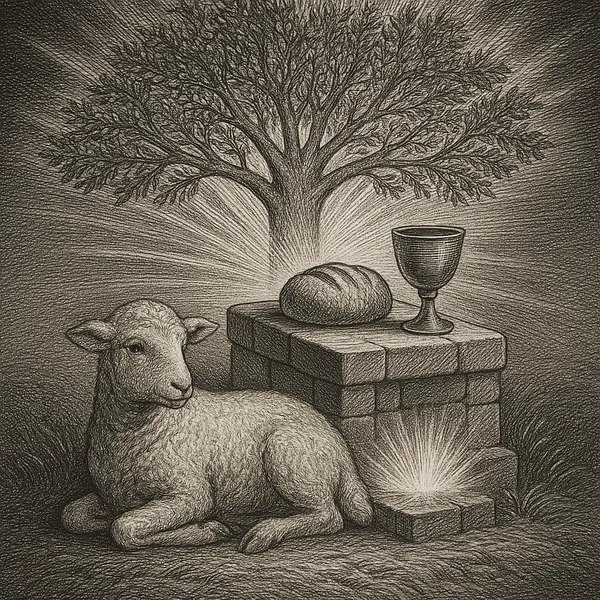
The post lands on the meal, and the image is genuinely beautiful: a king of peace and eternal priest setting out bread and wine in Genesis 14, and Jesus handing His disciples bread and wine in Luke 22. Nothing here is meant to take that away. It is meant to hand it back in a form that will hold weight.
First, the inspired commentary does not use it. Hebrews devotes an entire chapter to Melchizedek and builds on the blessing, the tithe, the oath, the silence in the genealogy, and the endless life. It says nothing about the meal. If bread and wine were the load-bearing link, that is a remarkable omission. So the connection is best held as pattern and resonance rather than as proof. It is an echo, audible once the song is already known.
Second, the pattern is real, and it is larger than one verse. Scripture repeats a covenant shape: oath, blood, table, Presence. Melchizedek sets a table and speaks a blessing over a man who has just come through blood. Abraham receives the covenant promise at Mamre and bread is set beneath the oaks (Genesis 18:1-8). The elders of Israel go up the mountain after the blood is sprinkled, and "they saw God, and did eat and drink" (Exodus 24:11). Jesus takes the bread and the cup and says, "this is my blood of the new testament, which is shed for many" (Matthew 26:28). And it ends at the marriage supper of the Lamb (Revelation 19:9).
That is where Genesis 14 belongs: near the head of a table that runs the length of the Bible. Not as a sacrifice being offered, but as a covenant meal being shared. The distinction is not cosmetic, because Hebrews has already settled the matter: He offered up Himself once, and "by one offering he hath perfected for ever them that are sanctified" (Hebrews 10:14). Whatever the table is, it is not a re-offering. Melchizedek did not sacrifice the bread and wine. He brought them out and blessed a man. That is fellowship in the Presence of God, which is exactly what the Lord's table is, and exactly what the marriage supper will be.
Section XWhat Was Restored
When Hebrews says the priesthood changed, it means the architecture changed with it. Four things moved at once, and they stand or fall together.
The law moved. From tablets of stone to the heart: "I will put my laws into their mind, and write them in their hearts" (Hebrews 8:10, citing Jeremiah 31:33). The same vows, in a new location, written now by the Holy Spirit, whose Hebrew name is the Ruach HaKodosh, the Holy Breath of God.
The temple moved. "Destroy this temple, and in three days I will raise it up... he spake of the temple of his body" (John 2:19-21). The veil tore from the top downward (Matthew 27:51), which is to say it was torn from heaven's side, not ours. And then the astonishing consequence: "know ye not that ye are the temple of God?" (1 Corinthians 3:16).
The sacrifice ended. Once. For all. Never repeated, never re-presented, never re-offered.
The priesthood was restored. Not upgraded but restored, to the order it held in the garden: "ye are a chosen generation, a royal priesthood" (1 Peter 2:9), and "hath made us kings and priests unto God" (Revelation 1:6; 5:10).
Read that last phrase with Genesis 14 in hand. Kings and priests. Both offices, in the same person. That is the Melchizedek order, and it is not describing Jesus alone. It is describing you, if you are in Christ, and with you the whole Bride, the one people God is gathering: the believing remnant of Judah, the house of Israel returning from exile, and every one of us from the nations who has been brought near.
Not tribal, because Judah was never a priestly tribe and its King is now the High Priest. Not mortal, because it rests on the power of an endless life. Not mediated through a separate priestly caste, because the veil is torn and the Voice is no longer terrifying to those in Christ. Not restricted by sex, because Eden's priesthood was held jointly by the man and the woman, and Pentecost restored it in the same terms: "your sons and your daughters shall prophesy" (Acts 2:17-18, citing Joel 2:28).
Every plank of the substitute has been retired. Not one of them survives the resurrection intact. Where a tradition has held on to a single feature of the older order, an altar that must be supplied again, or a separate priestly class, or a sacrifice re-presented, it has quietly kept the others alongside it in shadow, because the four moved together and will not come apart. That is not said with contempt for anyone. It is said because the resurrection deserves to be allowed to finish its work.
Section XISo Who Was Melchizedek?
He was a man. A real king of a real city that would one day be called Jerusalem. A priest of God Most High, standing in a succession older than Abraham, older than Israel, older than Levi, running back through Shem and Noah and Seth to a garden where a man and a woman kept a sanctuary and walked with God with no veil between.
He appears for three verses because three verses is all it takes. He blesses the man who carries the promise, receives a tenth from him, sets bread and wine before him, and leaves the page.
And God, who superintended every genealogy in that book, left his blank. No father, no mother, no beginning, no end. One office in all of Scripture held by a man with no recorded start and no recorded finish, standing in the record like an outline waiting for someone to step into it.
A thousand years later a king wrote down an oath about it. A thousand years after that, a Man from the wrong tribe, holding no priestly credentials at all, walked out of a tomb with an indestructible life and stepped into the outline exactly.
It was built to be unreadable until He arrived, and then to be unmistakable.
Ten Words Press
Shahriq Khan ends his post by saying that Melchizedek only ever made sense to him once he met Jesus. That is not a limitation of his reading. That is how the passage was constructed. The preview was not accidental, and neither was the wait.

Comments
No comments yet. Be the first.