The Four-Fold Restoration
How the Resurrection Rebuilt the Four Pillars of Access to God
There is a way to read the Resurrection that is true but too small.
·
We have been taught — and rightly — that Jesus died for our sins, that He rose again, that the tomb was empty, that we are forgiven, that we have eternal life. All of that is true. None of it should ever be diminished. But Scripture says the Resurrection did something even larger than securing our destination after death. The way of access changed and the cosmos changed, and they changed together, because they were always meant to belong together.
There is a name for what was happening. It is the Kingdom of Heaven breaking into the Kingdom of God. The Kingdom of God is the whole created order — every realm and rule and authority God spoke into being, all of it His by right. But at the Fall, that Kingdom was corrupted. The serpent took ground he was never given. Death entered. The nations were scattered. The Kingdom of God remained God's, but it was occupied, contested, and groaning. Then Jesus came preaching what no prophet before Him had quite named — the Kingdom of Heaven is at hand. Not a new Kingdom replacing the old, but Heaven's own uncorrupted reign breaking into the corrupted ground. He is the stone Daniel saw — cut without hands, striking the image of earthly kingdoms, growing into a mountain that fills the whole earth. He is the stone of stumbling, the stone the builders rejected that became the chief cornerstone. The Resurrection is the moment that stone was set, and the mountain began to grow. The Two Kingdoms are being made one again, from the inside out.
The heart of that in-breaking is the rebuilding of the four pillars of access. In the older covenant, God's people came near to Him by a fixed architecture. There was a Law that governed the approach, a Temple that hosted the approach, a Sacrifice that authorized the approach, and a Priesthood that mediated the approach. All four were real. All four were given by God Himself. And all four were outside the worshipper — written on stone, built in Jerusalem, slaughtered on an altar, performed by a tribe set apart.
At the Resurrection, all four moved. Not abolished — moved. From outside to inside. From stone to flesh. From the few to the many. From the once-a-year to the forever.
This is the Four-Fold Restoration. But the four do not stand alone. They sit inside a far older promise, and they open outward into a far wider fulfillment. Before we walk the four, we need to see the frame they hang in — because the frame goes back further than Sinai, further than Abraham, all the way back to the gate of Eden.
Section IThe Promise Older Than the Law
When God spoke His judgment over the serpent in Genesis 3, He spoke a sentence that would echo through every page of Scripture afterward.
This is the first gospel. Before there was an Abraham, before there was an Israel, before there was a Law, there was a promise — and the promise was that the Seed of the woman would crush the serpent's head, and the serpent would bruise the Seed's heel. The whole long story of redemption is the working out of that single sentence. Every covenant that follows it is the keeping of that promise in stages.
And every stage is partial. The Abrahamic covenant promised a Seed and a blessing for the nations, but the Seed had not yet come. The Sinai covenant gave the marriage vows and the Tabernacle, but the priesthood was mortal and the sacrifices repeated and the heart still unchanged. The prophetic covenant promised a New Covenant written on the heart, but Jeremiah did not live to see it. The promise to the serpent in Eden ran underneath all of them, waiting, unfulfilled.
Then Shiloh came.
Jacob's deathbed prophecy named two things at once: a Person who would come, and a gathering that would happen when He arrived. Jesus is Shiloh. The Resurrection is the moment everything held in promise across four thousand years was paid out in full. The serpent's heel-strike landed on a Wednesday afternoon outside Jerusalem. The serpent's head-wound was sealed three days and three nights later when the stone rolled away. The Seed of the woman was raised. The first gospel was kept. The stone was set in the wall.
And from that single event, the four pillars of access were rebuilt. Not because the old four were wrong — they were given by God Himself — but because the time of the shadow was over. The substance had come. The Kingdom of Heaven was breaking in.
Section IIThe Law Moved House
When God spoke from the mountain in Exodus 19, He gave His people Ten Words. Aseret haDevarim in Hebrew — the Ten Spoken Vows of the King. They are the marriage vows of the Covenant, the eternal terms on which God and His people belong to one another.
When Scripture talks about "the Law," it is not always talking about the same thing. At Sinai, two different bodies of instruction were given. First came the Book of the Covenant — Exodus 19 through 24, the Ten Words and the immediate covenant code that God Himself spoke from the mountain and that Israel confirmed by blood. These are the marriage vows. Eternal. Then, after the golden calf, a second body of instruction was added through Moses — the Book of the Law — which the Apostle Paul calls the schoolmaster or tutor, given "because of transgression" until the Seed should come (Galatians 3:19, 24). The tutor was always temporary. The vows were not.
When the New Testament announces the Law moving house at the Resurrection, the eternal vows are what get written by the Holy Spirit on the inside of the believer. The tutor's job ended when the Bridegroom arrived. What remains — and what has been deepened, not erased — is the Covenant itself.
The Ten Words were carved on stone. That mattered. Stone meant they were durable, public, weighty, and outside the human heart. They sat in the Ark; the Ark sat in the Holy of Holies; the Holy of Holies sat behind a curtain no ordinary person was permitted to cross. The vows were real and true, but they were external. They could be read, copied, recited, memorized — and broken, every single day, by people whose hearts had not been changed.
Jeremiah, six centuries before Christ, was shown what was coming.
This is the first pillar rebuilt. The vows did not get abolished. They moved house. The same Ten Words that thundered from Sinai are now written by the Holy Spirit on the heart of every believer. Same content. New location. Obedience interiorized.
This is not antinomianism. It is the deepest possible regard for God's Law. The reason a follower of Jesus does not steal is not because of a tablet in Jerusalem; it is because the Spirit of God has written thou shalt not steal on the inside of him, and to steal would now be to violate himself. The Reformers understood this when they preached the Third Use of the Law. The Hebrew prophets understood it a thousand years earlier. Ezekiel made the same promise in different words: A new heart also will I give you, and a new spirit will I put within you... and I will put my Spirit within you, and cause you to walk in My statutes (Ezekiel 36:26–27).
When the church teaches that the Resurrection abolished the moral Law, it has misunderstood what was abolished. What was abolished was the outside-the-heart mode and the tutor that supervised it. The vows themselves were elevated, internalized, and made the very signature of the indwelling Spirit. They are not less binding now; they are more deeply binding, because they are no longer something the believer reads — they are something the believer is.
And the vows moved inside the believer because the King had taken His throne. Shiloh come, sceptre in hand, now governs from the inside out. The Ten Words on the heart are the constitution of the in-breaking Kingdom, and every citizen carries it written on his heart.
Section IIIThe Temple Is a Body Now
In John 2, Jesus stood in the Temple courts and said something His enemies remembered for the rest of His life: "Destroy this temple, and in three days I will raise it up." John tells us plainly what He meant. "He spake of the temple of His body."
The veil of the Temple was thick — woven, scholars say, like the palm of a man's hand. It separated the Holy Place from the Holiest, the seven-branched lampstand from the Ark of the Covenant, the priesthood from the Presence. When Jesus died, Matthew records that this veil tore from the top to the bottom. From the top. From heaven's side. By the hand of the Father.
The veil was finished. The architecture of separation was finished. And the building it served was finished too — within one generation the Roman general Titus would burn it to the ground, exactly as Jesus had foretold.
But the second pillar rebuilt is not that the Temple was destroyed. It is that the Temple was relocated. Paul writes to Corinth: "Know ye not that ye are the temple of God, and that the Spirit of God dwelleth in you?" (1 Corinthians 3:16). And again: "What? know ye not that your body is the temple of the Holy Ghost?" (1 Corinthians 6:19).
The Holiest Place is no longer a stone room in Jerusalem. The Holiest Place is the believer in whom the Holy Spirit dwells.
The Second Pillar · Ten Words Press
Every gathering is a holy place. Every kitchen table where two or three are gathered in His Name. Every hospital room where a saint prays. Every prison cell where a martyr sings. The Presence has moved. The Bride is the Temple.
This is why the New Testament writers never speak of a future earthly Temple to be rebuilt and re-sanctified for sacrifice. They cannot. The category is closed. The Temple is a Person, and then through that Person, a People.
And this is where the in-breaking Kingdom presses in. The Temple moving from one stone building to millions of bodies is not just a relocation. It is the Ingathering Jacob prophesied. Shiloh come, and the peoples gathered to Him, and each gathered one becomes a dwelling place of the Most High. The middle wall of partition is broken down (Ephesians 2:14) precisely because there is no longer a stone Holy Place that excludes the nations. The Temple is now everywhere the Spirit indwells, which means the Temple is now in every tribe, tongue, and nation. The pillar rebuilt for one people is now a pillar standing in every people. The mountain is growing.
Section IVThe Sacrifice Was Once, and Once Is Enough
The book of Hebrews was written, in part, to people who were starting to drift back toward the old sacrificial pattern. The argument of Hebrews is relentless. The Levitical priests stood. Jesus sat down. The Levitical priests offered daily. Jesus offered once. The Levitical priests' sacrifices reminded the people of sins year after year. Jesus' sacrifice took sin away.
For ever. Not "until next Sunday." Not "until the next Mass." Not "until the next altar call." For ever.
The third pillar rebuilt is that the Sacrifice of Jesus is not repeated, not re-presented, not made present again on an altar week by week. It was finished on the Cross, accepted at the Resurrection, and seated at the right hand of the Father. The Communion table is a memorial of that finished work — Jesus said do this in remembrance of Me. It is not a re-offering. It cannot be. Hebrews forbids it.
Where a tradition has retained an altar that requires sacrifice — even a "sacrifice of praise" turned into a stone slab — it has kept a shadow of the Levitical pattern that the Resurrection abolished. This is not a small matter. It is the difference between standing before God on the basis of what Jesus did one Wednesday afternoon outside Jerusalem — three days and three nights before the empty tomb, exactly as He foretold in Matthew 12:40 — and standing before God on the basis of something a religious institution does every Sunday morning.
The covenant rests on a finished work. It must, or it does not rest at all.
The wider view sharpens this further. The one offering did not only cover sin. It broke the serpent's legal claim on the human race. Having spoiled principalities and powers, He made a shew of them openly, triumphing over them in it (Colossians 2:15). The head-wound promised in Genesis 3:15 was struck at Calvary. The serpent's grip on the human family was broken in the courts of heaven. And death itself — the serpent's instrument — was conscripted into its own destruction. That through death He might destroy him that had the power of death (Hebrews 2:14).
The Sacrifice was not a transaction inside a religious system. It was the decisive verdict that overturned the dominion of sin, death, and the Adversary over the human race. The cultic once-for-all and the cosmic defeat of the powers are the same event seen from two angles. The stone struck the image at its feet, and the image began to crumble.
Section VEvery Believer Is a Priest
The fourth pillar is the one most of the modern church has the hardest time hearing, because it strikes at the structure of religious authority itself.
The Levitical priesthood — sons of Aaron, tribe of Levi, male only, mediating between God and the people — has ended. It ended at the Cross. The high priest of Israel could only enter the Holy of Holies one day a year, and only with blood, and only after extensive purification, and even then he stood under the threat of death. When the veil tore, the high priest's office tore with it.
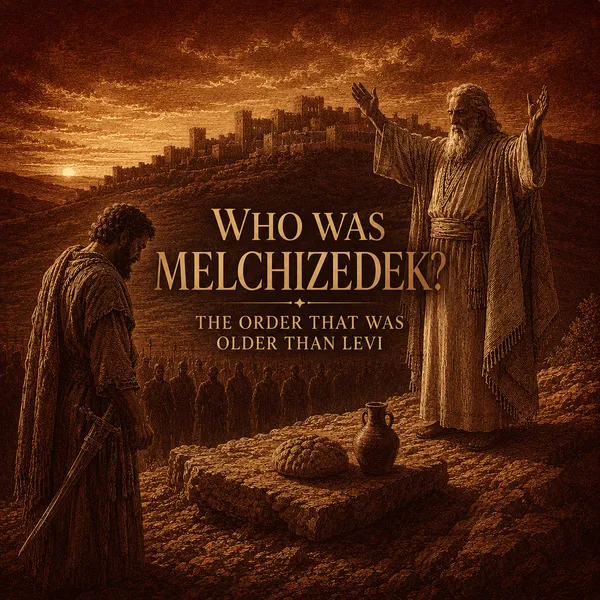
In its place came a different priesthood entirely. Not the line of Aaron, but the order of Melchizedek — the mysterious priest-king who blessed Abraham in Genesis 14, who served bread and wine, who had no recorded genealogy, who was not bound by tribe or by gender or by mortality. The book of Hebrews argues at length that Jesus is the eternal High Priest after the order of Melchizedek, and the writer of 1 Peter draws the consequence for the Bride:
A royal priesthood. Plural. Every believer. Revelation says it three times for emphasis — that He has made us kings and priests unto God (Revelation 1:6, 5:10, 20:6). This is not metaphor. This is the restoration of the priesthood pattern that existed in Eden before the Fall, when Adam and Eve walked with God in the cool of the day with no separating caste between them. The Fall broke the priesthood. The Resurrection restored it.
The fourth pillar rebuilt is that there is no longer a clerical caste between the believer and God. Every believer offers spiritual sacrifices. Every believer intercedes. Every believer carries the Presence. Every believer reads the Word and hears the Voice. The Reformation recovered this in principle — the priesthood of all believers — but most denominations did not carry it through structurally, and so we still operate as if there is a class of real priests (whether called pastor, father, reverend, bishop, or apostle) and another class of merely Christian laypeople.
That is the shadow of the old Aaronic pattern still hanging in the room.
The wider view is staggering. Kings and priests. Not priests only. Kings and priests. The Inheritance has been transferred. Believers are joint-heirs with Christ (Romans 8:17). Shiloh holds the sceptre, and those gathered to Him are not subjects only but co-regents in His Kingdom. The royal priesthood is the working aristocracy of the in-breaking Kingdom — a people indwelt, gathered, inherited into, who will reign with Him in the age to come.
Section VIWhy the Four Rise and Fall Together
Here is what most teachers miss. The Four-Fold Restoration is not four separate truths. It is one truth with four dimensions, and you cannot have any one without the others.
The vows on the heart require a New Temple, because heart-inscription requires the indwelling of the Holy Spirit, and the indwelt believer is the Temple. The New Temple requires the once-for-all Sacrifice, because the Holiest Place is occupied only because the Blood has been offered and accepted forever. The once-for-all Sacrifice requires the eternal Priesthood, because Aaron, being mortal, could never have offered an eternal offering — only a Priest who lives forever can secure a sacrifice that holds forever. And the eternal Priesthood, by its nature, makes every believer a Temple, because the Priest-King in Melchizedek's order does not stand between God and the people; He brings God's people into the Presence with Himself.
Pull on any one of these and the other three come with it. Keep any one of the old Aaronic features after the Resurrection — a separate priestly caste, an altar of sacrifice, a Holy of Holies behind a veil, a covenant that is only ever external — and you have preserved the others in shadow, whether you meant to or not.
Section VIIThe Four Inside the Larger Fulfillment
The four pillars are the heart of the matter — how the believer comes near to her King. But around them stands the wider architecture the Resurrection inaugurated, and the four cannot really be seen until the wider architecture is seen too.
The Kingship of Shiloh Now Reigns
The sceptre Jacob said would not depart from Judah until Shiloh came has now passed to Shiloh Himself, and He sits at the Father's right hand. All authority hath been given unto Me in heaven and on earth (Matthew 28:18). The Resurrection is not just the vindication of an innocent man; it is the enthronement of the rightful King over the in-breaking Kingdom.
The Ingathering of the Peoples Has Begun
The believing remnant of Judah, the lost tribes of Israel returning, the Sojourner from every nation grafted in — all gathered to the one Bridegroom. And unto Him shall the gathering of the people be. This is the corporate, cross-tribal, cross-national reordering of the human family that the four restorations make possible at the individual level.
The Adversary Has Been Judged
The head-wound promised in Eden has been struck. The serpent still operates within strict limits awaiting his final crushing, but his legal claim on the human race was broken at Calvary and sealed at the empty tomb. The God of peace shall bruise Satan under your feet shortly (Romans 16:20) — and the Bride participates in the very promise once made to the serpent in Eden. The serpent's head, our feet.
Death Itself Has Been Mortally Wounded
O death, where is thy sting? The faithful dead who had waited in the comfort-side of Sheol — what the Scriptures call Abraham's bosom — were led up with Him at His Resurrection. When He ascended up on high, He led captivity captive (Ephesians 4:8). Matthew records that the graves were opened; and many bodies of the saints which slept arose (Matthew 27:52) at the moment of His rising. Paradise has been relocated to the Presence of the risen Christ. To be absent from the body is to be present with the Lord (2 Corinthians 5:8) — a sentence that could not have been written before the Resurrection because it was not yet true. Now it is.
The Inheritance Has Been Transferred
The Bride is joint-heirs with Christ, co-regents in a Kingdom that has no end. The Eden pattern of priest-king and priest-queen walking with God in joint authority is restored and raised — no longer in a garden subject to a serpent, but in a Kingdom from which the serpent has been cast down.
The New Creation Has Begun
If any man be in Christ, he is a new creature; old things are passed away, behold, all things are become new (2 Corinthians 5:17). Already in the believer, not yet in the cosmos — the firstfruits planted, the harvest groaning to come. The mountain growing to fill the whole earth.
Section VIIIWhat the Empty Tomb Was For
This is the question the church has to be willing to ask: where in our own tradition have we kept a shadow that the Resurrection meant to remove? Where do we still treat the vows as external when the Spirit has written them inside? Where do we still treat the Temple as a building when the building is the believer? Where do we still treat the Sacrifice as re-offered when Hebrews says it was finished? Where do we still treat the priesthood as a caste when Scripture says we are all priests?
It is not a question to make us ashamed. The church has been faithful in much. Faithful believers have walked with Jesus for two thousand years under structures that were partly finished and partly still in shadow, and God in His mercy has met them where they were. He still does.
But the Bride is being made ready. The Bridegroom is coming for a people who walk in the full Four-Fold Restoration — the vows written on the heart, the Temple of the indwelling Spirit, the finished Sacrifice never re-offered, and the royal priesthood of every believer — and who know that those four sit inside a wider fulfillment: Shiloh on His throne, the peoples gathered, the serpent's head bruised, death dying, paradise reopened, the inheritance shared, the cosmos being made new.
That is the architecture of the New Covenant. That is what the Resurrection actually changed.
Charles Vance · Ten Words Press
The Kingdom of Heaven breaks in. The mountain grows. The Two are being made One.
That is what the empty tomb was for.
Comments
No comments yet. Be the first.