Those That Come After
The Joy Set Before Him — Gethsemane in the Eternal Now
·
The sweat falls like blood in Gethsemane.
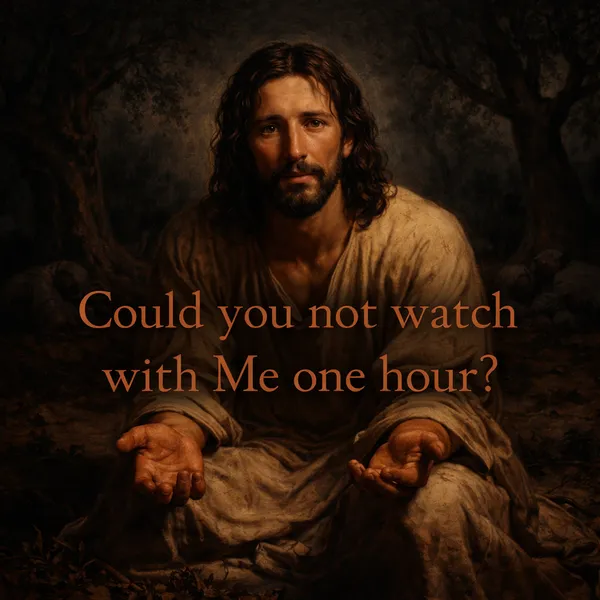
The disciples have failed Him. Peter, James, John — the inner circle, the ones He asked to watch and pray — are asleep on the ground fifty yards behind Him, their faces pressed into the dirt, their swords useless beside them. He asked one thing of them. One hour. They could not give it.
He kneels alone beneath the olive tree, and the weight of what is coming presses down on Him like a millstone on grain. In a few hours, Judas will arrive with torches. Then the binding. Then the mockery. Then the scourging. Then the nails. Then the darkness at noon. Then the cry — Eli, Eli, lama sabachthani — that will split the veil from top to bottom and shake the dead from their tombs.
He knows all of this. He has always known it. Before Abraham was, He is. He does not experience time the way the sleeping disciples do, the way Judas does, the way the high priest does. He dwells in the eternal now — the place where past and future collapse into the single, unbroken Presence of YHWH. He sees the end from the beginning, not because He has calculated it, but because He inhabits it. He is the Aleph and the Tav, the First and the Last, and every moment between is a room in His Father's house.
And so, kneeling in Gethsemane, drenched in the blood-sweat of agony, He sees them.
The Joy Set Before Him
"For the joy set before Him, He endured the cross, despising the shame, and sat down at the right hand of the throne of Elohim."
Hebrews 12:2For the joy set before Him. Not behind Him. Not beside Him. Before Him — in front of Him, ahead of Him, visible to Him in the garden while the disciples slept and the betrayer approaches.
What was that joy?
Not heaven. He came from heaven. Heaven was not a destination; it was home. He did not endure the cross to return to a place He had never left in His divine nature.
Not vindication. He did not need the resurrection to prove anything to Himself. He already knew who He was. He had told them plainly — "Before Abraham was, I AM" — and they had picked up stones.
The joy set before Him was them. The ones who would come after.
Look at the painting. Look past the Man kneeling under the olive tree and see what He sees. A hillside filled with faces. Modern faces. Faces from centuries He has not yet walked through in the flesh but has always inhabited in the Spirit. They are kneeling. They are holding Scriptures. Some of them are weeping. One of them wears a shirt with His Name on it — transliterated, Anglicized, stripped of its Hebrew root, but worn over a beating heart that knows nothing about etymology and everything about need.
These are the joy set before Him.
Not in the abstract. Not as a theological category. Not as a number on a celestial ledger. He sees faces. He hears voices. He knows the woman in the denim jacket who will open her Bible at three in the morning in a century called the twenty-first, desperate for a word, any word, and find one. He knows the man who will kneel in a prison cell in a country that does not yet exist and whisper His Name like contraband. He knows the child who will ask her mother, "Who is Yeshua?" and her mother will not know how to answer because the religion she inherited gave her a t-shirt when what she needed was a Covenant.
He sees all of them. Every generation. Every tongue. Every tribe. Every century. Not in sequence — not first-century, then second, then third, unspooling like thread from a bobbin — but all at once, in the eternal now, layered and present and real, their prayers reaching Him in Gethsemane as though time were nothing more than a curtain and their voices could pass through it because they can. Because they do.
The Prayers That Sustain Him
This is the part the theologians will struggle with. The part that offends systematic categories and makes the commentaries nervous. But the painting shows it, and Scripture supports it, and the Ruach HaKodosh confirms it to everyone who has ever prayed at three in the morning and felt — inexplicably, impossibly — that the prayer was not merely heard but received by Someone who needed to hear it.
He is sustained by their prayers.
Not because He is weak. Because He is human. Fully, completely, irrevocably human — not in appearance, not in simulation, but in the tearing, sweating, bleeding reality of flesh that can be broken. "He learned obedience through the things He suffered" (Hebrews 5:8). He did not play-act suffering. He suffered. And in Gethsemane, the suffering is so acute that His sweat becomes like great drops of blood falling to the ground — a medical reality, hematidrosis, that occurs only under extreme anguish.
The disciples are asleep. The Father has not yet sent the angel. And in that interval — that terrible, holy interval — the Man beneath the olive tree looks through time and sees a hillside filled with people who are praying.
They are praying for Him? No. That is not quite it. They are praying to Him, through Him, because of Him — and their prayers, rising from centuries He has not yet reached in His earthly body but has always occupied in His divine nature, reach backward through the curtain of time and settle on Him like dew. Like anointing oil. Like the hands of the women who will come to the tomb with spices, too late for the Body but never too late for the heart.
He hears a woman in Houston singing a psalm in her kitchen. He hears an old man in Seoul reading the Shema with failing eyes. He hears a teenager in Nairobi asking the question every teenager asks — Is any of this real? — and the answer is kneeling under an olive tree two thousand years before the question is spoken, and the answer is yes.
Their voices sustain Him. Their faith sustains Him. Not because His divinity requires human support, but because His humanity does. He chose to need them. He chose, in the most agonizing hour of the most consequential night in the history of creation, to draw strength not only from the angel the Father would send but from the Bride He was about to purchase with His own Blood.
This is the mystery of the incarnation that no creed has fully captured: the One who holds all things together (Colossians 1:17) chose to be held together by the prayers of those He was about to die for.
He Transcends
This is possible because He transcends. Not "transcends" in the philosophical sense — the abstract, detached, unmoved-mover sense that Greek philosophy bequeathed to Christian theology and that has poisoned the well for sixteen centuries. He transcends in the Hebraic sense: He fills all things, sustains all things, inhabits all things, and is not contained by any of them.
He is in Gethsemane in 30 CE. He is at the right hand of the Father in the eternal Presence. He is in the midst of two or three gathered in His Name in a living room in Tulsa in 2026. He is standing at the door and knocking in Laodicea and in every lukewarm assembly that has traded the Royal Covenant for a program and a parking lot. He is in all of these places not by division but by Presence — the same Presence that filled the tabernacle, that split the sea, that spoke from the fire at Sinai.
The eternal now is not a philosophical abstraction. It is His address. It is where He lives. And because He lives there, every prayer ever prayed reaches Him not after a delay, not after routing through celestial bureaucracy, but immediately — which means, in the most literal sense, without mediation by time.
When the woman in the painting kneels with her Bible open and her head bowed, she kneels in Gethsemane. She does not know this. She thinks she is in her living room, or on a hillside in her imagination, or in a painting she found on the internet. But the Man beneath the tree knows where she is. She is with Him. Her prayer is reaching Him in the hour when He needs it, in the hour when the disciples have failed and the betrayer is walking, in the hour when the cup has not yet been taken and the will has not yet been surrendered and the sweat is falling like blood.
She is the joy set before Him.
The Cup and the Crowd
"Father, if it is possible, let this cup pass from Me; yet not as I will, but as You will."
Matthew 26:39Three times He prays this. Three times. The number of complete witness. And each time, the answer is the same: the cup will not pass. He must drink it. The Covenant requires it. The Blood must be shed. The Passover Lamb must be slain at three in the afternoon on the fourteenth of Aviv, and there is no substitute, no alternative, no plan B.
But between the prayer and the answer — in that space where the agony lives — He looks up. And He sees them. The crowd. The hillside. The centuries. The faces.
He sees the ones who will be baptized in His Name in rivers and bathtubs and horse troughs. He sees the ones who will be martyred — thrown to lions, burned at stakes, shot in fields, beheaded on camera — and who will die with His Name on their lips because His death gave their death meaning. He sees the ones who will stumble, fail, deny Him three times before the rooster crows, and come back weeping — because Peter was not the last man to weep at his own cowardice, and he was not the last man to be restored by a Bridegroom who asks only, "Do you love Me?"
He sees the ones who will get it wrong. The ones who will build empires in His Name that look nothing like His Kingdom. The ones who will print t-shirts and miss the Covenant. The ones who will argue about doctrine while the widow next door goes hungry. He sees all of it — every cathedral and every inquisition, every revival and every schism, every hymn and every heresy — and He does not look away.
Because behind every error, underneath every distortion, despite every betrayal of the Covenant by those who claim to carry it, there are those faces. The ones who kneel. The ones who pray. The ones who open the Book and find the Ten Words still there — still incorruptible, still carved by the Finger of Elohim, still saying what they have always said: I am YHWH your Elohim. You shall have no other gods before Me.
These are the ones the Covenant was made for. These are the Bride. Judah's remnant, Israel in exile, the sojourner grafted in — one people, one Covenant, one Bridegroom, one Table. They do not yet see what He sees. They see dimly, through a glass, through two thousand years of accumulated religion and mistranslation and institutional drift. But they kneel. And they pray. And their prayers reach Gethsemane.
The Third Prayer
The third time He prays, something shifts. Not in the words — the words are the same. But in the Man. The agony does not leave. The cup does not pass. But He rises from His knees, and He walks back to the sleeping disciples, and He says the words that divide time itself:
"Rise, let us be going. Behold, the one who betrays Me is at hand."
Matthew 26:46He has made His decision. He will drink the cup. He will go to the cross. He will become the Passover Lamb, slain at the ninth hour, buried before sunset, sealed in stone for three days and three nights, and raised at the close of the Sabbath — every detail aligned with the moedim, the appointed times, the covenant calendar that YHWH set in the heavens before the foundation of the world.
And He makes this decision not only because the Father wills it, not only because the Covenant requires it, but because He has seen the hillside. He has heard the prayers. He has looked through time and found the joy set before Him — a Bride, imperfect and stumbling, wearing t-shirts and kneeling in dirt, holding books they do not fully understand, praying prayers they do not know are reaching a garden in Jerusalem on the night before the world changed forever.
He rises for them.
He walks toward the torches for them.
He stretches out His arms for them.
Those that come after do not merely follow a Man who lived and died and rose. They sustain Him. Their prayers, their faith, their fumbling love — these are the joy set before Him in the hour of His greatest agony. They reach Him across time because He transcends time. They strengthen Him in Gethsemane because He chose, in the mystery of His incarnation, to be strengthened by the very Bride He was purchasing.
The tree still stands.
The Man still kneels.
The prayers still reach Him.
And the joy — the joy that carried Him through the cross and the grave and into the eternal Presence at the right hand of the Father — that joy is still being set before Him, every time one of those that come after opens a Book, bends a knee, and whispers His Name into the dark.
Yeshua.
YHWH Saves

Comments
No comments yet. Be the first.