The Ministry of Jesus Was Not
Three and a Half Years
The Daniel Payload — The Fractal Seventy Sevens
·
The Year the Prophets Declared
How long was the ministry of Yeshua? Ask almost anyone and the answer comes back without hesitation: three and a half years. It is dogma. Press them for chapter and verse and the room goes quiet — because the Canon never says it. What the Canon does say, repeatedly and without ambiguity, is year. Singular.
Yeshua Himself read this passage aloud in the Nazareth synagogue, declared “Today this is fulfilled in your hearing,” and sat down (Luke 4:18–21). He did not read the next clause about the day of vengeance. He announced the scope of His mission: one year. The acceptable year.
The prophets said year. Yeshua said year.
The burden of proof falls entirely on anyone who claims otherwise.
The Parable That Confirms It
Some will point to the parable of the fig tree in Luke 13:6–9 as evidence for a three-and-a-half-year ministry. A man comes seeking fruit on his fig tree for three years and finds none. He tells the vinedresser to cut it down. But the vinedresser replies, “Sir, let it alone this year also, until I dig around it and fertilize it. And if it bears fruit, well. But if not, after that you can cut it down.”
At first glance, this seems to support three years. But read it again. If the three years are the ministry, then “this year also” is a fourth year — and nobody argues for a four-year ministry. The math does not work on their own terms.
The parable has two actors doing two different things. The owner of the vineyard has been visiting for three years and finding nothing. That is not Yeshua’s ministry. That is what came before Him — the prophets, the second temple establishment, the religious leadership. Three years of the Holy One seeking fruit and finding none.
Then the vinedresser steps in. He is a different actor with a different approach. He does not visit and judge. He digs around the roots. He fertilizes. He tends. And he asks for one year. “Let it alone this year.” One year of a different kind of intervention.
The three years are the backdrop of failure. The “this year” is the ministry. Isaiah 61:2 in parable form. The acceptable year.
The Typology of the First Year
The sacrificial system confirms the same testimony. When the Canon specifies the age of a sacrifice, the requirement is consistent: of the first year.
Numbers 28:9 — the Sabbath offering: lambs in their first year. Numbers 28:11 — the new moon offering: lambs in their first year. Numbers 28:19 — the Passover feast offering: lambs of the first year.
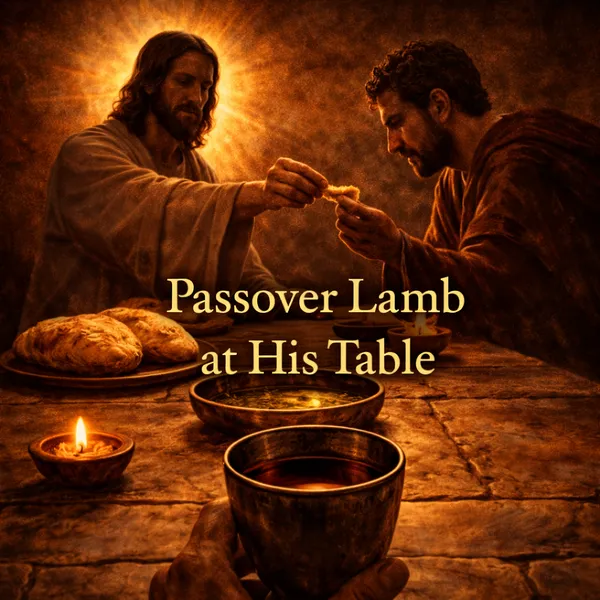
And Paul identifies Yeshua directly with the Passover lamb in 1 Corinthians 5:7: “For indeed Messiah, our Passover, was sacrificed for us.” The type demands a first-year animal. A ministry of three and a half years breaks the typology. Messiah is the Passover lamb — of the first year.
The red heifer of Numbers 19:2 adds a further witness. Though the text does not specify age, it requires an animal “upon which a yoke has never come.” Any farmer or rancher understands the practical implication: a beast left unyoked and unbridled for three and a half years would be nearly unmanageable. The ordinance assumes a young animal taken before the yoke becomes necessary, offered while still unbroken. Messiah wore no man’s yoke — no religious system, no political faction, no earthly institution. He was offered young, in the prime of His acceptable year.
The Daniel Payload
With the one-year ministry established from the prophets, from Yeshua’s own words, from parable, and from typology, we can now turn to Daniel and discover something remarkable: the prophet already encoded this ministry — not once, but at three scales.
Daniel 9:24 delivers the mission brief. Six purposes are assigned to the seventy sevens: finish the transgression, make an end of sins, make atonement for iniquity, bring in everlasting righteousness, seal up vision and prophet, and anoint the Most Holy. This is the complete Covenant transaction. Everything Messiah came to accomplish is listed in this single verse.
Daniel 9:25–27 then lays out the timeline: seventy sevens, divided into segments, culminating in Messiah being cut off and sacrifice ceasing. Nearly every interpreter reads these seventy sevens as 490 years. And they are right — at the first scale. But the prophecy does not stop unpacking there. The seventy sevens are fractal — the same covenantal pattern repeating at three resolutions. Not allegory. Not spiritualizing. Scale invariance. The Covenant sharpens at every magnification.
The macro layer. Four hundred and eighty-three years — sixty-nine sevens — from the decree to restore and rebuild Jerusalem, running through the Persian period and the intertestamental centuries. This is the layer every student of Daniel recognizes. It answers the question: When will Messiah come? And the answer is precise. The prophetic clock ticks for 483 years, Yeshua is immersed, endures forty days of temptation in the wilderness, and emerges on Aviv 1 — the head of the year, the beginning of the feast cycle. John sees Him and speaks the first words of His public ministry: “Behold the Lamb of God” (John 1:29). The Passover lamb has been identified at the start of the Passover month. The sixty-nine sevens deposit Messiah at the starting line of the covenantal calendar.
That leaves the seventieth seven. Everyone assumes it must also be seven years — and this is where the three-and-a-half-year dogma is born. They split the final seven in half and map the first half onto the ministry. But the final seven is not seven years. It is seven literal days. The Passion Week. The scale shifts — and that shift is where the fractal reveals itself.
The 490-day clock begins at the Jordan — the immersion itself. This is the “anointing of the Most Holy” from Daniel 9:24. The Spirit of the Holy One descends on Yeshua. The Father speaks. Day one.
Forty days of temptation in the wilderness follow — inside the count, not before it. Then Yeshua emerges on Aviv 1, the head of the year, the beginning of the feast cycle. John sees Him and declares, “Behold the Lamb of God” (John 1:29). The Passover lamb identified at the start of the Passover month. The forty days are the offset between the private anointing and the public declaration. The ministry moves through three decisive moments from here.
The Crucifixion — Messiah is cut off, but not for Himself. In a single day, three of the six purposes reach fulfillment: transgression is finished, sin is ended, atonement is made. Sacrifice and offering cease — not because a Roman army destroys the Temple decades later, but because the reality to which every sacrifice pointed has arrived in His body on the tree.
Shavuot — The Baptism by Fire — The remaining days after the resurrection carry through to Pentecost. The Spirit of the Holy One falls publicly on the Temple Mount, where the multitudes have gathered for the feast — not hidden in a private venue, but in the open, at the place of sacrifice, before the assembled nation. The rushing wind, the tongues of fire, the three thousand who respond. Everlasting righteousness is brought in. Vision and prophet are sealed — every prophetic word converges and is satisfied. What was accomplished covenantally at the cross is now distributed to the Bride. The 490 days close.
One Passover cycle. The prophets confirm it.
The typology confirms it. The Synoptics confirm it.
Here is the seventieth seven. Not seven years. Not three and a half years split from a hypothetical second half. Seven literal days. The Passion Week.
Messiah enters Jerusalem. He teaches, He confronts, He serves. In the middle of the seven, He is cut off. Sacrifice and offering cease — not in some distant future, not by imperial decree, but in that hour, in His flesh. The veil tears. The transaction is complete.
Death. Burial. Resurrection. This is the irreducible seed of the entire pattern. The seven days that the 483 years were always pointing toward, that the 490 days were always converging upon. The fractal bottoms out here. There is no smaller scale. This is the foundation. The seventieth seven was always the Passion Week.
So Why Does Everyone Say Three and a Half Years?
The entire three-and-a-half-year tradition rests on one Gospel — John — and depends on counting multiple Passovers within his narrative, reinforced by the assumption that Daniel’s seventieth week splits in half and maps the first half onto Yeshua’s ministry. But the Passover count requires two assumptions that do not hold under scrutiny.
The first assumption involves John 5:1, which mentions “a feast of the Jews” without naming it. Tradition identifies this unnamed feast as a Passover, but the text never says so, and the historical context identifies it as Shavuot. John names Passover explicitly when he means it (John 2:13, 6:4, 11:55). His silence here is not an accident. The feast in question is not Passover. Calling it one is an interpretation, not a reading.
The second assumption involves John 6:4, which does name a Passover: “Now the Passover, a feast of the Jews, was near.” This verse is the sole basis for inserting a third Passover into the narrative. But it is disputed. It is absent from several early manuscripts. Scholars have identified it as a probable scribal insertion, added to harmonize the Gospel with an emerging liturgical calendar that needed a longer ministry to fill its annual readings.
More than disputed — the verse introduces clear error into the text and makes Messiah a sinner. Deuteronomy 16:16 requires every male to appear before YHWH at the chosen place three times a year — Passover, Shavuot, and Tabernacles. If John 6:4 is authentic, Yeshua is in the Galilee during Passover, nowhere near Jerusalem. The sinless Lamb of God is violating the Covenant He came to fulfill. A law-breaking sacrifice is no sacrifice at all. The entire typology collapses.
And it is not only Yeshua. If this is Passover, the Pharisees are also in the Galilee — arguing with Him by the Sea of Galilee instead of appearing at the Temple as required. These are the men who tithed mint and cumin, who strained gnats from their wine, who built their entire identity on meticulous observance. We are asked to believe they skipped Passover in Jerusalem to follow a rabbi around the countryside. The verse turns the entire characterization of the Pharisees in the Gospels on its head. It muddies the narrative at every level.
Remove John 6:4 and every problem vanishes. Yeshua never misses a required feast. The Pharisees are where they should be when they should be there. The narrative flows without contradiction. The timeline compresses to one year. The Canon is clean.
The traditional count needs both of these — the Shavuot feast misidentified as Passover at 5:1, and the disputed insertion at 6:4 — to arrive at four Passovers: John 2:13, the misidentified one at 5:1, the inserted one at 6:4, and the final one at 11:55. Four Passovers give them roughly three and a half years. Pull either leg and the structure falls. Without both assumptions, John records two Passovers — one at the beginning of the ministry and one at the end. One year. The same testimony as the Synoptics. The same testimony as the prophets. The same testimony as the typology.
The Canon says year. The typology says first year. Daniel encoded it at three scales.
One misidentified feast and one disputed verse that introduces sin into the sinless —
that is all that stands between the dogma and the truth.
One Holy One, One Covenant
At every layer of the fractal, the same Holy One is the actor.
At the Jordan — His Spirit descends on Messiah. The Holy One anoints His own.
At the cross — Yeshua commits His spirit back to the Father. The Holy One accomplishes atonement through His servant.
At Shavuot — the Spirit of the Holy One falls on the Temple Mount before the assembled nation. What was concentrated in one man is now poured out on the Bride.
One Holy One. One Spirit. One Covenant.
Unpacking across 490 years, 490 days, and seven final days.
The prophets said year. Yeshua said year. The typology says first year. The Canon says year. Daniel encoded it. And the only thing that says three and a half years is one misidentified feast, one disputed verse that introduces sin into the sinless, and a tradition that never questioned either.

Comments
No comments yet. Be the first.