Tell No One
·
The traditional portrait of Yeshua as a penniless wanderer collapses under the weight of the Gospels' own evidence. He had a home in Capernaum. He employed a full-time treasurer. Women of extraordinary wealth funded His ministry from their personal estates. His family attended three annual pilgrimages to Jerusalem for thirty years. And when He was betrayed, the price was denominated in Tyrian shekels — Temple currency — counted out to a man who had been embezzling from the ministry's treasury for months without anyone noticing the shortfall.
The question is not whether Yeshua had access to substantial resources. The Gospels make that unavoidable. The question is where the resources came from — and why no one talks about it.
The thesis begins in Babylon. Daniel — prophet of YHWH and rab mag, chief of the Magian priestly caste — held dual authority unmatched in Scripture. He administered the wealth of empires. He received "many great gifts" from Nebuchadnezzar. He survived regime change from Babylon to Persia with his authority intact. And he possessed three things no one else on earth had simultaneously: prophetic knowledge of the Messiah's coming, institutional control of the Magian order, and access to the treasury of the ancient world's wealthiest empire.
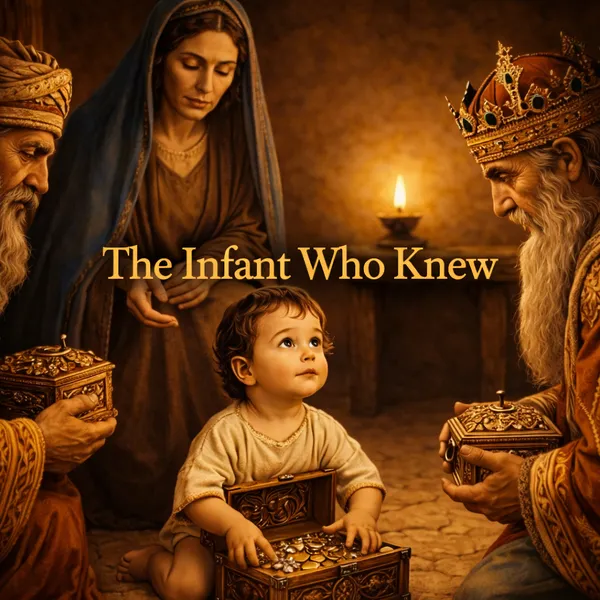
Did Daniel establish a trust? The Magi arrived five centuries later with gold, frankincense, and myrrh, saying, "We saw His star." They traveled eight hundred miles with an armed escort large enough to trouble all Jerusalem. They presented gifts scaled to royal protocol. And they knew exactly where to look — because they had been trained to watch, generation after generation, preserving Daniel's instructions across five hundred years of institutional memory.
"There shall come forth a Rod from the stem of Jesse, and a Branch shall grow out of his roots." Isaiah 11:1
The gifts were not a spontaneous gesture of worship. They were the delivery of an endowment — the trust's first visible disbursement, timed to the hour. The treasure arrived before the sword. Herod's massacre followed the Magi's departure. The gold paid for the flight to Egypt. Providence did not merely warn the family. It funded the escape.
In Alexandria, the wealthiest Jewish city on earth, the family had access to banking networks, synagogue communities, and a financial corridor stretching back to Babylon. They converted portable treasure into managed assets. They established the relationships that would sustain them for decades. And then they returned to Nazareth — a village whose very name, Natzeret, derives from the Hebrew word for "branch," a Davidic settlement populated by descendants of the royal house of Jesse.
For thirty years the family lived behind the cover of a carpenter's trade. Joseph worked as a tekton — not because the family needed the income, but because the trust required the cover. A household living on invisible wealth in a village of four hundred people would have attracted immediate suspicion. The trade explained everything the neighbors needed to see and concealed everything they were not meant to know.
And here the theological dimension becomes essential. Yeshua is God. He could have turned limestone into gold with a whisper. He did not. For thirty years there is no recorded instance of Him exercising supernatural power. John calls the water-to-wine at Cana "the beginning of signs" — the archēn, the origin. Before Cana, no signs. The incarnation was not a costume. The Son took on flesh and submitted to the full weight of the Torah's demands as a man. He ate purchased food. He wore made clothing. He attended feasts funded by real silver. The trust was not a backup plan for a God who lacked power. It was the primary plan for a God who chose limitation.
The cover cracked at a wedding in Cana, where Mary commanded hired servants and was instantly obeyed — the behavior of a woman with authority, not a charity guest. It cracked further in Capernaum, where the family relocated to a property the Gospels call "His own city," staffed a ministry household, and operated from a base large enough to accommodate the Twelve, visiting disciples, and crowds pressing against the door.
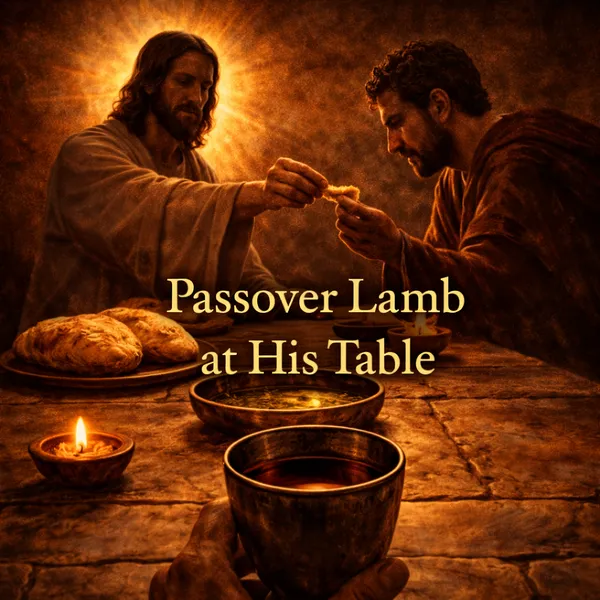
The ministry had a treasury — the glossokomon, a dedicated money box carried by Judas Iscariot. It received contributions from women of means, including Joanna, wife of Herod's chief financial officer. The treasury was large enough that Judas's habitual embezzlement went undetected. The disciples could contemplate a single expenditure of three hundred denarii — nearly a year's wages — without apparent strain. When Judas left the upper room, the others assumed he had gone to make large purchases or distribute charitable gifts. At a moment's notice. At night. During Passover.
And the Messianic Secret — Yeshua's repeated commands to "tell no one" — takes on new dimension as the operational security of a funded mission with a fixed timeline. A man with nothing has nothing to protect. A man managing a sacred trust on a prophetic calendar has everything to protect. The silence commands preserved the timeline so that every shekel could be spent in its proper sequence, every prophecy funded to fulfillment, every feast attended — before the appointed hour.
The financial narrative began in gold and ended in silver. Thirty Tyrian shekels — the price of a slave, prophesied by Zechariah to the syllable — bought the betrayal. Judas threw the coins into the Temple sanctuary. The priests bought a potter's field. Every detail fulfilled. The metals descend: gold to silver to the iron in His blood — hemoglobin built on iron atoms, the basest metal, poured out on a cross forged from the same element. Gold could not pay the debt. Silver could not pay it. Only the iron in His veins was the currency heaven accepted.
"It is finished." John 19:30
Tetelestai — a commercial term written on ancient receipts. Paid in full. The trust exhausted. The mission complete.
Fifty days later, Peter stood at the Beautiful Gate and delivered the final audit: "Silver and gold I do not have, but what I do have I give you: In the name of Yeshua the Messiah of Nazareth — rise up and walk." The silver was gone because it had done its job. The Name replaced the treasury. The currency changed. The power did not.
Comments
No comments yet. Be the first.