The Feasts You Will Keep
The Appointed Times of the LORD in the Kingdom to Come
A word to every preacher who mocks the Feasts as "Jewish fables," and to every believer who has been taught to laugh along
·
This article responds to a publicly posted sermon, available in full at x.com/sanderson1611. The link is provided for transparency, so readers may weigh the source against Scripture for themselves. Ten Words Press does not endorse the sermon's teaching or its characterizations of any people; this response addresses its claims concerning the Feasts of the LORD and the family of God, and nothing more. All quotations from the sermon are cited for the purpose of commentary and correction.
Section IThe Question Behind the Mockery
A sermon has been circulating that treats the appointed times of God as enemy territory. In it, the Feasts are lumped together with "diet and blowing trumpets and wearing funny clothes" as carnal garbage; the believer who honors them is compared to a costumed fan at a science-fiction convention. The preacher is confident that the whole subject belongs to a category he calls "Jewish," and that the Christian's only duty toward it is distance.
Let us grant him, at the outset, everything he is right about. No feast ever saved a soul. No calendar observance adds one ounce to the finished work of the Cross. Salvation is by grace through faith in the Messiah, and any teacher who makes a festival a condition of redemption has fallen into the very error Paul burned down in Galatia. On that ground we stand together, and we do not move.
But the mockery rests on two assumptions the preacher never examines, because his tradition never taught him to. The first is that the Feasts are Jewish: that they belong to one people, and Christians are another. The second is that the Feasts are finished: relics of a closed dispensation, with no place in the future God has written. Scripture contradicts both assumptions by name, chapter, and verse. And the second contradiction carries a warning this preacher, of all men, needs to hear: the prophets declare that the Feasts of the LORD will be kept in the Millennial Kingdom, by all nations, under the reigning King, with drought decreed upon any family that refuses. If he is a true believer, he will be there. And he will be keeping the very feast he mocks.
Section IIWhose Feasts Are They? Hebrew, Not Jewish; and the LORD's Before Either
Open Leviticus 23, the charter chapter of the appointed times, and read the ownership language carefully. It is the most neglected pronoun in the modern church.
Not the feasts of the Jews. Not the feasts of Moses. Not the feasts of a passing age. My feasts: the Feasts of Yahweh, the Name God revealed at the burning bush, written in the Hebrew text with the four letters YHWH. The Hebrew word rendered "feasts" is moedim: appointed times, fixed meetings, appointments the King Himself placed on the calendar of His creation. The sun and moon were hung in the heavens partly for this purpose, "let them be for signs, and for seasons" (moedim, the same word) "and for days, and years" (Genesis 1:14). The appointments predate Sinai in the architecture of the world itself.
And if the Feasts must carry any adjective of heritage at all, the accurate one is Hebrew, not Jewish. The word "Jew" descends from Judah, one tribe of the twelve, and does not even appear in Scripture until 2 Kings 16:6, roughly seven centuries after Sinai. The nation that stood at the mountain and heard the appointments proclaimed was not "the Jews"; it was the Hebrews, the name Scripture gives Abraham himself (Genesis 14:13), all twelve tribes together with the mixed multitude that came up out of Egypt with them (Exodus 12:38). To call the moedim "Jewish" is to shrink a twelve-tribe inheritance down to one tribe's name and hand the other eleven their walking papers. They are Hebrew feasts by language and lineage; they are the LORD's feasts by title and deed; and the title outranks the lineage.
Scripture never once calls them "Jewish feasts" as a category of ownership. When John writes "a feast of the Jews," he is locating an event for Greek readers, not transferring the deed. The deed never moved. They are His feasts, proclaimed to His people; and the question of who His people are is precisely where the sermon's second error begins.
To call the Feasts "Jewish" is to misfile the property of the King. A man may argue about how the New Covenant believer relates to the appointed times; that is an honest discussion. But he may not relabel what Yahweh has claimed by Name. "These are my feasts" settles the title question forever.
Section IIIThe Family of God Is Twelve Tribes, Not Two Categories
The sermon operates on a two-box theology: there are "the Jews" over there, and "the Christians" over here, and the Gospel's work is to keep the boxes separate. But this is not the architecture of the Bible. The family of God, from Genesis to Revelation, is Israel: twelve tribes, one people, one Covenant; and the miracle of the Gospel is not that God started a second family, but that He opened the doors of the first one to the whole world.
Consider where the New Covenant itself is addressed. The preacher loves the New Testament; let him read the address label on it:
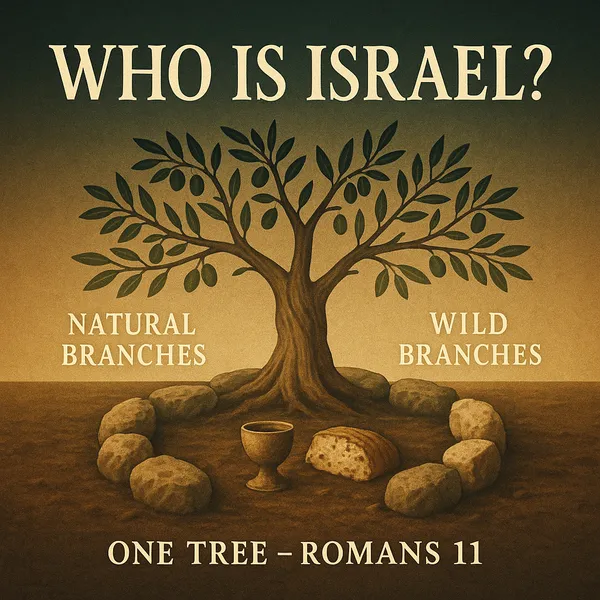
Two houses, the northern kingdom scattered into the nations and the southern kingdom of Judah, and no third party. There is no covenant made with "the Gentiles" as a separate entity. Whoever drinks the cup of the New Covenant is drinking a cup poured for the house of Israel and the house of Judah, which means every believer at that table has been brought inside Israel's Covenant or has no covenant at all. Paul says exactly this to the believers at Ephesus, Gentiles by birth every one of them: you were "aliens from the commonwealth of Israel, and strangers from the covenants of promise... But now in Christ Jesus ye who sometimes were far off are made nigh by the blood of Christ... Now therefore ye are no more strangers and foreigners, but fellowcitizens with the saints, and of the household of God" (Ephesians 2:12–19). The commonwealth they join is Israel's. The promises they inherit are Israel's. The Olive Tree they are grafted into, Paul warns in Romans 11, is Israel's cultivated tree; and the wild branch that boasts against the natural branches is commanded to fear.
The pattern holds to the last page of the Book. James addresses his letter "to the twelve tribes which are scattered abroad" (James 1:1). Paul before Agrippa speaks of the hope of "our twelve tribes, instantly serving God day and night" (Acts 26:7). The sealed multitude of Revelation 7 is counted tribe by tribe, twelve by twelve. And when the New Jerusalem descends, John records a detail the two-box theology cannot survive:
Every gate of the eternal city bears a tribal name. There is no Gentile gate. Whoever enters, enters through Israel, because the family of God has never been anything else.
Ten Words Press
This is the truth that dissolves both of the church's oldest errors at once. It leaves no room for the teaching that ethnic descent confers covenant privilege: the wild branch and the natural branch stand in the same tree by the same faith, and "there is neither Jew nor Greek... ye are all one in Christ Jesus" (Galatians 3:28). But read the next verse, the one the sermon never finishes: "And if ye be Christ's, then are ye Abraham's seed, and heirs according to the promise." One in Christ does not mean one in a new, Israel-free entity. It means one in Abraham's family: the Bride of twelve tribes, gathered from Judah, from the scattered house of Israel among the nations, and from every sojourner who takes hold of the Covenant. A preacher cannot claim Abraham's inheritance while despising Abraham's household and mocking the household calendar. The estate and the family come together.
Section IVThe Calendar of Redemption Is Half Fulfilled
Here the appointed times reveal what they always were: not arbitrary rituals, but prophecy set to a calendar, dress rehearsals for the acts of the Messiah, each fulfilled not approximately but on its own day. Paul says it outright: the feast days are "a shadow of things to come; but the body is of Christ" (Colossians 2:16–17). Note his tense. Things to come. A shadow is cast by a real body standing in real light; you do not mock the shadow without mocking the body that casts it.
| Appointed Time | Rehearsal | Fulfillment | Status |
|---|---|---|---|
| Passover | The lamb slain, the blood applied | The Messiah crucified: "Christ our passover is sacrificed for us" (1 Cor. 5:7) | Fulfilled on its day |
| Unleavened Bread | Purging of leaven | The sinless body in the tomb; sin put away | Fulfilled on its day |
| Firstfruits | The first sheaf waved | The Resurrection: "Christ the firstfruits" (1 Cor. 15:20, 23) | Fulfilled on its day |
| Weeks (Pentecost) | Harvest; the Covenant at Sinai | The Ruach HaKodosh poured out (Acts 2:1) | Fulfilled on its day |
| Trumpets | The awakening blast | Resurrection "at the last trump" (1 Cor. 15:52; 1 Thess. 4:16) | Awaiting fulfillment |
| Atonement | National affliction and cleansing | "They shall look upon me whom they have pierced" (Zech. 12:10) | Awaiting fulfillment |
| Tabernacles | Yahweh dwelling with His people | The Kingdom reign; "the tabernacle of God is with men" (Rev. 21:3) | Awaiting fulfillment |
The spring appointments were kept by the Bridegroom to the day: crucified at Passover, buried during Unleavened Bread, raised at Firstfruits, the Spirit given at Pentecost. Four appointments, four fulfillments, a perfect record. The autumn appointments (Trumpets, Atonement, Tabernacles) stand open on the calendar, pointing at the resurrection, the national turning of Israel, and the Kingdom itself. To declare the Feasts obsolete is to tear the second half of the prophetic calendar out of the Book while the ink of the first half is still vindicating it. Even the Messiah, at the last supper, set a future appointment at a Covenant table: "I will not drink henceforth of this fruit of the vine, until that day when I drink it new with you in my Father's kingdom" (Matthew 26:29). He is not finished feasting. Neither is His Bride.
Section VZechariah's Millennium: Attendance Is Not Optional
Now to the text that ends the argument. Zechariah 14 describes the Day of the LORD and what follows it: the King's feet on the Mount of Olives, the nations judged, and "the LORD shall be king over all the earth" (Zechariah 14:9). Then, with the Kingdom established and the King enthroned in Jerusalem, the prophet records the standing ordinance of the Millennial age:
Read it slowly, preacher. This is not Israel keeping a feast while the church watches. This is all the families of the earth: the nations, the Gentiles, the very people your theology exempts, commanded up to Jerusalem year by year to keep the Feast of Tabernacles before the reigning King. And the sanction for absence is not a footnote: no rain. Egypt is named specifically in verse 18; if her family does not come up, "there shall be the plague." The Feast of Tabernacles, in the Kingdom, is enforced by the weather. Heaven itself withholds the harvest from the household that despises the appointment.
Nor does Zechariah stand alone; the Law requires two or three witnesses, and the prophets supply them. Ezekiel's vision of the Kingdom temple ordains Passover and Tabernacles kept in their seasons under the Prince (Ezekiel 45:21–25), with the people worshiping at the gate "in the sabbaths and in the new moons" (Ezekiel 46:3). Isaiah closes his prophecy with the rhythm of the restored world: "from one new moon to another, and from one sabbath to another, shall all flesh come to worship before me, saith the LORD" (Isaiah 66:23). All flesh. On the calendar of Heaven. Forever.
If the preacher is a true believer, he will keep the Feast of Tabernacles. Not as a Judaizer, not under compulsion of the tutor, but as a citizen of the Kingdom under its King, going up with all the families of the earth, year by year, to the feast he once called cosplay. The only men absent from Tabernacles in the Millennium are the rebellious and the unredeemed. There is no third gallery for Baptists who found the whole thing embarrassing.
Sit with the irony for a moment, because it is the mercy of God wearing a stern face. The man who mocks trumpets will rise at the sound of one. The man who sneers at booths will worship the King at the festival of booths. The calendar he consigned to the fables will be the public liturgy of the world he hopes to inherit. He will not be dragged to it; he will be glad of it, because in that day his eyes will be opened and he will see what the Feasts were always for: the King dwelling with His people, the marriage supper rehearsed at last in the presence of the Bridegroom. But how much better to understand it now than to be surprised by joy he spent his ministry ridiculing.
Section VIWhat This Does Not Mean
Let the boundaries be stated as plainly as the thesis, so no one can wrench this article into the opposite error. This is not a summons to salvation by calendar. The believer who keeps the Feasts today keeps them as rehearsal and remembrance, resting entirely on the finished work of the Messiah; and the believer who does not keep them is not thereby condemned, for "one man esteemeth one day above another: another esteemeth every day alike. Let every man be fully persuaded in his own mind" (Romans 14:5). The compulsion Paul fought in Galatia is dead, and Ten Words Press will not resurrect it. Neither is this a call to rabbinic compliance; the appointed times belong to Yahweh, not to any council's fence around them.
But Romans 14 is a two-edged liberty, and the sermon wields only one edge. If the feast-keeper may not judge the abstainer, then the abstainer may not despise the feast-keeper; that is the verse's own symmetry, "let not him that eateth despise him that eateth not; and let not him which eateth not judge him that eateth" (Romans 14:3). A preacher who extends patience to vegetarians and contempt to believers honoring the appointments of Leviticus 23 has not applied Paul; he has inverted him. The brother rehearsing Tabernacles in his backyard sukkah is not a heretic. He is early.
Section VIILearn the Songs Before the Wedding
The Feasts of the LORD are the wedding rehearsal of the universe. Passover was kept for fifteen centuries before the Lamb stood up at the table and said, "this is my body." Pentecost was kept for fifteen centuries before the fire fell on the very day. The rehearsals were not wasted years; they were the reason a remnant recognized the fulfillment when it came. The autumn feasts are being rehearsed right now, by a Bride gathered from twelve tribes and every nation, against the day the trumpet sounds and the King descends and the whole earth goes up to Jerusalem to dwell in booths with its God.
So this is the closing word to the pulpit that laughs: you are invited, not indicted. Put down the mockery and pick up Zechariah 14. Trace the calendar your own King kept to the day. Ask why every gate of the city you preach about carries the name of a tribe of Israel. The Feasts do not threaten your Gospel; they are your Gospel, set to seasons: grace with a date on it. You will keep Tabernacles in the Kingdom, preacher, if indeed you belong to the King. The only question the appointed times put to you is whether you will meet them for the first time on that day, a stranger to your own inheritance, or whether you will walk into the Millennium already knowing the songs.
Comments
No comments yet. Be the first.