Abjure the Realm
The Road
Part Three of a series — the oath, the cross placed in your hands, and the one road out
·
Section IThe Oath Spoken Aloud
In Part Two we left a guilty man on the threshold of the sanctuary, wrestling with doubt while the Spirit pressed but would not force. That wrestling does not end with every question answered. It ends when the old world has become unbearable — when a man has tasted enough of a different kingdom that he can no longer pretend he never breathed its air. And when that moment comes, it is not kept silent. It is spoken.
In the medieval system, the abjurer did not merely feel something shift inside him. He confessed his crime aloud before the king's coroner, surrendered everything he owned, and swore a binding oath — the most serious legal instrument in that whole world — that he would leave the realm and never return. The oath was not a mood. It was a public, witnessed, irrevocable act. From the moment it left his lips, he was a different man under a different authority.
The modern church has nearly lost this. We have reduced the most consequential decision a human being can make to a soft, private feeling — "I asked Jesus into my heart" — language so gentle it could describe inviting a friend to dinner. But Scripture never treats covenant entry as a vague inner warmth. It treats it as an oath sworn between two parties, sealed in blood, with everything on the table.
When God made covenant with Abraham, the ground ran with the blood of split animals. When Israel stood at the foot of the mountain, they swore aloud together: all that the LORD hath spoken we will do. A covenant is not a sentiment. It is a vow. And the believer who has truly turned has not merely felt something. He has sworn something — and the swearing changes his citizenship.
Confess with your mouth. The crossing has a spoken word in it. You are not a tourist who wandered into grace for a season. You have taken an oath. You are a citizen of somewhere else now, under a new authority, by your own sworn word.
Section IIThe Cross Placed in Your Hands
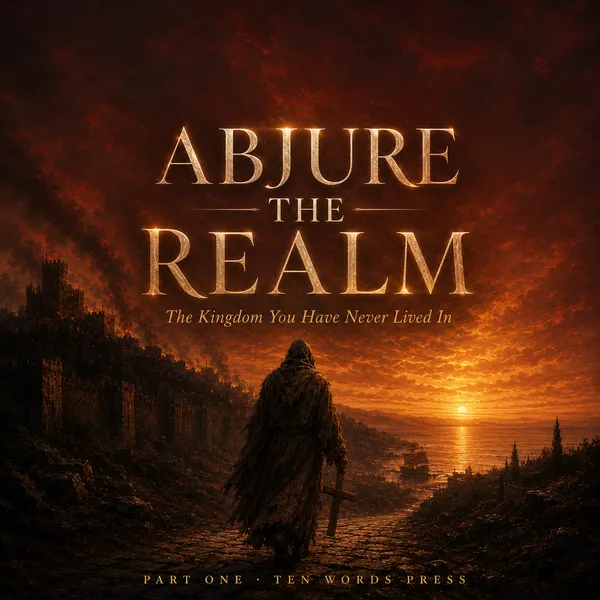
Once the oath was sworn, the abjurer was given one thing to carry: a plain wooden cross. He surrendered his possessions, his rights, his place in the old world — and in their place, the cross was set in his hands. It was the only thing he carried out of the sanctuary and onto the road.
We must recover what that cross actually was, because the church has badly mistaken it. For generations we have heard "take up your cross" and understood it to mean "brace for suffering" — a heavy thing laid across the back, a hardship to endure with gritted teeth. But the abjurer's cross was not an instrument of torture he dragged toward his own death. It was his safe-conduct. Everyone who saw it on the road understood at a glance: this man is no longer under the authority of the realm he is leaving. The cross was his passport. It announced that he had already died to the old world and now belonged somewhere else.
That is exactly how the apostle Paul speaks of it — not as a burden, but as a severance already accomplished.
Read it slowly. The world is crucified to me, and I to the world. A mutual execution has already taken place. The cross is the legal instrument that cut the cord between the believer and the old jurisdiction. It is not a weight you carry toward defeat. It is the document of your freedom, and you carry it the rest of your life as the visible sign that you have left.
The cross is not the weight on your back. It is the passport in your hand.
Abjure the Realm · Ten Words Press
Section IIIOne Road, and Only One
The abjurer did not get to choose his route. The coroner assigned him a single road to the nearest port — the king's highway, the public way that anyone could see and verify. He was forbidden to wander off it, forbidden to cut across private land, forbidden to take the scenic detour. One road. One destination. And if he strayed from it, he lost the protection of his oath and could be seized by anyone.
This offends the modern ear, which has been trained to believe that the most spiritual thing is to "find the path that works for you." But Jesus did not describe Himself as a path among many. He used the definite article every time.
Not a way. The way. The king's highway — the single, prescribed, public route from the old realm to the new. And here is the thing we get backwards: the narrowness of the road is not a punishment. It is a protection. The broad way is broad precisely because it never actually leaves the old kingdom. It wanders around inside Babylon's borders, sampling a little of this and a little of that, and calls the wandering freedom. The narrow road is narrow because every step on it is safe, and every step off it leads back into territory where the old authority still has its claws.
Narrow is not the same as harsh. A surgeon's incision is narrow. A flight path is narrow. The narrowness is what gets you safely where you are going. The wide road asks nothing and arrives nowhere; the narrow road asks everything and arrives home.
Section IVThe Smell of Death on the Road
Now comes the part no one warns the new believer about. The cross that marks you as free also marks you as visible — and the people still living in the old realm do not all react to that sight the same way. The abjurer on the king's highway was unmistakable. Some let him pass in peace. Some jeered. Some attacked. The cross did not make him beloved; it made him identifiable, and to those with no intention of leaving, the sight of someone walking out was an offense.
Paul names this exactly, and it is one of the strangest verses in the New Testament.
The same cross. The same road. The same person carrying it. Two opposite reactions — and which one you get depends entirely on which realm the observer belongs to. To another person who is also being ruined for the old world, who is also beginning to hear the call, the sight of you on the road is life. It is proof the road is real, that the crossing is possible, that they are not insane for wanting out. But to the one who has built his whole identity inside the old system and has no intention of leaving, the sight of you carrying the cross is death — not because you threaten him, but because your very existence is a quiet accusation. You cannot watch someone walk out of a kingdom and stay comfortable in it, unless you convince yourself the one walking is a fool.
This is why the road is harder than the altar. The decision was costly, but at least it was yours. The road is where the old realm fights back — and it often fights back through people who call themselves your friends, your family, even your fellow believers, who are unsettled that you have actually begun to walk. Do not be surprised by it. The cross has always smelled like death to those who intend to stay.
Section VThe One Thing the Road Asks
So the oath is sworn, the cross is in your hands, the road stretches ahead. What does the journey actually require of you, day after day? Not heroics. Not a formula. One thing — and it is the one thing the flesh resists more than any other.
Abide.
John 15:4
Stay on the road. Stay connected to the One who is the Vine. Stay under the authority the cross established. Do not deviate — not because deviation will undo your salvation, it will not and it cannot, the blood holds — but because deviation leads off the highway into territory where the old operating system still governs, where fear reassumes the throne, where you find yourself making decisions from your senses again as though you had never left.
And here, I have to tell you the truth, because this is where most of us actually live. On the road, technically. Carrying the cross, technically. Joined to Christ, permanently. But wandering — drifting onto the side paths, slipping back into the old jurisdiction for a season, returning to the highway only when the consequences become unbearable, then drifting off again when the flesh makes its case. The covenant holds the whole time. The walk does not. The inheritance sits untouched. The road is barely traveled.
If that is you, take heart — and take the next step. The abjurer stumbled too, and the oath still held, because in the new covenant the oath is kept by the Bridegroom, not by your own willpower. When you wander, you do not have to flee the country and start over. You confess, you return to the road, and you walk on. He who began the good work in you will finish it.
In the next installment we reach the water's edge — the port, and the ship, and the meaning of baptism as the final crossing out of the old realm and into the new. For now, the oath is sworn. The cross is in your hands. The road is ahead, narrow and safe and going home.
Now walk.
Comments
No comments yet. Be the first.